Telugu Alphabet Chart Manufacturer,Supplier and Exporter in India

Product Code : EL-AC-3177
Jlab Export is a leading Telugu Alphabet Chart Manufacturer,and suppliers in India
The Telugu Alphabet Chart (తెలుగు అక్షరమాల) sets out the aksharamala, the vowels and consonants that children learn before they write syllables. Primary teachers and Telugu second-language classes use it to introduce each letter and its sound. The chart measures 70 x 100 cm and is laminated with thick plastic film on both sides.
Specifications
| Language | Telugu |
| Content | Telugu aksharamala: vowels (achulu) and consonants (hallulu) |
| Size | 70 x 100 cm |
| Finish | Laminated with thick plastic film on both sides |
| Minimum order quantity | 10 units |
| Dispatch time | Usually 4–6 working days |
| Manufacturer | JLab (Jain Laboratory Instruments Pvt Ltd), Ambala, India |
Alphabet Chart or Guninthalu Chart?
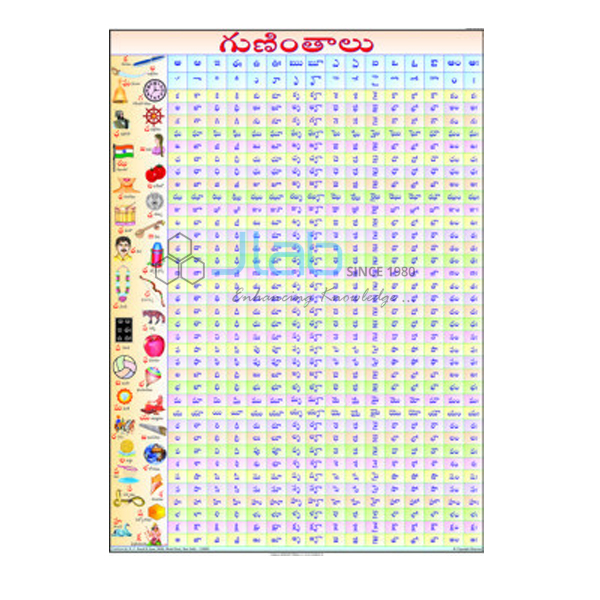
This aksharamala chart shows the letters on their own: the achulu (vowels) and the hallulu (consonants). A guninthalu chart, which JLab makes as the Telugu Barakhadi Chart, shows each consonant written with every vowel sign. On it, ka is followed by kaa, ki, kee, ku and so on. Children learn the aksharamala first, then guninthalu, and later the ottulu, the joined consonant forms.
Classroom Practice with Telugu Letters
Vowel pairs come first. The teacher writes a short and a long vowel side by side on a Magnetic Whiteboard with a Board Marker, then says a word containing one of them. Children point to the matching letter on the chart and say which of the pair they heard.
Older pupils hunt for letters in real words. They read a short passage from their reader aloud and tick off on the chart each consonant they meet, so gaps show up quickly. When the letters are secure, the Telugu Barakhadi Chart takes the class on to guninthalu.
Frequently Asked Questions
Can teachers trace letters on the chart with dry-wipe markers?
Yes. Dry-wipe ink sits on the plastic film and lifts off with a soft cloth, so a teacher can trace the strokes of a letter while the class watches. Wipe it off the same day, because ink left for days can leave a faint shadow on the film.
Is the 70 x 100 cm chart large enough for a whole class to see?
Yes, for teaching from the front wall. At 70 x 100 cm it is a large wall chart, and the teacher points to each letter while the class reads it aloud. For tracing a letter or checking a small stroke, children come up to the chart in small groups.
How do children tell short and long vowels apart?
Telugu vowels come in short and long pairs, such as అ and ఆ, ఇ and ఈ, or ఉ and ఊ. The long one is held for about twice as long, and its letter usually adds a stroke to the short form. Reading such pairs aloud slowly trains both the ear and the eye.
What are ubhayaksharalu?
They are signs that follow a vowel or syllable instead of standing alone: the sunna (ం), the half-nasal arasunna (ఁ) and the visarga (ః). The sunna is the one children meet most, in words such as అందం. The arasunna is rarely used in modern writing.
Why do some Telugu letters appear in old books but not in everyday writing?
A few letters, such as the old ra (ఱ) and the vowel ఌ, have dropped out of everyday use. They still turn up in classical texts and some older letter lists, so students should know them by sight, but they will rarely need to write them.
Other Alphabet Charts
For a quote, use Add To Cart or send us a message through the contact page.
Last updated: 16 November 2026