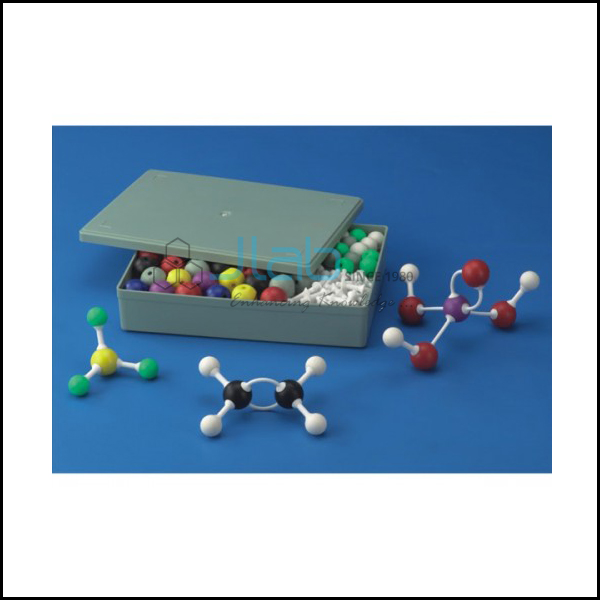
Atomic Model (Senior and Junior Sets) Manufacturer,Supplier and Exporter in India

Product Code : EL-MS-66
Jlab Export is a leading Atomic Model (Senior and Junior Sets) Manufacturer,and suppliers in India
With these atomic models, students join coloured balls with lugs to build organic and inorganic compounds in three dimensions. The balls are moulded in different colours and sizes, and the connecting lugs also come in different sizes. Two sets are made. The Senior Set has 370 balls and 185 lugs, and the Junior Set has 75 balls and 37 lugs, each in a moulded box.
Specifications
| Balls | Moulded, in different colours and sizes |
| Connecting lugs | Different sizes |
| Senior Set | 370 balls and 185 lugs |
| Junior Set | 75 balls and 37 lugs |
| Box | Moulded; the Senior Set box has a separate space for each colour and size of ball |
| Used for | Models of organic and inorganic compounds |
| Minimum order quantity | 15 units |
| Dispatch time | Usually 4–6 working days |
| Manufacturer | JLab (Jain Laboratory Instruments Pvt Ltd), Ambala, India |
Choosing Between the Senior and Junior Sets
Choose the Senior Set when one box has to serve a whole class. With 370 balls and 185 lugs, several groups can work from it at the same time. Its moulded box has a place for every colour and size of ball, so any gap shows up when the box is packed after the lesson. The Junior Set is the smaller kit, sized for one pair of students building simple molecules at the bench.
Practicals with the Ball-and-Lug Models
A first practical is to build methane, ammonia and water and compare their shapes. Students find each element on the Periodic Table Chart, work out how many bonds its atom forms, and then check that every ball carries that many lugs.
Later, a teacher can place a small molecule built from this set beside a diamond or sodium chloride lattice made with the Crystal Models Set. Students then explain why one is a single molecule and the other a giant structure that repeats in every direction.
Frequently Asked Questions
How do I stop a long chain model from sagging or coming apart?
Push every lug fully home, straight into the hole rather than at an angle, so each joint is firm. Build long chains flat on the bench and lift them by the middle, not by one end. If one joint stays loose, swap that lug for another of the same size.
Why does a ball still have an empty hole when the model looks finished?
Each hole marks a bond that the atom has not made yet. Most often a hydrogen ball has been left off. Count the lugs on every ball against the bonds that element normally forms, four for carbon and one for hydrogen, before calling the model complete.
Why does the model look different from the formula drawn in the book?
A drawn structure is flat, so methane looks like a cross on paper. In the model, the four bonds of carbon point to the corners of a tetrahedron. Holding the model up and rotating it shows the angles and the true shape that a flat drawing hides.
Can one set show two different molecules with the same formula?
Yes. Ethanol and dimethyl ether share the formula C2H6O. Build both from two carbon, six hydrogen and one oxygen ball, and the different order of the atoms shows why the two compounds are not the same substance.
How should the pieces be put away after a class?
Pull each lug straight out of its ball to take a model apart. Sort the balls by colour and size into their places in the box. Count the lugs before closing it, so the next class starts with a full set.
More Model Sets for Chemistry Lessons
- Atomic Model Euro Design (student and teacher sets)
- Molecular Model Set
- Hybridized Benzene C6H6 Model Set
- Organic Atom Molecular Model Set
For a quote, use Add To Cart or send us a message through the contact page.
Last updated: 14 November 2026