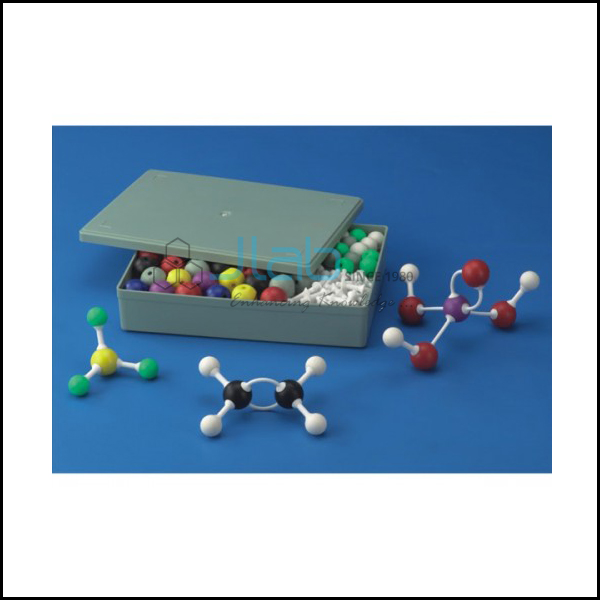
Crystal Models Set Manufacturer,Supplier and Exporter in India

Product Code : EL-MS-68
Jlab Export is a leading Crystal Models Set Manufacturer,and suppliers in India
This set builds three well-known crystal structures: diamond, graphite and sodium chloride, each supplied as its own set. The sets hold coloured jacks in red, black and white, with long and short connectors in a prescribed number. Students join them by following an illustration, so the finished model shows how the particles sit in the solid.
Specifications
| Structures | Diamond, Sodium Chloride and Graphite (one set each) |
| Jacks | Red, black and white |
| Connectors | Long and short |
| Pieces | Prescribed number for each structure |
| Assembly | Joined as shown in an illustration |
| Minimum order quantity | 15 units |
| Dispatch time | Usually 4–6 working days |
| Manufacturer | JLab (Jain Laboratory Instruments Pvt Ltd), Ambala, India |
Lab Exercises on Giant Structures
Students build the three lattices in turn and note how many neighbours each atom or ion has. To tie the graphite model to a property, they connect an Electrode Carbon Rod into a circuit with a cell and a torch bulb in a Bulb Holder. The bulb lights, and the class uses the layers in the model to explain where the moving electrons come from.
Grains of table salt seen through a Hand Lens look like tiny cubes. Students compare them with the cubic pattern of ions in the sodium chloride model and discuss why the crystal shape follows the lattice.
Frequently Asked Questions
How does the graphite model show why graphite is soft and slippery?
Within each layer, every carbon joins three others in flat hexagons held by strong bonds. The layers sit much further apart than the atoms inside a layer, and only weak forces act across that gap. In the real solid the layers slide over one another, so graphite marks paper and works as a lubricant.
Why is each carbon joined to four atoms in diamond but three in graphite?
In diamond every carbon uses all four outer electrons to bond with four neighbours in a tetrahedral pattern. In graphite each carbon bonds to three, and its fourth electron is delocalised along the layer. Those free electrons let graphite conduct electricity, while diamond does not.
How do students count the ions in one unit cell of the sodium chloride model?
Each ion is shared by position. A corner ion counts as one eighth, an edge ion one quarter, a face ion one half and the centre ion one whole. In a cubic unit cell of sodium chloride both kinds of ion add up to four, matching the 1:1 formula NaCl.
What should we do if a jack or connector goes missing?
Each structure needs its prescribed number of pieces, so one lost jack leaves a gap in the lattice. Count the jacks and connectors against the illustration when the set is unpacked and again before it is packed away, so a loss is found the same day.
Should a built lattice be taken apart after the lesson?
Not always. A finished lattice takes a while to assemble, so a teacher may keep one built for display and revision. When a model must come apart, pull each connector straight out of its jack rather than twisting the layers, which strains the joints.
Other Structure and Lattice Models
For a quote, use Add To Cart or send us a message through the contact page.
Last updated: 14 November 2026