Demonstration Motor Model Manufacturer,Supplier and Exporter in India
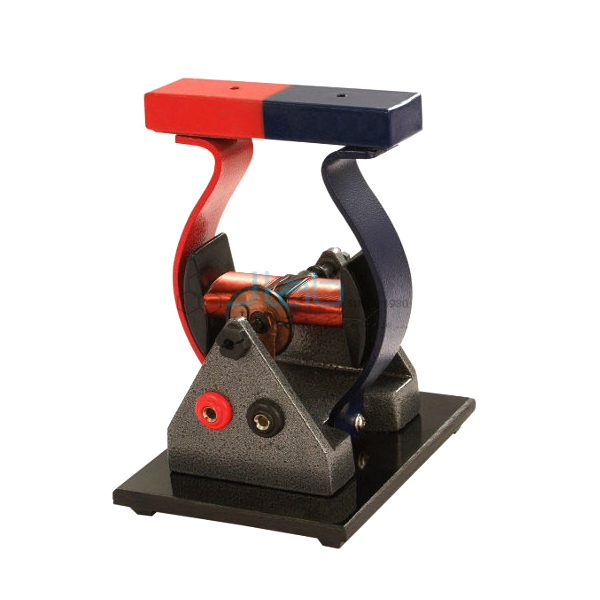
Product Code : EL-ELA-5296
Jlab Export is a leading Demonstration Motor Model Manufacturer,and suppliers in India
Demonstration Motor Model (code EL-ELA-5296) is a working model of the simplest form of DC electric motor, built completely open so that every part can be identified and its action watched. It has a 2-pole armature wound with enamelled copper wire, a removable permanent magnet, a disc-type commutator and 4 mm colour-coded sockets, and runs on 6–8 V DC in school and college physics labs. It is made by Jain Laboratory Instruments Pvt Ltd (JLab) at its works in Ambala, India.
Specifications
| Parameter | Detail |
|---|---|
| Type | Model of the simplest form of DC electric motor |
| Armature | 2-pole, wound with enamelled copper wire on an insulated plastic bobbin |
| Magnetic field | Removable permanent magnet |
| Commutator | Disc type |
| Brushes | Phosphor bronze |
| External connection | Pair of 4 mm colour-coded sockets |
| Operating supply | 6–8 V DC |
| Construction | Completely open; all components easily identifiable and their working clearly observable |
| Power supply | Not part of this listing — order separately |
| Quality check | Each model is visually inspected before dispatch |
| Pack quantity | Each (sold individually) |
| Minimum order quantity | 10 units |
| Dispatch time | Usually 7–10 working days |
| Product code | EL-ELA-5296 |
| Manufacturer | Jain Laboratory Instruments Pvt Ltd (JLab) — OEM |
| Country of origin | India (made in Ambala, Haryana) |
How Does It Compare with Other JLab Motor Models?
| Model | Supply | Construction details given in each listing |
|---|---|---|
| This model (EL-ELA-5296) | 6–8 V DC | 2-pole armature on an insulated plastic bobbin; removable permanent magnet; completely open construction; disc-type commutator; phosphor-bronze brushes; colour-coded 4 mm sockets |
| Demonstration Electric Motor | 6–8 V DC | 2-pole armature with enamelled copper wire; removable bar magnet; disc-type commutator; phosphor-bronze brushes; pair of 4 mm sockets |
| Electric Motor Model | 6–8 V DC | Disc-type commutator; phosphor-bronze brushes; pair of 4 mm sockets |
| Demonstration Electric Motor with Magnet | 4–6 V DC | Two-pole armature with enamelled copper wire; detachable permanent bar magnet with N and S marked, mounted on a base; 4 mm sockets; small and compact |
Choose this model when you want the fully open construction and colour-coded sockets for teaching the parts of a motor. The motor with magnet runs on a lower 4–6 V supply and marks the magnet’s poles; the other two share this model’s 6–8 V rating, and their listings give fewer construction details.
What Is the Demonstration Motor Model Used For?
The model shows the motor effect taught in secondary school physics: a current-carrying coil in a magnetic field feels a turning force, whose direction is given by Fleming’s left-hand rule. Because nothing is enclosed, students can follow the current from the colour-coded sockets through the phosphor-bronze brushes to the disc commutator and round the armature coil, and see how the commutator reverses the current every half turn so the armature keeps spinning. Teachers use it to show that reversing the supply leads, or turning the magnet round, reverses the direction of rotation, and that removing the magnet stops the motor. College and polytechnic electrical courses use it as an introduction to DC machines.
Connect it to a 6–8 V DC source with leads in the 4 mm sockets; if the armature rests at a dead point, a gentle flick starts it. Switch off rather than leaving the armature stalled, since the coil warms if current flows without rotation, and keep the brushes and commutator clean so contact stays reliable.
What to Specify When Ordering
- Quantity — the minimum order is 10 units; schools often order one per group bench.
- Power source — add a DC supply or battery eliminator able to give 6–8 V DC, as no supply is listed with the model.
- Leads — add connecting leads with 4 mm plugs for the sockets.
Frequently Asked Questions
What voltage does the demonstration motor model need?
6–8 V DC, connected through the pair of 4 mm colour-coded sockets.
Is the magnet removable?
Yes. The magnetic field comes from a removable permanent magnet, so you can show the motor stopping without it or reverse it to change the direction of rotation.
Is a power supply included?
No supply is part of this listing. Use any DC source that can deliver 6–8 V, such as a regulated power supply or battery eliminator, linked below.
How does it differ from the Demonstration Electric Motor?
Both run on 6–8 V DC with a 2-pole armature, removable magnet, disc commutator and 4 mm sockets. This listing adds the insulated plastic bobbin, the completely open construction and colour-coded sockets; the listings state no other difference.
What information is needed for an export quotation?
The quantity, destination country and port or city, preferred delivery terms (for example FOB or CIF), any packing or labelling needs, and the tender reference if there is one.
Who manufactures this motor model?
Jain Laboratory Instruments Pvt Ltd, trading as JLab, at its works in Ambala, Haryana, India.
OEM Manufacturer
JLab is the trading name of Jain Laboratory Instruments Pvt Ltd, a physics and electrical demonstration equipment manufacturer in India, incorporated in 2017 and based on Hargolal Road, Ambala, Haryana. The motor models are wound and assembled at JLab’s own works rather than bought in from a trader, so schools, colleges, polytechnics and dealers buy factory-direct, each model is visually inspected before dispatch, and repeat orders are handled by the manufacturer. JLab holds MSME Udyam registration UDYAM-HR-01-0003849 as a manufacturing enterprise and Importer-Exporter Code 3317504552. JLab exports worldwide and ships to buyers in every region — for example Sierra Leone in West Africa, Denmark in Northern Europe, Japan in East Asia, Costa Rica in Central America and the Caribbean and South Africa in Southern Africa. Tender information is on the JLab lab tenders page.
Power and Wiring for the Motor
- DC Regulated Power Supply — a variable DC bench supply whose range covers the motor’s 6–8 V.
- Battery Eliminator (0-12 Volts) — a mains power pack that replaces batteries in classroom experiments.
- Connecting Leads — plastic-coated leads with connectors for wiring the model.
See the full Educational Laboratory Apparatus range or the wider Laboratory Apparatus section.
Request a Quote
Quotes come direct from the manufacturer. Use the Add To Cart enquiry button or the contact page and send the quantity (minimum 10 units), any power supplies or leads you need, and your delivery location.
Last updated: 9 October 2026