

Freeze Dryer Manufacturer,Supplier and Exporter in India
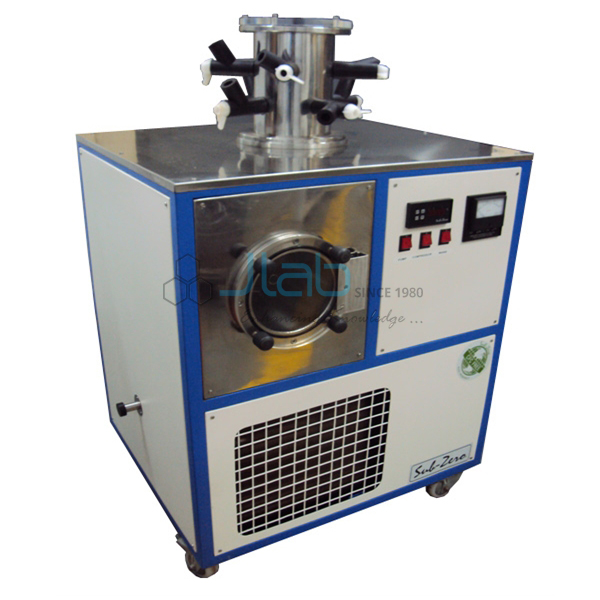
Product Code : EL-FD-2275
Jlab Export is a leading Freeze Dryer Manufacturer,and suppliers in India
A freeze dryer, or lyophilizer, takes water out of a frozen sample by sublimation. Under vacuum the ice turns straight to vapour, which freezes again on a cold condenser. In this free-standing unit the condenser cools to −40 °C under a digital controller. A stainless steel drum with a plexiglass lid and 6, 8 or 12 manifold ports sits on top, and a vacuum pump comes with it.
Specifications
| Type | Free-standing lyophilizer, castor-mounted cabinet |
| Condenser temperature | Down to −40 °C, set and held by digital controller |
| Refrigeration | Hermetically sealed compressor, insulated copper coils |
| Condenser trap | Non-magnetic stainless steel, dished bottom for draining |
| Vacuum drum | 22.8 cm dia × 25.4 cm high, stainless steel, plexiglass top cover |
| Manifold ports | 6, 8 or 12 quick-seal valves, 12.5 mm OD |
| Vacuum pump | Supplied with the unit |
| Capacity | 3, 5 or 10 litres |
| Power | 220 V AC, 50 Hz |
| Optional | Voltage stabiliser, 5 kVA |
| Minimum order quantity | 1 unit |
| Dispatch time | Usually 14–18 working days |
| Manufacturer | JLab (Jain Laboratory Instruments Pvt Ltd), Ambala, India |
Freeze-Drying Practicals in the Lab
In a food science or biotechnology practical, students weigh fruit slices on an Electronic Balance Analytical, then freeze them hard in a Laboratory Deep Freezer. Liquids are frozen as a thin shell inside Flasks, Round Bottom, Short Neck JLab, which are fitted to the manifold ports through adaptors.
Once dry, each sample is weighed again and the loss gives its water content. Teachers can set a freeze-dried slice beside one dried in an oven, so the class sees how freeze drying keeps shape and colour. Watching frost build on the condenser through the clear lid shows where the water has gone.
Frequently Asked Questions
Why must samples be frozen solid before drying?
A liquid sample put under vacuum boils and foams instead of subliming, and can spray into the manifold. Freeze it hard first, and freeze liquids as a thin shell on the flask wall so the vapour has a short path out.
Why will the vacuum not pull down far enough?
Usually there is a leak. Check that unused quick-seal valves are closed, that the drum lid and gaskets are clean and seated, and that the pump hose is not cracked or loose. Worn pump oil also limits how low the pump can go.
How is the condenser defrosted after a run?
Switch off the refrigeration and vacuum and let the ice melt. The condenser trap has a dished stainless steel bottom, so the meltwater runs to its lowest point and drains out completely. Dry the trap before the next run.
How can I tell when a sample is dry?
Frost on the outside of a manifold flask disappears as its ice is used up, and the flask warms towards room temperature. The sample itself looks light and porous. Weighing it twice, some time apart, confirms that no more water is coming off.
Can samples containing solvents go in?
Keep to water-based samples. Many organic solvents stay liquid at −40 °C, pass on into the vacuum pump and can attack rubber seals and the plexiglass lid. Dry sugar-rich samples a few at a time, as they melt back easily.
Other Cold, Vacuum and Steam Equipment
For a quote, use Add To Cart or send us a message through the contact page.
Last updated: 12 November 2026