Funnel Plastic Manufacturer,Supplier and Exporter in India
Product Code : EL-SLE-5673
Jlab Export is a leading Funnel Plastic Manufacturer,and suppliers in India
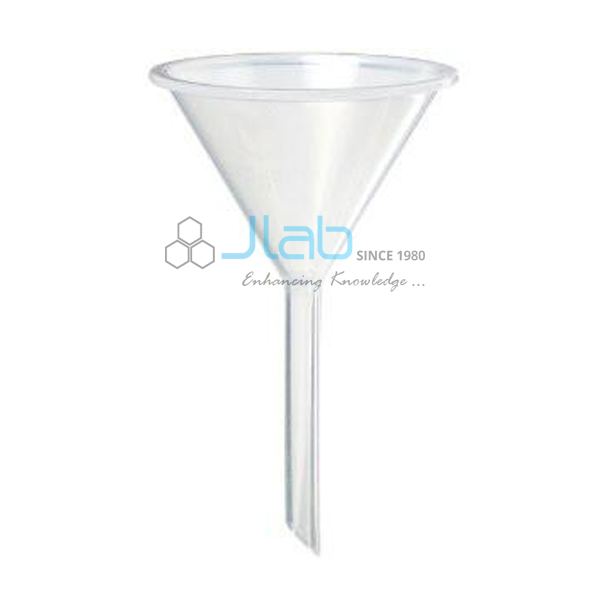
Funnel Plastic (code EL-SLE-5673) is a separating funnel in transparent polypropylene, graduated and supplied with a stopper, used to separate immiscible liquids and for simple solvent extractions in school, college and teaching labs. It is listed in 100 ml, 250 ml and 500 ml sizes, and being plastic it will not shatter if knocked over on the bench. It is made by Jain Laboratory Instruments Pvt Ltd (JLab) at its works in Ambala, India.
Specifications
| Parameter | Detail |
|---|---|
| Type | Separating funnel |
| Material | Polypropylene, transparent |
| Markings | Graduated |
| Closure | Supplied with stopper |
| Sizes listed | 100 ml, 250 ml and 500 ml |
| Stopcock and body shape | Not described in this listing — ask JLab |
| Quality check | Each separating funnel is visually inspected before dispatch |
| Pack quantity | Each (sold individually) |
| Minimum order quantity | 10 units |
| Dispatch time | Usually 7–10 working days |
| Product code | EL-SLE-5673 |
| Manufacturer | Jain Laboratory Instruments Pvt Ltd (JLab) — OEM |
| Country of origin | India (made in Ambala, Haryana) |
How Does It Compare with Other JLab Separating Funnels?
| Listing | Material | Capacity and other listed details |
|---|---|---|
| This funnel (EL-SLE-5673) | Transparent polypropylene | 100, 250 and 500 ml; graduated; with stopper |
| CLASS IX Separating Funnel | Polypropylene | 250 ml; pear shaped; autoclavable; threaded screw cap; polypropylene stopcock with self-lubricating PTFE plug |
| Separating Funnel | Borosilicate glass | 500 ml; heat and chemical resistant; clear |
| Separating Funnel, Stopper | Borosilicate glass | 125 ml; PTFE stopcock |
Choose this polypropylene funnel when you want three sizes in a material that survives student handling. The class IX funnel gives more detail about its tap and cap, and the borosilicate glass funnels suit hot work and the organic solvents that plastics do not tolerate.
What Is a Plastic Separating Funnel Used For?
A separating funnel splits two liquids that do not mix. The mixture is poured in through the top, the stopper is put in, and the liquids are left to settle into two layers; the lower layer is then run off through the tap at the bottom and the upper layer is poured out of the top. This is the class 9 science activity for separating oil or kerosene from water, and in class 11 and 12 chemistry and college organic labs the same funnel is shaken with a solvent to extract a compound from a solution. The graduations let students see roughly how much of each layer they have.
Support the funnel in a ring or separatory holder on a stand, take out the stopper before opening the tap so the liquid can flow, and when shaking with a volatile solvent, open the tap now and then with the funnel inverted to release pressure. Polypropylene is tough and resists water-based acids and alkalis, but some organic solvents, such as chloroform or toluene, can attack plastics — check compatibility or use a glass funnel for those. Rinse and dry the funnel after use.
What to Specify When Ordering
- Capacity — 100 ml, 250 ml or 500 ml, and how many of each.
- Tap and shape — the listing does not describe the stopcock or the body shape; ask JLab if your method needs a particular tap.
- Quantity — the minimum order is 10 units; schools often plan one funnel per student group.
- Supports — add separatory holders or retort stand rings so the funnels can be clamped safely.
Frequently Asked Questions
What sizes is this separating funnel available in?
Three: 100 ml, 250 ml and 500 ml. Each is transparent polypropylene, graduated, and comes with a stopper.
Can it be used with organic solvents?
Check first. Polypropylene suits water, dilute acids and alkalis, but solvents such as chloroform or toluene can swell or attack many plastics; for extractions with those, a borosilicate glass separating funnel is the safer choice.
What kind of stopcock does it have?
The listing does not describe the stopcock or its material. Ask JLab to confirm the tap details when you request a quotation.
Are the graduations accurate enough for measuring?
They are a guide. Graduations on a separating funnel show approximate volumes; use a measuring cylinder or pipette when you need a measured quantity.
Is a stand or holder included?
No. The listing covers the funnel with its stopper; separatory holders, retort stand rings and stands are separate items.
Who manufactures this separating funnel?
Jain Laboratory Instruments Pvt Ltd, trading as JLab, makes it at its works in Ambala, Haryana, India, and quotes for it directly.
OEM Manufacturer
JLab is the trading name of Jain Laboratory Instruments Pvt Ltd, a maker of laboratory plasticware, glassware and school science equipment in India, incorporated in 2017 and based on Hargolal Road, Ambala, Haryana. The funnel is made at JLab’s own works and not bought from a trader, which means schools, colleges, dealers and importers buy from the source, each piece is inspected visually before packing, and repeat orders come from the same production. JLab exports worldwide and ships to buyers in every region — Guatemala in Central America and the Caribbean, Uganda in East Africa, Angola in Central Africa, Cyprus in Southern Europe and Austria in Western Europe are some examples. See the JLab lab tenders page for tender purchases.
Separating Funnels and Supports
- CLASS IX Separating Funnel — a 250 ml pear-shaped polypropylene funnel with PTFE-plug stopcock.
- Separating Funnel — a 500 ml borosilicate glass funnel for heat and solvent work.
- Separating Funnel, Stopper — a 125 ml borosilicate funnel with PTFE stopcock.
- Separatory Holder — a polypropylene holder with a front opening that grips a stand rod.
- Retort Stand Ring — a ring support that holds a separating funnel at working height.
See more in the School Lab Equipment range or the plastic Funnels range.
Request a Quote
Quotes come direct from the manufacturer. Use the Add To Cart enquiry button on this page, or send the sizes and quantity (minimum 10 units), any holders or stand rings you need, and your delivery location through the contact page.
Last updated: 4 October 2026