Junior Pythagoras Theorem Manufacturer,Supplier and Exporter in India
Product Code : EL-MLE-1800
Jlab Export is a leading Junior Pythagoras Theorem Manufacturer,and suppliers in India
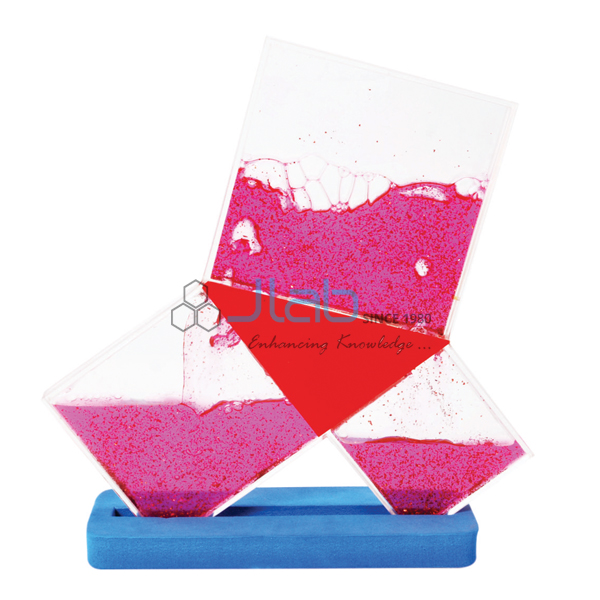
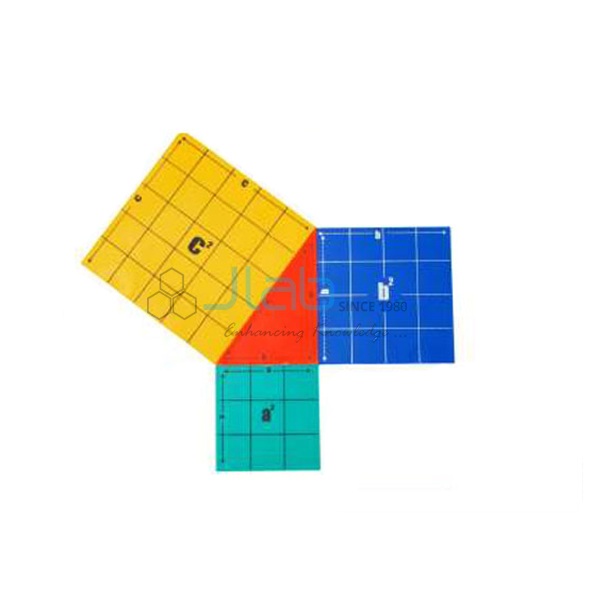
Junior Pythagoras Theorem (code EL-MLE-1800) is a set for verifying that the square of the hypotenuse of a right triangle equals the sum of the squares of the other two sides. It has a plastic 3 in x 4 in right triangle and three squares equal to its sides, each with a square-inch grid. It is made by Jain Laboratory Instruments Pvt Ltd (JLab) at its works in Ambala, India.
Specifications
| Parameter | Detail |
|---|---|
| Purpose | To verify that in a right triangle the square of the hypotenuse equals the sum of the squares of the other two sides |
| Triangle | One plastic right-angled triangle, 3 in x 4 in |
| Squares | Set of three squares equal to the sides of the triangle |
| Grid | Each square printed with a grid of square inches |
| Quality check | Each set is visually inspected before dispatch |
| Pack quantity | Each (sold individually) |
| Minimum order quantity | 10 units |
| Dispatch time | Usually 7–10 working days |
| Product code | EL-MLE-1800 |
| Manufacturer | Jain Laboratory Instruments Pvt Ltd (JLab) — OEM |
| Country of origin | India (made in Ambala, Haryana) |
How Does It Compare with Other JLab Pythagoras Theorem Sets?
| Set | Pieces | Material and display | Method |
|---|---|---|---|
| Junior Pythagoras Theorem (EL-MLE-1800) | One right triangle, 3 in x 4 in; three squares on its sides | Plastic triangle; square-inch grids printed on the squares | Count the grid squares on each side |
| Senior Pythagoras Theorem Magnetic | Four right-angle triangles and one big square; 16 in x 16 in overall | Acrylic, with a strong magnet at the back for a magnetic board | Demonstration on the board |
| Pythagoras Theorem By Small Square | One right-angle triangle and 25 unit squares in two colours | — | Arrange unit squares to build the side squares |
| Pythagoras Theorem By Reverse Method | — | Foam, with magnet at the back for demonstration | Reverse method, also called the Bhaskaracharya proof |
Choose the junior set for verification by counting squares; the senior magnetic set is a larger board display, and the other two show the theorem in different ways.
What Is the Junior Pythagoras Theorem Set Used For?
The set turns the Pythagoras theorem into something students can count. The triangle’s shorter sides are 3 in and 4 in, so the squares on them carry 9 and 16 square-inch grid squares, and the square on the 5 in hypotenuse carries 25 — the same as 9 + 16. Placing each square against its side makes the relationship visible before students meet the algebraic form a² + b² = c².
It supports the Pythagoras property of right triangles in CBSE and NCERT class 7 maths and verification activities in school maths labs in later classes. The 3 in, 4 in and 5 in sides also give students a first Pythagorean triple to remember.
What to Specify When Ordering
- Set type — this junior set, or the senior magnetic, small-square or reverse-method sets compared above.
- Number of sets — for example one per student pair or group in the maths lab.
- Board display — the senior magnetic version is a separate item that can be quoted on the same enquiry for teacher demonstration.
Frequently Asked Questions
What does the Junior Pythagoras Theorem set contain?
One plastic right-angled triangle measuring 3 in x 4 in and a set of three squares equal to the sides of the triangle, each printed with a square-inch grid.
How does it show the theorem?
By counting grid squares. The squares on the 3 in and 4 in sides hold 9 and 16 square inches, and the square on the hypotenuse holds 25, so the two smaller squares together equal the square on the hypotenuse.
How long is the hypotenuse?
5 in. It follows from the theorem itself: 3 x 3 + 4 x 4 = 25, and the square root of 25 is 5.
How is it different from the Senior Pythagoras Theorem Magnetic set?
The senior set is an acrylic board display of four right-angle triangles and one big square, 16 in x 16 in overall, with a strong magnet at the back for a magnetic board. The junior set is a small plastic set with gridded squares for counting.
What information is needed for an export quotation?
Send the quantity, the destination country and port or city, your preferred delivery terms (for example FOB or CIF), any packing or labelling requirements, and the tender reference if the order is for a tender.
Who manufactures the Junior Pythagoras Theorem set?
Jain Laboratory Instruments Pvt Ltd (JLab) makes it at its works in Ambala, Haryana, India.
OEM Manufacturer
JLab is the trading name of Jain Laboratory Instruments Pvt Ltd, a maths lab and geometry teaching aid manufacturer in India, incorporated in 2017 and based on Hargolal Road, Ambala, Haryana. The junior Pythagoras set is made in JLab’s own works rather than bought from a trader, so schools, dealers and importers buy it straight from the maker; each set is visually checked before dispatch, and reorders are made by the same works. JLab is registered under CIN U29309HR2017PTC069123 and holds MSME Udyam registration UDYAM-HR-01-0003849 as a manufacturing enterprise. JLab exports worldwide and ships to buyers in every region — for example Australia in Oceania, Gabon in Central Africa, Spain in Southern Europe, Senegal in West Africa and Sri Lanka in South Asia.
More Pythagoras Theorem Models
- Senior Pythagoras Theorem Magnetic — an acrylic board display with a strong magnet at the back.
- Pythagoras Theorem By Small Square — build the side squares from unit squares.
- Pythagoras Theorem By Reverse Method — a foam magnetic set for the Bhaskaracharya proof.
- Working Model of Pythagoras Theorem — shows the theorem by volume, for the whole class.
Other geometry models are in the Maths lab Equipments range and the full Maths Lab Equipment section.
Request a Quote
Click Add To Cart to send an enquiry, or use the contact page with the number of sets, any other Pythagoras models you want quoted, and the delivery city and country.
Last updated: 16 October 2026