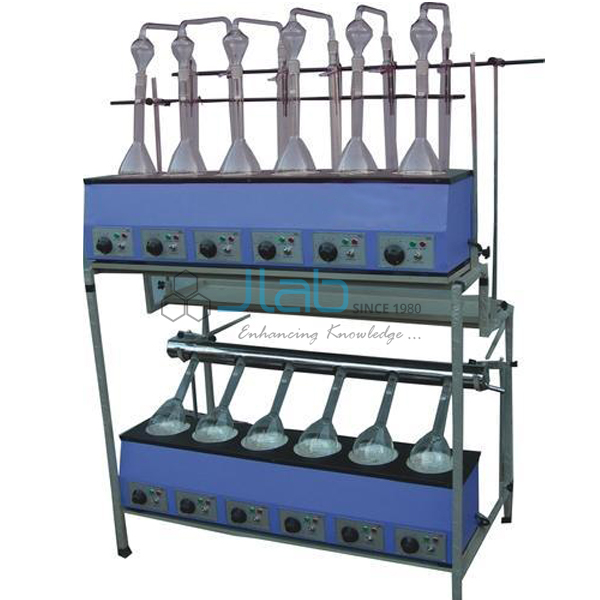
Kjeldahl Distillation Unit Manufacturer,Supplier and Exporter in India
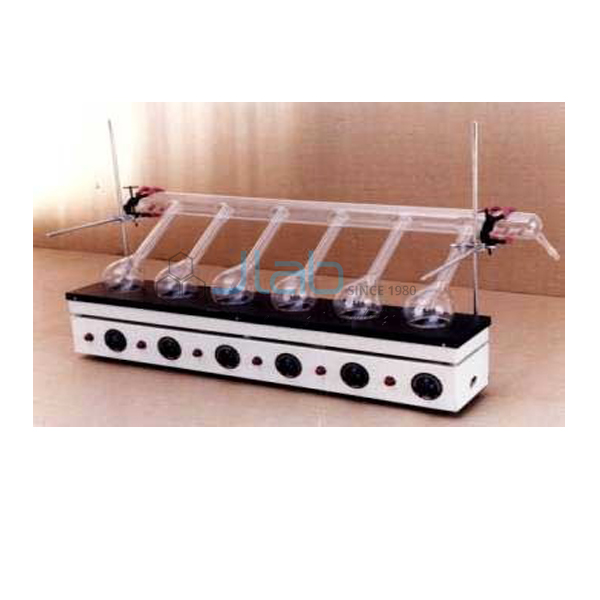
Product Code : EL-KDU-4000
Jlab Export is a leading Kjeldahl Distillation Unit Manufacturer,and suppliers in India
The Kjeldahl distillation unit handles the second half of a nitrogen test. After digestion, excess alkali is added to the digest, and the freed ammonia distils over with the steam into a receiving flask for titration. This unit heats 300 ml and 500 ml flasks on mantle-type heaters rated at 200 watts per test, with a condenser rack, and runs on 220/230 V AC.
Specifications
| Heating | Mantle type |
| Flask capacity | 300 ml and 500 ml |
| Condenser | Condenser rack provided |
| Rating | 200 W per test |
| Glass parts and clamps | Supplied with or without, as ordered |
| Power supply | 220/230 V AC |
| Minimum order quantity | 1 unit |
| Dispatch time | Usually 7–10 working days |
| Manufacturer | JLab (Jain Laboratory Instruments Pvt Ltd), Ambala, India |
Practicals with the Distillation Unit
A common college practical is the crude protein of a flour sample. Students heat the weighed flour in one of the Kjeldahl Flasks JLab with concentrated sulphuric acid and a catalyst mixture until the liquid turns clear. This turns the organic nitrogen into ammonium sulphate. The cooled digest then goes on this unit, where excess alkali frees the ammonia.
The ammonia is caught in Boric Acid solution, or in a measured volume of standard acid, and titrated from a Burette, Borosilicate Glass, with PTFE Stopcock. Students work out nitrogen per cent from the titre and convert it to crude protein. Teachers often extend the practical to compare pulse and cereal flours.
Frequently Asked Questions
What goes in the receiving flask?
Usually boric acid solution with an indicator. It holds the ammonia, which is then titrated with standard acid. The other way is to collect the ammonia in a measured volume of standard acid and titrate the acid left over.
Which flask sizes does this unit take?
It is made for 300 ml and 500 ml capacity flasks. Glass parts and clamps can come with the unit or be left out, as ordered, if your lab already has its own glassware.
How do I know when the ammonia is all over?
Lower the receiving flask and touch a drop from the condenser tip to red litmus paper. If the paper no longer turns blue, no more ammonia is coming over. Stopping too early is a common reason for low student results.
Why should students run a blank?
The reagents and the water can carry traces of nitrogen. A blank goes through the same digestion and distillation with no sample, and its titre is taken off the sample titre before the nitrogen is worked out.
Which forms of nitrogen does the Kjeldahl method miss?
It recovers amino and ammonium nitrogen. Nitrate, nitrite and the nitrogen in nitro and azo groups or some ring compounds are not fully turned into ammonium sulphate. Such samples read low unless the method is changed.
Other Kjeldahl Apparatus
- Kjeldahl Distillation & Digestion Combined Unit (mantles for both steps on one stand)
- Kjeldahl Digestion and Distillation Unit
- Sulphuric Acid Concentrated
For a quote, use Add To Cart or send us a message through the contact page.
Last updated: 12 November 2026