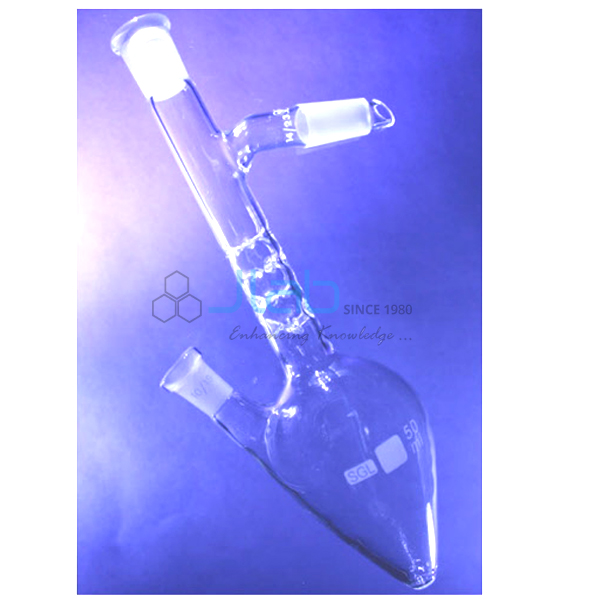
Kjeldahl Flasks JLab Manufacturer,Supplier and Exporter in India

Product Code : EL-F-1615
Jlab Export is a leading Kjeldahl Flasks JLab Manufacturer,and suppliers in India
Kjeldahl flasks hold a sample while it boils in concentrated sulphuric acid, which turns its organic nitrogen into ammonium sulphate for distillation later. These come in 100, 300, 500 and 800 ml, each with a B24 socket. Two round bottom Kjeldahl flasks of 50 and 100 ml carry a B19 cone for smaller set-ups.
Specifications
| Kjeldahl flask capacities | 100 ml, 300 ml, 500 ml, 800 ml |
| Kjeldahl flask socket | B24 |
| Round bottom Kjeldahl flask capacities | 50 ml, 100 ml |
| Round bottom Kjeldahl flask cone | B19 |
| Minimum order quantity | 50 units |
| Dispatch time | Usually 3–5 working days |
| Manufacturer | JLab (Jain Laboratory Instruments Pvt Ltd), Ambala, India |
Nitrogen Estimation Practicals
Nitrogen in an organic compound such as acetanilide, or in urea fertiliser, is a regular B.Sc. and pharmacy estimation. Students weigh the sample into a Kjeldahl flask and add Sulphuric Acid Concentrated, potassium sulphate and a little Copper Sulphate as catalyst. The flask is heated at a slant on the Kjeldahl Digestion Units rack until the digest turns clear.
After cooling and careful dilution, the digest is distilled on the Kjeldahl Distillation Unit, which takes 300 and 500 ml flasks. Sodium Hydroxide solution sets the ammonia free. It is caught in a solution of Boric Acid Extra Pure and titrated with standard acid. Agriculture students follow the same steps with soil, leaf and grain samples.
Frequently Asked Questions
Why does a Kjeldahl flask have such a long neck?
The neck works as an air condenser. Acid vapour and steam condense on the cooler upper glass and run back down, so little acid is lost during long boiling. Heating the flask at a slant also keeps spurting droplets away from the mouth.
Why is potassium sulphate added with the acid?
It raises the boiling point of the sulphuric acid, so the digest runs hotter and the sample breaks down faster. A catalyst such as copper sulphate speeds the change further. Too little salt slows digestion, while far too much can drive off some nitrogen.
What is the B24 socket on these flasks for?
A classic Kjeldahl flask has a plain neck. The B24 socket lets this flask take jointed glassware, such as a Distillation Heads - Splash Head, Adapter with a B24 cone. The digest can then be distilled from the flask it was boiled in.
How do these differ from an ordinary round bottom flask?
A Kjeldahl flask has a long neck and is used for long boiling in strong acid, held at a slant. An ordinary round bottom flask has a short neck for condensers and adapters. The small round bottom Kjeldahl flasks here have a B19 cone for semi-micro work.
Which flask size should I choose?
Choose by sample size and by the stage that follows. The 300 and 500 ml flasks match the distillation unit. The 800 ml flask leaves headroom for bulky samples that froth, and the 100 ml flask suits small samples.
Other Glassware for the Distillation Stage
- Distillation Heads - Splash, Sloping (B24 cone to the flask)
- Condensers, Liebig
- Narrow Neck Conical Flasks, Erlenmeyer, Borosilicate Glass (receiving flask)
For a quote, use Add To Cart or send us a message through the contact page.
Last updated: 14 November 2026