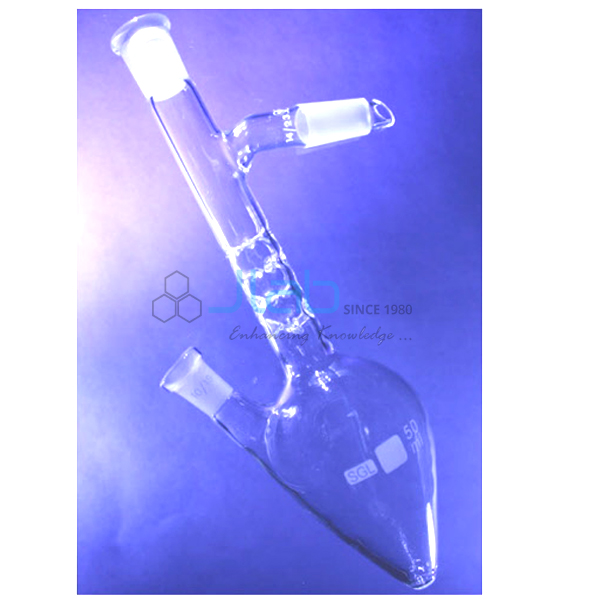
Rotary Evaporator Flasks JLab Manufacturer,Supplier and Exporter in India

Product Code : EL-F-1623
Jlab Export is a leading Rotary Evaporator Flasks JLab Manufacturer,and suppliers in India
These flasks hold the solution on a rotary evaporator and turn in its water bath while the solvent is drawn off under vacuum. Sizes run from 50 to 2000 ml. Every size up to 1000 ml is made with a B24 or a B29 socket, and the 2000 ml flask comes with B29.
Specifications
| Capacities | 50, 100, 250, 500, 1000 and 2000 ml |
| B24 socket | 50, 100, 250, 500 and 1000 ml |
| B29 socket | 50, 100, 250, 500, 1000 and 2000 ml |
| Minimum order quantity | 50 units |
| Dispatch time | Usually 3–5 working days |
| Manufacturer | JLab (Jain Laboratory Instruments Pvt Ltd), Ambala, India |
Lab Work with the Rotary Evaporator
Extracting caffeine from tea is a familiar college practical that ends in one of these flasks. Students shake the cooled tea extract with dichloromethane in a Separating Funnel, dry the organic layer and run it into a weighed 100 ml flask. The solvent is then stripped off on the Rotary Vacuum Evaporator, leaving crude caffeine as a pale film.
Fractions from Chromatography Columns with Sintered Disc are concentrated the same way in 50 or 250 ml flasks. Weighing the flask before and after gives the yield directly.
Frequently Asked Questions
Which socket will fit my evaporator?
Match the socket to the cone on the vapour duct or bump trap of your evaporator. B24 and B29 are both common, and a flask fits only a cone of its own size. If your unit takes B29, every capacity here is available, including 2000 ml.
What does the bump trap do, and what if liquid lands in it?
The bump trap sits between the flask and the vapour duct. It catches liquid that bumps or foams, so it cannot reach the condenser or the receiver. If much liquid jumps into it, stop, rinse the trap with a little solvent and pour the rinse back into the flask.
Why must the joint clip stay out of the water bath?
A plastic clip softens in hot water and can let go, dropping the flask into the bath. Lower the flask only until the solution sits below the bath surface, with the clip above it. The vacuum also helps hold the flask on the joint while it turns.
Why are there water droplets in my residue?
The solution was not dry before evaporation. Water boils off far more slowly than most organic solvents and stays behind as drops. Redissolve the residue, dry the solution over anhydrous sodium sulphate, filter it into a clean flask and evaporate again.
How warm should the water bath be?
Only warm enough for the solvent to boil steadily under the vacuum, which is far below its normal boiling point. If nothing boils within a minute or so, warm the bath a little. Too hot a bath or too deep a vacuum makes the solution bump.
Other Glassware for Solvent Removal
- Flasks Pear Shape, Single Neck JLab
- Flasks, Round Bottom, Short Neck JLab
- Joint Clips, Plastic (B24 and B29 sizes)
For a quote, use Add To Cart or send us a message through the contact page.
Last updated: 14 November 2026