Kjeldahl Digestion Units Manufacturer,Supplier and Exporter in India

Product Code : EL-KUGP-2096
Jlab Export is a leading Kjeldahl Digestion Units Manufacturer,and suppliers in India
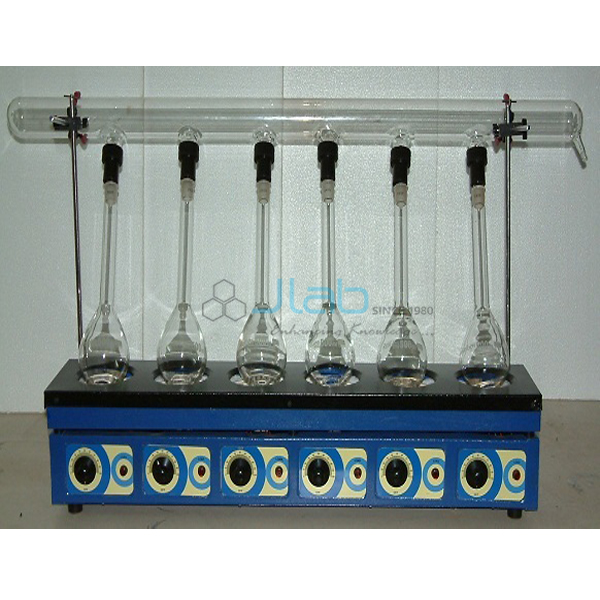
Six Kjeldahl flasks can be heated side by side on this digestion rack, either over open heaters or in heating mantles. It takes 250 ml and 500 ml flasks. Each place has its own on-off switch, and a single energy controller sets the heat for the whole row. The frame is mild steel in stoving enamel, with chrome plated fittings.
Technical Details
| Purpose | Digestion stage of Kjeldahl nitrogen estimation |
| Capacity | 6 tests |
| Heating | Heater type or mantle type |
| Flask sizes | 250 ml and 500 ml |
| Controls | Individual on-off switch for each place, one energy controller for all |
| Fume duct (optional) | Lead or borosilicate glass, lead duct with a pair of hangers |
| Body | Mild steel in stoving enamel paint, other metal parts chrome plated |
| Power | 220 V AC, 50 Hz, single phase |
| Minimum order quantity | 1 unit |
| Dispatch time | Usually 7–10 working days |
| Manufacturer | JLab (Jain Laboratory Instruments Pvt Ltd), Ambala, India |
What Happens in the Digestion Step
The weighed sample goes into a long-necked flask with concentrated sulphuric acid and a catalyst mixture. Heating continues until the liquid turns clear. By then the organic nitrogen in the sample has become ammonium sulphate. The optional fume duct sits over the flask necks and carries the acid fumes away.
The cooled digest then moves to a distillation unit. There, excess alkali frees the ammonia, which is steam-distilled into a receiving flask of boric acid or a measured standard acid and titrated. The titre gives the nitrogen per cent.
Protein Nitrogen Practicals
Pharmacy, food technology and agriculture students use the rack to find the crude protein of flour, pulses, milk powder or cattle feed. They weigh each sample into Kjeldahl Flasks JLab and run up to six digests at once, often with a blank in one place. After digestion, each flask goes to the Kjeldahl Distillation Unit, where the ammonia collects in Boric Acid solution before titration.
Frequently Asked Questions
Should I choose the heater type or the mantle type?
Both hold 6 tests. In the heater type, each flask sits over an open heater. In the mantle type, a heating mantle wraps the flask bulb and heats it more evenly, which reduces local overheating and spattering.
How do I know when digestion is complete?
The digest should turn clear, with no black or brown specks left on the walls. Keep heating for a while after it clears, then switch that place off and let the flask cool before dilution.
How is the heat set for six flasks at once?
One energy controller sets the heat level for the row. Each place also has its own on-off switch, so a finished flask can be turned off without disturbing the others.
How is crude protein worked out from the nitrogen?
Multiply the nitrogen per cent by a protein factor. The general factor is 6.25, and it is used when no factor is given for the material being tested.
Why do student results often come out low?
Digestion is often stopped before the liquid clears, or digest is lost by frothing. Heating too hard also drives off acid, and the digest can dry out before all the nitrogen is converted.
Other Kjeldahl Apparatus
- Kjeldahl Digestion and Distillation Units Combined
- Kjeldahl Distillation & Digestion Combined Unit
- Kjeldahl Digestion and Distillation Unit
For a quote, use Add To Cart or send us a message through the contact page.
Last updated: 12 November 2026