Magnets Round with a Hole Ceramic Manufacturer,Supplier and Exporter in India
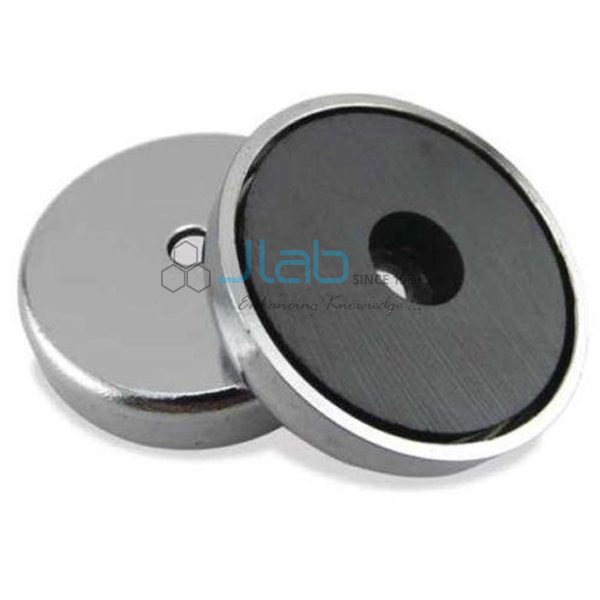
Product Code : EL-SLE-4635
Jlab Export is a leading Magnets Round with a Hole Ceramic Manufacturer,and suppliers in India
Magnets Round with a Hole Ceramic (code EL-SLE-4635) are round ceramic magnets with a central hole, of moderate magnetic strength, used in school and college physics labs for experiments on magnetic poles, attraction and repulsion. They are listed in 25 mm and 38 mm sizes. They are made by Jain Laboratory Instruments Pvt Ltd (JLab) at its works in Ambala, India.
Specifications
| Parameter | Detail |
|---|---|
| Shape | Round, with a hole through the centre |
| Material | Ceramic magnet — hard and brittle |
| Magnetic strength | Moderate |
| Sizes listed | 25 mm and 38 mm (given in the listing as thickness — confirm the diameter, thickness and hole size when you order) |
| Quality check | Each magnet is visually inspected before dispatch |
| Pack quantity | Each (sold individually) |
| Minimum order quantity | 10 units |
| Dispatch time | Usually 7–10 working days |
| Product code | EL-SLE-4635 |
| Manufacturer | Jain Laboratory Instruments Pvt Ltd (JLab) — OEM |
| Country of origin | India (made in Ambala, Haryana) |
How Does It Compare with Other JLab Ring and Disc Magnets?
| Model | Form and material | Other listed details |
|---|---|---|
| This magnet (EL-SLE-4635) | Round ceramic magnet with a hole | Moderate strength; 25 mm and 38 mm sizes |
| Ferrite Magnet | Ferrite ring | Made as the ring for the floating ring magnet apparatus |
| Ring Magnet | Ferrite ring | Radially and axially magnetised versions listed |
| Ferrite Discs | Ferrite disc | Hard and brittle; six sizes from 15 x 3 mm to 35 x 8 mm |
Choose these round ceramic magnets when you want loose magnets with a hole, in a small or a larger size, for general magnetism practicals. The Ferrite Magnet is the spare ring for JLab’s floating ring apparatus, the Ring Magnet listing is the one to check if you need a stated magnetisation direction, and the ferrite discs offer the widest choice of sizes.
What Are Round Ceramic Magnets Used For?
Ceramic magnets, also called ferrite magnets, are pressed and fired from iron oxide combined with barium or strontium compounds, which is why they are hard but brittle. In the class 6 science chapter on magnets, students use them to find north and south poles with a compass, to show that like poles repel and unlike poles attract, and to map the field with iron filings sprinkled on a card above the magnet. The hole lets a magnet be threaded onto a non-magnetic rod or a pencil: if the poles are on the two flat faces, two magnets with like poles facing push apart and the upper one floats — the principle of a floating ring magnet demonstration.
Handle them as you would any ceramic part. Do not let two magnets jump together from a distance or drop them on a hard floor, as the edges chip and the magnet can crack. Store them in pairs with unlike poles together, and keep them away from mobile phones, watches and cards with magnetic strips.
What to Specify When Ordering
- Size — 25 mm or 38 mm; ask JLab to confirm the diameter, thickness and hole size of each.
- Quantity — the minimum order is 10 magnets; for class sets, plan one or two per student group.
- Accessories — plotting compasses, iron filings or a floating ring magnet apparatus can go in the same enquiry.
Frequently Asked Questions
What sizes are available?
25 mm and 38 mm. The listing gives these figures as the thickness and does not state the diameter or hole size separately, so confirm the dimensions you need with JLab before ordering.
What are ceramic magnets made of?
Iron oxide combined with barium or strontium compounds, pressed and fired like a ceramic. The result is a hard, brittle permanent magnet; these round magnets are listed as moderate in strength.
Which faces are the poles?
The listing does not mark the poles or state the direction of magnetisation. Find the north and south poles with a plotting compass, and ask JLab to confirm the pole orientation if your experiment depends on it.
Why do ceramic magnets chip?
Because the material is brittle. Letting two magnets snap together or dropping them on a hard surface can chip the edges or crack the magnet, so slide them apart rather than pulling, and store them with a soft card between pairs if they are kept loose.
Who manufactures these magnets?
Jain Laboratory Instruments Pvt Ltd (JLab) makes them at its works in Ambala, Haryana, India, and quotes for them directly as the manufacturer.
OEM Manufacturer
JLab is the trading name of Jain Laboratory Instruments Pvt Ltd, a school and physics lab equipment manufacturer in India, incorporated in 2017 and based on Hargolal Road, Ambala, Haryana. These ceramic magnets are made at JLab’s own works and not bought in from a trader, so schools, colleges, dealers and importers buy them factory-direct; each piece is checked by eye before packing, and repeat orders are handled by the manufacturer. JLab exports worldwide and ships to buyers in every region — for example the USA in North America, Albania in Southern Europe, France in Western Europe, Lesotho in Southern Africa and Bulgaria in Eastern Europe.
Magnetism Apparatus
- Magnetic Plotting Compass — a needle in a circular case with a printed scale, for finding the poles and tracing field lines.
- Iron Filling — filings in a storage jar with a shaker lid, for showing the field pattern.
- Floating Ring Magnet Apparatus — a complete set of magnet rings and a stand for demonstrating repulsion.
- Floating Ring Magnet — painted ceramic ring magnets on a vertical non-magnetic rod, mounted on a wooden base.
See more physics apparatus in the School Lab Equipment range.
Request a Quote
Quotes come direct from the manufacturer. Use the Add To Cart enquiry button on this page, or send the quantity (minimum 10 units) in each size, any compasses or filings to add, and your delivery location through the contact page.
Last updated: 4 October 2026