Milli Ammeter Manufacturer,Supplier and Exporter in India
Product Code : EL-MI-4873
Jlab Export is a leading Milli Ammeter Manufacturer,and suppliers in India
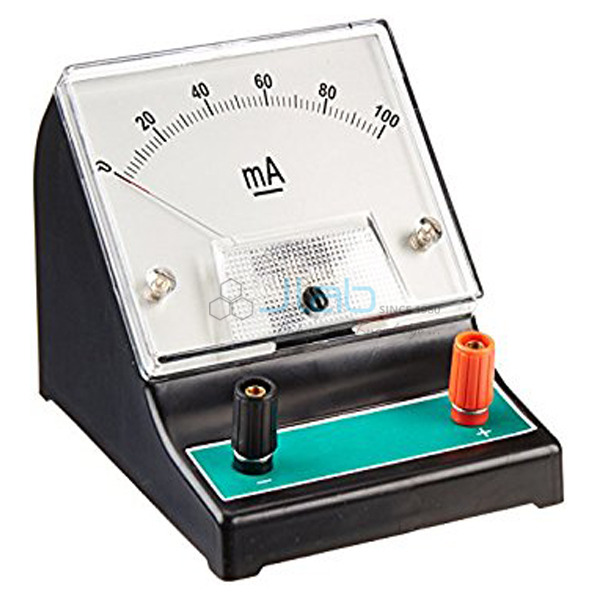
Currents in diode, LED and transistor circuits are often far too small to read on an ordinary ammeter. This milli ammeter is made for such small currents, from 0 to 100 mA, and is used in physics and electrical engineering labs.
Specifications
| Measures | Small DC currents |
| Range | 0–100 mA |
| Movement | Moving coil, for DC current |
| Used in | Physics and electrical engineering labs |
| Minimum order quantity | 5 units |
| Dispatch time | Usually 7–10 working days |
| Manufacturer | JLab (Jain Laboratory Instruments Pvt Ltd), Ambala, India |
Circuit Practicals for Students
In the diode characteristic practical, students connect the meter in series with a diode and a current-limiting resistor. They raise the voltage from a Battery Eliminator 12 Volt in small steps and record the current at each step. The graph of current against voltage shows the sharp rise once the diode starts to conduct.
With a Resistance Box in place of the diode and Plug Keys to switch the circuit, the same set-up checks Ohm’s law at small currents. Students close the key only while they take a reading.
Frequently Asked Questions
Why must the milliammeter be connected in series?
It measures the current flowing through it, so all the current in that branch has to pass through the meter. Its resistance is very low, so connecting it in parallel across a component makes a near short circuit that can burn out the meter.
Why does the needle move backwards?
The meter is connected the wrong way round. Current must enter at the positive terminal, usually marked red or plus. Switch off at once, swap the leads and check the direction of any diode in the circuit as well.
Can its range be extended later?
Only upward. A low-value shunt resistor connected across the terminals carries part of the current, so the meter reads a larger range. A shunt cannot make it read smaller currents more finely, so for currents far below 100 mA a more sensitive meter is the better choice.
How should the meters be packed and carried?
The moving coil turns on fine pivots that a sharp knock can damage. Ship meters in padded cartons, face up, and link the two terminals with a short wire during transport to damp the needle. Never drop one on the bench.
How do we get a correct reading from the scale?
Before each practical, check that the needle rests on zero with nothing connected. Look straight at the pointer, not from one side, to avoid parallax. Readings in the upper part of the scale carry a smaller share of error than readings near zero.
Other Current Meters
For a quote, use Add To Cart or send us a message through the contact page.
Last updated: 16 November 2026