Pinned Joint Model Manufacturer,Supplier and Exporter in India
Product Code : EL-SML-10083
Jlab Export is a leading Pinned Joint Model Manufacturer,and suppliers in India
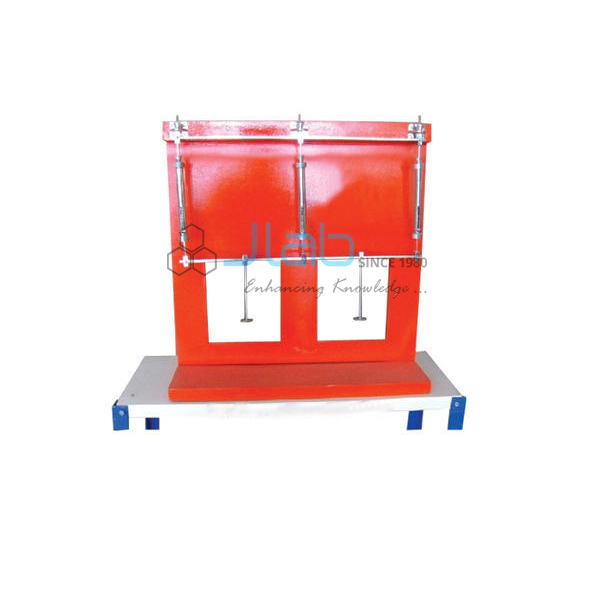
Pinned Joint Model (code EL-SML-10083) is a truss model with hinged joints and very flexible members, made to show qualitatively how a truss carries load: compression members visibly bow out of plane, while tension members stay straight and tight. Students can also watch the angle between members at each joint change slightly as load goes on. JLab makes the pinned-joint truss model in Ambala, India.
Specifications
| Parameter | Detail |
|---|---|
| Model type | Truss with hinged (pinned) joints |
| Members | Very flexible, so compression members bow out of plane |
| Tension members | Stay straight and tight under load |
| Joint behaviour | Angle between members at each joint changes slightly |
| Shows | Compression or tension in each member for different load positions |
| Quality check | Each truss model is visually inspected before dispatch |
| Pack quantity | Each (sold individually) |
| Minimum order quantity | 1 unit |
| Dispatch time | Usually 14–18 working days |
| Product code | EL-SML-10083 |
| Manufacturer | Jain Laboratory Instruments Pvt Ltd (JLab) — OEM |
| Country of origin | India (made in Ambala, Haryana) |
Seeing Which Members Push and Which Pull
In an ideal pin-jointed truss the pins pass no moment, so with loads at the joints each member carries only an axial force, tension or compression. Because the members of this model are very flexible, a compressed member cannot stay straight: it buckles and curves out of the plane, while a member in tension is drawn taut. Moving the load to another position changes the member forces, and some members can switch from tension to compression, so the class sees the pattern shift at once. The observed pattern can then be checked against forces found by the method of joints or the method of sections.
Why the Joint Angles Change
A member in tension lengthens a little and one in compression shortens, so the triangles of the truss change shape slightly under load. Free to turn on their pins, the members rotate, and the angle between them at each joint changes by a small amount. In a frame with rigid joints the same movement would be resisted, bending the members and adding secondary stresses; the pinned model shows the idealised case that hand analysis of trusses assumes.
Other Truss, Joint and Strut Rigs
- Deflection of Truss Apparatus — four-panel Pratt steel truss with detachable springs in its tension members.
- Redundant Joint Apparatus — three spring-balance members of different stiffness joined at one loaded joint.
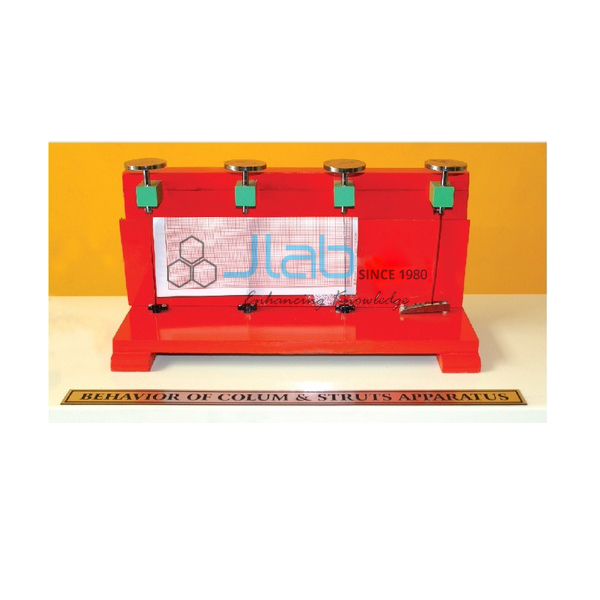
- Behaviour of Column Struts Apparatus — four spring steel columns with different end conditions, to compare buckling.
The model belongs to Structural Mechanics Lab, part of Engineering Lab Equipment, alongside the arch, frame and beam rigs.
Request a Quote
Add the model to an enquiry with Add To Cart, or send the quantity and the delivery town through our contact page and a quotation will follow.
Last updated: 30 October 2026