Poppit Beads Yellow Manufacturer,Supplier and Exporter in India

Product Code : EL-GAIE-6894
Jlab Export is a leading Poppit Beads Yellow Manufacturer,and suppliers in India
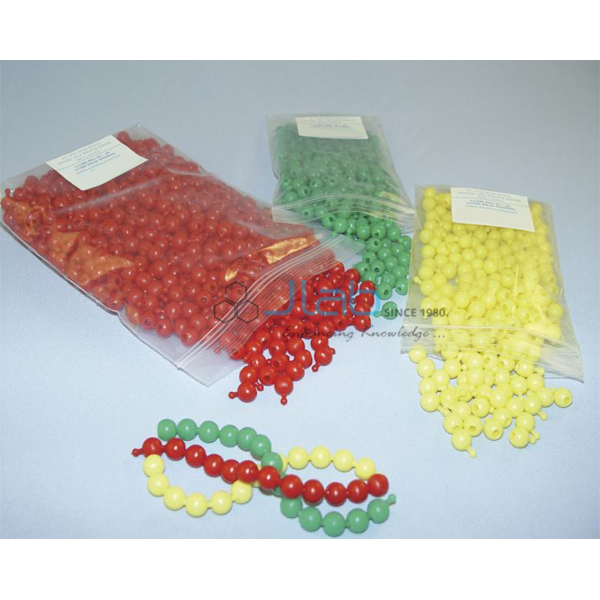
Poppit Beads Yellow (code EL-GAIE-6894) are yellow beads that serve as a laboratory modelling unit for genetics and biochemistry: strings of beads can represent the genetic code or whole chromosomes, and the same beads model sugars, amino acids and proteins in lessons on carbohydrate and protein metabolism. Matching green and red beads are listed separately. They are made by Jain Laboratory Instruments Pvt Ltd (JLab) at its works in Ambala, India.
Specifications
| Parameter | Detail |
|---|---|
| Colour | Yellow |
| Description | Beads used as a laboratory modelling unit |
| Genetics uses | Representing the genetic code and whole chromosomes |
| Carbohydrate uses | Monosaccharides, disaccharides and polysaccharides in carbohydrate metabolism |
| Protein uses | Amino acids, dipeptides, polypeptides and proteins in protein metabolism |
| Quality check | Each pack is visually inspected before dispatch |
| Pack quantity | Each (one pack as listed) |
| Minimum order quantity | 10 units |
| Dispatch time | Usually 7–10 working days |
| Product code | EL-GAIE-6894 |
| Manufacturer | Jain Laboratory Instruments Pvt Ltd (JLab) — OEM |
| Country of origin | India (made in Ambala, Haryana) |
Using Yellow Poppit Beads in Genetics Lessons
A string of beads is a simple way to show that genes lie in a fixed order along a chromosome. Students can build two strings in different colours for a pair of homologous chromosomes, then swap matching sections between them to model crossing over and the new combinations of alleles it produces. For the genetic code, groups of three beads can stand for codons, showing how a sequence is read in triplets and how inserting or removing a single bead shifts every codon that follows. Outside genetics, the yellow beads work in exactly the same way as the green and red ones for building sugars, polysaccharides, peptides and proteins, so a mixed set covers several chapters of secondary-school and college biology.
Frequently Asked Questions
How can these beads represent chromosomes?
Each bead stands for a gene, and a chain of beads stands for a chromosome. Using two colours for a homologous pair makes crossing over and gene linkage easy to see.
Can the beads model the genetic code?
Yes — representing the genetic code is one of the uses given in the listing. Groups of beads can stand for bases and codons in a sequence.
Are bead size and pack count given?
No, the listing does not state them. JLab confirms the pack contents with your quotation.
Who is the manufacturer?
JLab — Jain Laboratory Instruments Pvt Ltd — makes these beads at its works in Ambala, Haryana, India.
OEM Manufacturer
JLab is the trading name of Jain Laboratory Instruments Pvt Ltd, incorporated in 2017 and based on Hargolal Road, Ambala, Haryana, where it makes biology teaching aids and other laboratory equipment. Because the beads come straight from its own works, schools, colleges, dealers and importers deal with the manufacturer for every order. JLab exports worldwide and ships to buyers in every region — Eswatini in Southern Africa, Chile in South America, Spain in Southern Europe, Jamaica in Central America and the Caribbean, and Taiwan in East Asia are examples. For tenders, see the JLab lab tenders page.
Other Colours and Genetics Aids
- Poppit Beads Green — the matching beads in green.
- Poppit Beads Red — the matching beads in red.
- Fruit fly Genetics Kit — crosses with printed fruit fly pieces, including sex linkage.
- DNA Activity Model — a double helix students build and unzip to show replication.
See the Genetics and Inheritance Equipments range or all Biology Lab Equipment.
Request a Quote
Quotes come direct from the manufacturer. Use the Add To Cart button on this page, or send the number of packs (minimum 10 units), any green or red beads you need and your delivery location through the contact page.
Last updated: 5 October 2026