Simulating Natural Selection Manufacturer,Supplier and Exporter in India
Product Code : EL-GAIE-6897
Jlab Export is a leading Simulating Natural Selection Manufacturer,and suppliers in India
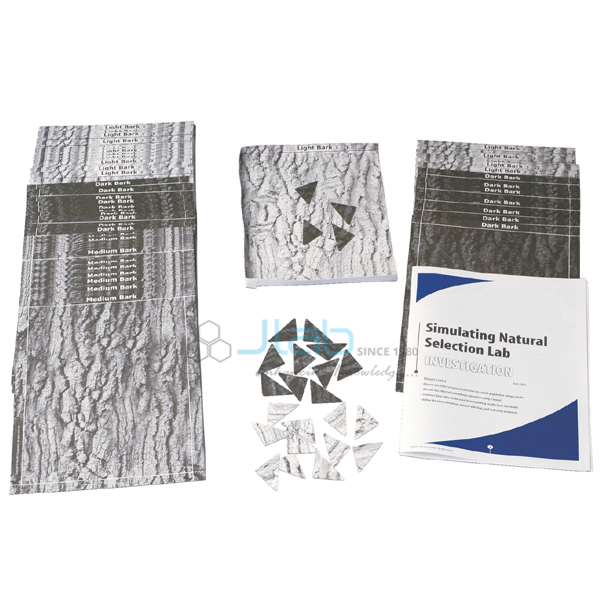
Simulating Natural Selection (code EL-GAIE-6897) is a classroom activity in a game-like format that recreates the natural selection seen in peppered moths in England during the Industrial Revolution. Using tree-trunk backgrounds and moth cutouts, students discover why darker moths came to survive and reproduce more often. It is made by Jain Laboratory Instruments Pvt Ltd (JLab) at its works in Ambala, India.
Specifications
| Parameter | Detail |
|---|---|
| Type | Classroom simulation activity in a game-like format |
| Topic | Natural selection in the peppered moth population as selection pressures changed in England during the Industrial Revolution |
| Materials described | Backgrounds that simulate the colour of various tree trunks, and peppered moth cutouts |
| Learning outcome | Students find that as tree trunks darkened, darker peppered moths were more likely to survive and reproduce |
| Quality check | Each activity set is visually inspected before dispatch |
| Pack quantity | Each (sold individually) |
| Minimum order quantity | 10 units |
| Dispatch time | Usually 7–10 working days |
| Product code | EL-GAIE-6897 |
| Manufacturer | Jain Laboratory Instruments Pvt Ltd (JLab) — OEM |
| Country of origin | India (made in Ambala, Haryana) |
What Is Simulating Natural Selection Used For?
The peppered moth is the textbook case of industrial melanism. Before industrialisation most moths in England were pale and hard to see against lichen-covered bark; as soot from coal burning darkened the tree trunks, the pale moths stood out to birds while the dark form was hidden, so dark moths survived to breed and became common in industrial areas. When the air became cleaner, the pale form recovered. Class 12 biology uses this example in the evolution chapter, and the activity lets students work through the same steps themselves: variation in a population, a selection pressure, unequal survival and reproduction, and a change in the population over generations.
A common way to run it is in rounds. One student plays the predator and removes the moth cutouts that are easiest to spot on a given background; the survivors are counted and “reproduce” for the next round, and the class then repeats the game on a different trunk colour and compares the results. Because it needs no live insects, it works in any classroom and suits secondary biology, teacher-training courses and first-year college lessons on evolution. Count the pieces back into the set after each lesson so the next class starts with everything it needs.
What to Specify When Ordering
- Quantity — the minimum order is 10 sets; many schools order one per group of students.
- Contents — the number of backgrounds and moth cutouts is not given in the listing, so ask JLab to confirm what each set contains.
- Companion items — evolution posters or fossil kits can be quoted together for a complete evolution unit.
- Delivery — destination, packing and any labelling for distribution to several schools.
Frequently Asked Questions
What does this activity teach?
The key steps of natural selection, through the history of the peppered moth: a varied population meets a change in its environment, the better-hidden moths survive and reproduce more, and over generations the population shifts towards the darker form.
What comes in the set?
The listing describes backgrounds that simulate the colour of various tree trunks and peppered moth cutouts. It does not give the number of pieces, so JLab confirms the contents with your quotation.
Are live moths or specimens needed?
No. The activity uses moth cutouts against tree-trunk backgrounds, so there is nothing to collect, keep alive or preserve.
Which classes can use it?
It fits the class 12 evolution chapter, where industrial melanism is the classic example of natural selection, and it can introduce adaptation in lower secondary classes or first-year college biology.
Who manufactures this activity?
JLab, the trading name of Jain Laboratory Instruments Pvt Ltd, makes it at its works in Ambala, Haryana, India and quotes for it directly.
OEM Manufacturer
JLab is the trading name of Jain Laboratory Instruments Pvt Ltd, an Indian manufacturer of biology teaching kits and laboratory equipment, incorporated in 2017 and located on Hargolal Road, Ambala, Haryana. This activity is produced in JLab’s own works and not sourced from a trader, so schools, colleges, dealers and importers deal directly with the maker, each set is visually checked before dispatch, and reorders are handled by the same team. JLab exports worldwide and ships to buyers in every region — for example Canada in North America, Jamaica in Central America and the Caribbean, Mozambique in East Africa, Iceland in Northern Europe and Slovenia in Southern Europe. For tender purchases see the JLab lab tenders page.
Related Evolution and Genetics Activities
- Variation and Evolution Fossil — students measure fossil brachiopods with the calipers and rulers supplied to study variation within and between species.
- Laminated Poster, Evolution Tree of Life Poster — a laminated wall poster of the evolutionary tree of life.
- Genes and Probability — game-like exercises on inheritance, dominance and segregation.
- Classification of Living Things — students sort life forms into the Five Kingdoms with a dichotomous key.
- Fruit fly Genetics Kit — fruit fly crosses simulated with printed plastic pieces, without live flies.
More items are in the Genetics and Inheritance Equipments range and the wider Biology Lab Equipment catalogue.
Request a Quote
JLab quotes for this activity directly as the manufacturer. Use the Add To Cart button on this page or the contact page, and include the number of sets (minimum 10), any other evolution or genetics items, and the delivery address or port.
Last updated: 5 October 2026