Reagent Bottle Wide Mouth Manufacturer,Supplier and Exporter in India

Product Code : EL-B-12
Jlab Export is a leading Reagent Bottle Wide Mouth Manufacturer,and suppliers in India
A wide neck makes this reagent bottle quick to fill and lets a spatula reach the contents. It is moulded in rigid, translucent polypropylene, and its polypropylene cap has a built-in seal ring that keeps it leak proof. The bottle can be autoclaved filled or empty and comes in six sizes from 30 ml to 1000 ml.
Specifications
| Material | Polypropylene (PP), rigid and translucent |
| Mouth | Wide |
| Cap | Polypropylene, built-in seal ring, leak proof |
| Autoclaving | Filled or empty |
| Capacities | 30, 60, 125, 250, 500 and 1000 ml |
| Minimum order quantity | 10 units |
| Dispatch time | Usually 4–6 working days |
| Manufacturer | JLab (Jain Laboratory Instruments Pvt Ltd), Ambala, India |
Preparation and Microbiology Practicals
In salt preparation exercises, students keep their dry crystals in a labelled wide mouth bottle and take samples out with a Spatula (Polypropylene) for weighing or testing. On the side bench, the same bottles hold solid reagents such as sodium chloride or copper sulphate.
Microbiology classes make up nutrient medium in these bottles and autoclave it inside them. Once it has cooled enough to handle, the medium is poured into a Petri Dish (Polypropylene) and left to set for culture work.
Frequently Asked Questions
Can the bottle be autoclaved with liquid inside?
Yes, it can be autoclaved filled or empty. Fill it only part way to leave headspace, loosen the cap a little so the pressure can equalise and run a liquid cycle with a slow exhaust. Tighten the cap once the bottle has cooled.
How many times can it be autoclaved?
There is no fixed number. Polypropylene takes repeated cycles, but heat slowly ages the plastic. Replace the bottle when it turns cloudy, shows fine cracks or its neck no longer seals against the cap.
Why does the cap sometimes fail to seal?
The seal ring in the cap presses against the rim of the bottle. Powder, crystals or dried solution on the rim or the ring stop it seating fully, so wipe both clean before closing. Let hot contents cool before tightening the cap.
Should the bottle be cleaned before it is autoclaved?
Yes. Wash and rinse the bottle and cap first, because residue left inside can bake onto the wall and is then hard to remove. Autoclaving sterilises a bottle but does not clean it.
Other Reagent and Stock Bottles
- Reagent Bottle Narrow Mouth (same seal ring cap, 4 to 1000 ml)
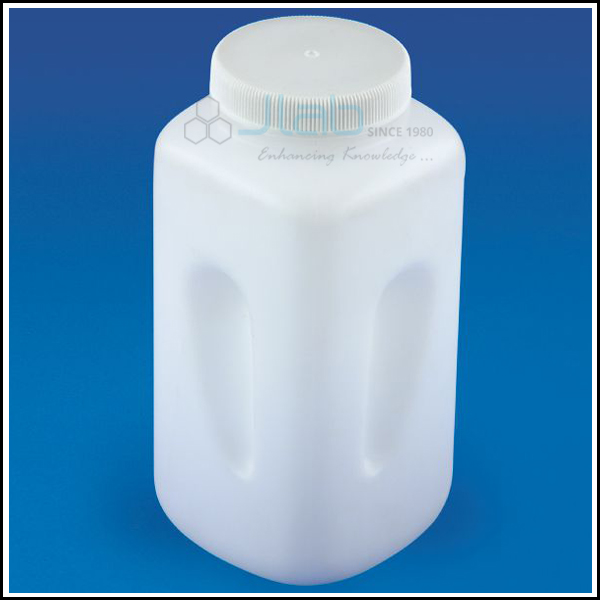
- Wide Mouth Square Bottle (large square bottle with grip depressions)
- Dropping Bottles Euro Design (screw cap with lid)
For a quote, use Add To Cart or send us a message through the contact page.
Last updated: 14 November 2026