Spatula (Polypropylene) Manufacturer,Supplier and Exporter in India
Product Code : EL-GL-58
Jlab Export is a leading Spatula (Polypropylene) Manufacturer,and suppliers in India
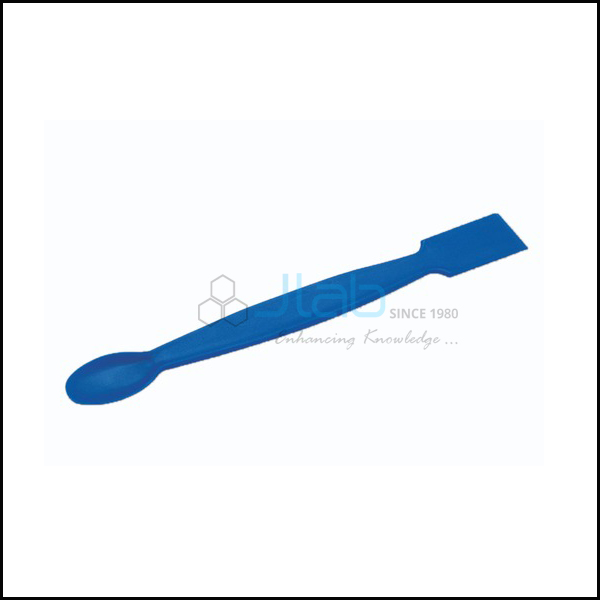
Moulded in polypropylene, this double-ended spatula has a spoon at one end for drawing salts out of their containers. The other end is flat, with a knife edge that breaks up crystals and caked lumps. Two lengths are made, 150 mm and 200 mm.
Specifications
| Material | Moulded polypropylene |
| One end | Spoon, for drawing salts from containers |
| Other end | Flat, with a knife edge for breaking up crystals |
| Lengths | 150 mm, 200 mm |
| Minimum order quantity | 10 units |
| Dispatch time | Usually 4–6 working days |
| Manufacturer | JLab (Jain Laboratory Instruments Pvt Ltd), Ambala, India |
Salt Analysis and Solution Practicals
In salt analysis, students take a little of the unknown salt with the spoon end for the dry tests, then dissolve a second portion for the wet tests. Salts kept in a Reagent Bottle Wide Mouth are easy to reach with the spoon. To make up a solution of known strength, students weigh the solid on a Watch Glass and tip it into the beaker.
Damp salts often set into lumps that dissolve slowly. Students chop them with the knife edge first, and grind them in a Porcelain Pestle and Mortar when a fine powder is needed. Teachers hand out the plastic spatula for iodine crystals and copper salts, which corrode steel and pick up traces of iron.
Frequently Asked Questions
When should I use a plastic spatula instead of a steel one?
Use it for solids that attack metal, such as iodine, copper salts and damp acidic salts. It also helps when a trace of iron would spoil a result, for example in a test for iron with thiocyanate.
Can I use it on hot solids or near a flame?
No. Polypropylene softens with heat, so keep the spatula out of flames and away from crucibles or dishes that have just been heated. A stainless steel spatula is the right tool for hot work.
How do I break up a caked salt?
Chop and scrape the lump with the knife edge, either inside the container or on a watch glass. Large lumps dissolve slowly and can leave undissolved solid in a solution, so grind them to a powder in a mortar if needed.
How do I avoid contaminating the stock bottle?
Use a clean, dry spatula for each chemical and take out only what you need. Never return unused solid to the bottle. Wipe and dry the spatula before it goes into the next reagent.
Other Spatulas
- Spatula-Spoon Metal (stainless steel, spoon-ended)
- Double Spatula (stainless steel, Chattaway and flat ends)
- Micro Spatula (stainless steel wire, flat ends)
For a quote, use Add To Cart or send us a message through the contact page.
Last updated: 14 November 2026