

Round Hot Plates Manufacturer,Supplier and Exporter in India
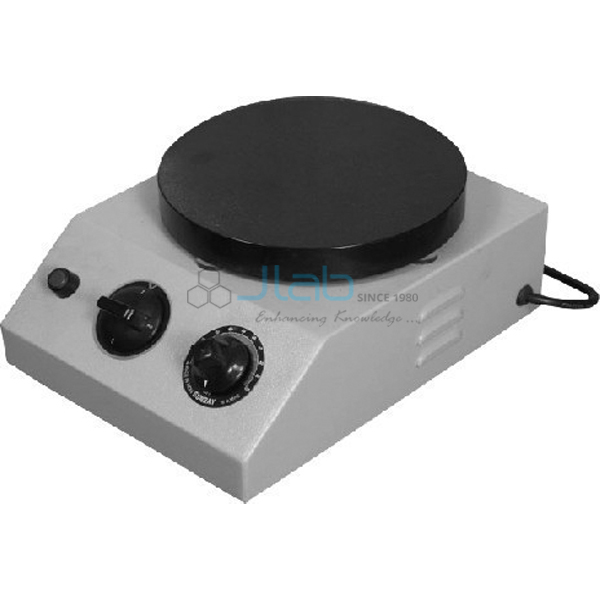
Product Code : EL-HP-2311
Jlab Export is a leading Round Hot Plates Manufacturer,and suppliers in India
A hot plate heats beakers, flasks and dishes from below on a flat top, with no open flame on the bench. These plates have a stainless steel top over nichrome elements and reach a surface temperature of 300 °C. An energy regulator sets the heat. The round heated disc is made in 10, 12, 18 and 24 in diameters, for 230 V.
Specifications
| Top | Stainless steel |
| Maximum surface temperature | 300 °C |
| Temperature control | Energy regulator |
| Heating elements | Nichrome |
| Voltage | 230 V |
| Heated disc diameter | Ø10 in (254 mm), Ø12 in (305 mm) and Ø18 in (457 mm); large plate Ø24 in (610 mm) |
| Cabinet width | About 12 in (305 mm) for the Ø10 in plate |
| Rating | 1.5 kW (Ø10 in), 2.0 kW (Ø12 in), 3.0 kW (Ø18 in) |
| Minimum order quantity | 5 units |
| Dispatch time | Usually 7–10 working days |
| Manufacturer | JLab (Jain Laboratory Instruments Pvt Ltd), Ambala, India |
Heating Practicals for School and College Labs
A classic physics and chemistry practical is the heating curve of water. Students heat water in a Tall Form Beakers, Borosilicate Glass, Economy and read a Chemical Thermometer every minute. The plot rises steadily, then flattens at the boiling point while the water keeps taking in heat.
Repeating the run at a lower regulator setting shows how the heating rate depends on the power fed to the plate. Students lift the hot beaker off with a Beaker Tong and stand it on a heat-proof mat, never straight on the cold bench.
Frequently Asked Questions
Can I heat a reagent bottle or a thick glass jar on the plate?
It is better not to. Thick glass heats unevenly from a flat plate and can crack, and a capped bottle can build up pressure. Use borosilicate beakers or flasks, or stand the bottle in a water bath on the plate.
Why did my beaker crack on the hot plate?
The usual causes are a small crack already in the glass, a vessel heated until it boiled dry, or a sudden change such as a cold splash on hot glass. Check glassware before use and bring the heat up gradually.
How full should a vessel be on the plate?
Keep liquids to about half the vessel so they cannot boil over. The vessel base should sit fully on the plate, not overhang its edge, so that it heats evenly.
What should I check before switching on?
Look over the cord and plug for damage and make sure the top is clean and dry. Clear paper, solvents and other flammable items from around the plate. After use, switch off at the mains and remember the top stays hot for some time.
Other Hot Plates
For a quote, use Add To Cart or send us a message through the contact page.
Last updated: 20 November 2026