Silicon Rubber Cork Manufacturer,Supplier and Exporter in India
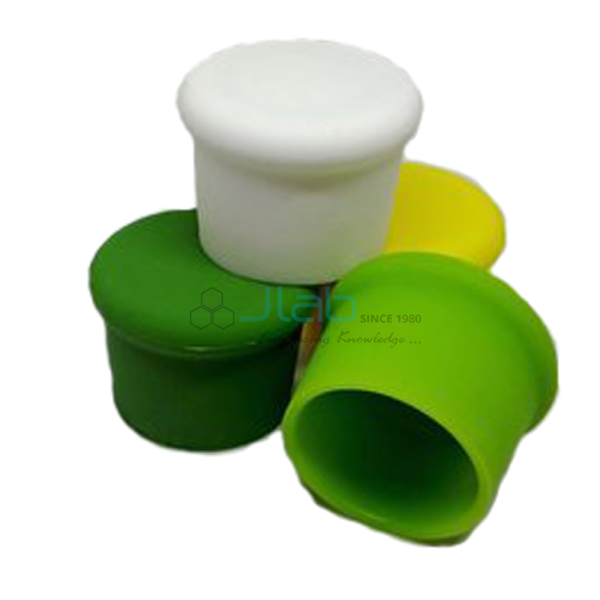
Product Code : EL-MI-4914
Jlab Export is a leading Silicon Rubber Cork Manufacturer,and suppliers in India
Silicon Rubber Cork (code EL-MI-4914) is a silicone rubber stopper for laboratory use, for closing flasks, tubes and bottles that must go through heat or sterilisation. It is highly elastic, listed for −50 to 250 °C and suitable for the autoclave, so it suits microbiology and biology work as well as warm chemistry set-ups. It is made by Jain Laboratory Instruments Pvt Ltd (JLab) at its works in Ambala, India.
Specifications
| Parameter | Detail |
|---|---|
| Material | Silicone rubber (listed as “silicon rubber”) |
| Type | Laboratory cork (stopper) |
| Temperature range | −50 to 250 °C |
| Sterilisation | Suitable for autoclaving |
| Elasticity | Highly elastic |
| Chemical compatibility | Confirm with JLab for solvents, halogens and concentrated acids or alkalies (see FAQ) |
| Quality check | Each cork is visually inspected before dispatch |
| Pack quantity | Each (sold individually) |
| Minimum order quantity | 10 units |
| Dispatch time | Usually 7–10 working days |
| Product code | EL-MI-4914 |
| Manufacturer | Jain Laboratory Instruments Pvt Ltd (JLab) — OEM |
| Country of origin | India (made in Ambala, Haryana) |
What Is the Silicone Rubber Cork Used For?
Silicone rubber corks close culture tubes and flasks that go into the autoclave, seal apparatus that runs warm — such as a heated flask fitted with a thermometer or delivery tube — and stopper containers that are sterilised again and again. Because silicone stays elastic across a wide temperature range, the cork keeps its grip after repeated heating and cooling, where a natural rubber stopper tends to harden. School biology and chemistry practicals, college microbiology labs and research labs all use them alongside ordinary rubber stoppers.
Silicone is not a universal stopper material: it generally swells or weakens in aromatic and chlorinated solvents such as toluene and carbon tetrachloride, in halogens such as bromine and in concentrated acids and alkalies, so tell JLab what the cork will seal if your work involves those chemicals. When pushing a glass tube through a bored cork, wet both with water or glycerol and protect your hand with a cloth.
What to Specify When Ordering
- Size — the cork size, or the inside diameter of the neck or tube it must close.
- Solid or bored — and the number and size of holes if glass tubes or thermometers pass through.
- Chemicals and temperature — what the cork will seal and how hot it runs.
- Quantity — the minimum order is 10 units.
Frequently Asked Questions
What temperature can the silicone rubber cork take, and can it be autoclaved?
It is listed for −50 to 250 °C and as suitable for autoclaving, so it can be sterilised with the culture tube or flask it closes.
Is it resistant to strong acids and organic solvents?
Not reliably. Silicone rubber generally swells or weakens in toluene, carbon tetrachloride, bromine and concentrated acids or alkalies. Send the chemical and concentration, and JLab will confirm whether this cork suits it.
Which sizes and bores are available?
The listing does not give sizes. State the cork size or the neck diameter, and whether you need it solid or with holes, and JLab will confirm the options in the quotation.
How does it differ from JLab’s ordinary rubber corks?
The ordinary rubber corks are listed solid or with one or two holes, for test tubes, boiling tubes and flasks, in packs of one hundred. This cork is silicone rubber, chosen when the stopper must be autoclaved or used warm.
Who manufactures this cork?
Jain Laboratory Instruments Pvt Ltd (JLab) makes it at its works in Ambala, Haryana, India.
OEM Manufacturer
JLab is the trading name of Jain Laboratory Instruments Pvt Ltd, a laboratory apparatus manufacturer in India, incorporated in 2017 and based on Hargolal Road, Ambala, Haryana. The silicone corks are made at JLab’s own works instead of being bought from traders, which lets schools, colleges, dealers and importers buy factory-direct, with a visual check of every cork before packing and repeat orders handled by the same maker. JLab exports worldwide and ships to buyers in every region — for example Australia in Oceania, Uzbekistan in Central Asia, Chad in Central Africa, Bhutan in South Asia and Tanzania in East Africa. Tender buyers can refer to the JLab lab tenders page.
Corks, Stoppers and Fitting Tools
- Rubber Corks (without Holes) — solid rubber stoppers for test tubes, boiling tubes and flasks.
- Rubber Corks (with One Hole) — take a single glass tube or thermometer.
- Rubber Corks (with Two Holes) — for a thistle funnel and delivery tube in gas preparation.
- Cork Borer (Brass) — brass-tube borers for cutting holes in corks and rubber stoppers.
- Rubber Tubing Silicon — silicone rubber tubing to pair with silicone corks.
See more items in the Measuring Instruments section or the full Indian Instruments range.
Request a Quote
Quotes come direct from the manufacturer. Use the Add To Cart enquiry button on this page, or send the quantity (minimum 10 units), the cork size and holes, what it will seal and your delivery location through the contact page.
Last updated: 9 October 2026