Stop Watch Manufacturer,Supplier and Exporter in India
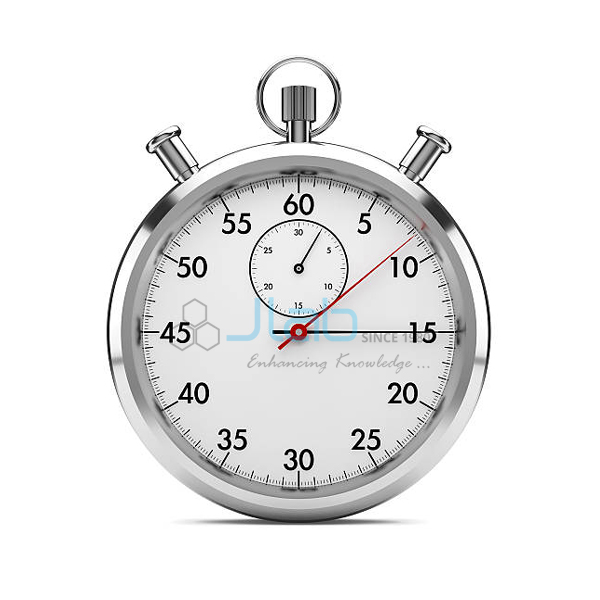
Product Code : EL-MI-2126
Jlab Export is a leading Stop Watch Manufacturer,and suppliers in India
Stop Watch (code EL-MI-2126) is a hand-held stop watch with a precision-made jewelled movement that reads to 1/10th of a second, used for timing experiments in school, college and field work. It has a chromium-plated case and a transparent face over clear graduations and figures, and one lever at the top starts, stops and zeroes it. It is made by Jain Laboratory Instruments Pvt Ltd (JLab) at its works in Ambala, India.
Specifications
| Parameter | Detail |
|---|---|
| Reading | 1/10th of a second |
| Movement | Precision-made jewelled movement |
| Case | Chromium plated |
| Face | Transparent, for easy reading of the graduations and figures |
| Operation | Single lever at the top: first press starts, second press stops, third press returns the watch to zero |
| Quality check | Each stop watch is visually inspected before dispatch |
| Pack quantity | Each (sold individually) |
| Minimum order quantity | 10 units |
| Dispatch time | Usually 7–10 working days |
| Product code | EL-MI-2126 |
| Manufacturer | Jain Laboratory Instruments Pvt Ltd (JLab) — OEM |
| Country of origin | India (made in Ambala, Haryana) |
How Does It Compare with Other JLab Timers?
| Model | Reading and range (as listed) | Movement or power | Case and controls |
|---|---|---|---|
| This stop watch (EL-MI-2126) | 1/10th of a second; range not stated | Jewelled movement | Chromium-plated case; one top lever for start, stop and zero |
| Stop Watch (7-jewel) | 1/5th second with 30 minutes, or 1/10th second with 60 minutes | 7-jewel lever movement | Chrome-plated steel case, dust and damp-proof; white dial, black steel hands |
| Stop Watch Digital | Not detailed on its page | One button cell battery, included | Strong construction; neck lanyard |
| Stop Clock | 0–60 minute subsidiary dial | Smith-type analogue clock | Metal case; side lever and fly-back reset press |
Choose this watch for hand-held timing to 1/10th of a second with a single-lever action. The 7-jewel stop watch states its minute range and a dust and damp-proof case, the digital watch hangs on a lanyard and runs on a button cell, and the bench stop clock is easier for a whole group to read.
What Is the Stop Watch Used For?
In the physics lab a stop watch times a counted number of swings of a simple pendulum to find its period, the fall of a ball, or the intervals between temperature readings on a cooling curve; in chemistry it times how long a reaction takes to reach a visible change, and in biology and geography field work it times observations outdoors, where a mains-powered clock cannot go. Reading to 1/10th of a second makes it suitable for class 9 to class 12 practicals and for college labs, while the transparent face keeps the graduations easy to read in poor light.
Press the top lever once to start at the instant the event begins and again to stop; read the dial, then press a third time to return the hands to zero. Because the single lever works in this fixed start–stop–zero order, each timing begins from zero. Keep the watch dry and avoid dropping it, as a jewelled movement is a fine mechanism.
What to Specify When Ordering
- Type — this jewelled-movement watch, the 7-jewel model with a stated minute range, or a digital stop watch.
- Quantity — the minimum order is 10 watches; many schools order one per practical group.
- Bench timers — add analogue or digital stop clocks to the same enquiry if a group needs a larger display.
Frequently Asked Questions
What does this stop watch read to?
1/10th of a second. The listing does not give the longest time the watch records, so ask JLab for the minute range with your quote.
How is it started, stopped and reset?
With one lever at the top: the first press starts the watch, the second stops it and the third brings it back to zero.
Does it need a battery?
The listing describes a jewelled movement, which is a mechanical watch movement, and mentions no battery. If you prefer a battery stop watch, the digital model linked above runs on a button cell.
How does it differ from the 7-jewel Stop Watch?
That model is listed with 1/5th-second (30 minute) and 1/10th-second (60 minute) versions, a dust and damp-proof chrome-plated steel case, a white dial and black steel hands. This watch reads 1/10th of a second in a chromium-plated case with a transparent face and single-lever control.
What should be included in an export enquiry?
Quantity, destination country and port or city, delivery terms such as FOB or CIF, any packing or labelling needs and a tender reference if one applies.
Who manufactures this stop watch?
JLab, the trading name of Jain Laboratory Instruments Pvt Ltd, makes it at its works in Ambala, Haryana, India.
OEM Manufacturer
JLab — Jain Laboratory Instruments Pvt Ltd — is a physics lab instruments maker in India, incorporated in 2017 and located on Hargolal Road, Ambala, Haryana. This stop watch comes from the company’s own works rather than a trading house, so schools, colleges, dealers and importers deal with the manufacturer directly, each watch is checked by eye before dispatch, and repeat orders are handled by the same factory. JLab exports worldwide and ships to buyers in every region — for example the USA in North America, Austria in Western Europe, Finland in Northern Europe, Kazakhstan in Central Asia and Bhutan in South Asia. Tender information is on the lab tenders page.
Related Timers and Apparatus
- Stop Clock — a Smith-type bench stop clock with a 0–60 minute dial.
- Digital Stop Clock — a quartz-controlled mains timer for the bench.
- Stop Watch Digital — a button-cell digital watch with a neck lanyard.
- Simple Pendulum — the time-period practical that a stop watch is most often used for.
Browse the Measuring Instruments range or the wider Indian Instruments range.
Request a Quote
Quotes come direct from the manufacturer. Use the Add To Cart enquiry button, or send the quantity (minimum 10 units), any stop clocks you also need, and your delivery location through the contact page.
Last updated: 9 October 2026