Digital Stop Clock (Quartz) Manufacturer,Supplier and Exporter in India
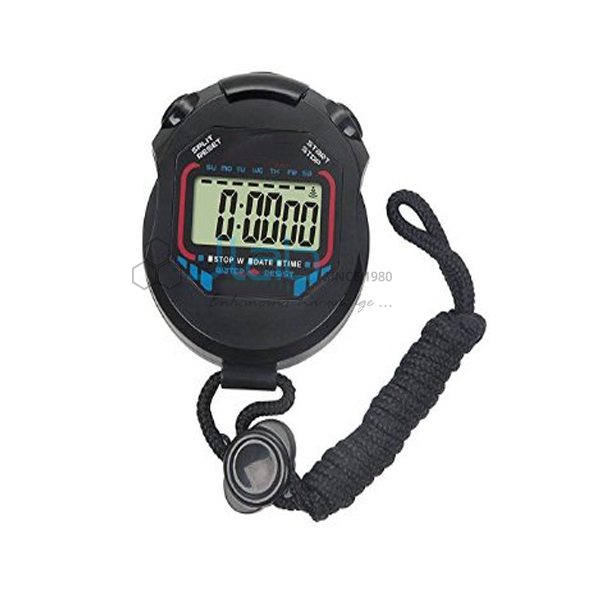
Product Code : EL-MI-2127
Jlab Export is a leading Digital Stop Clock (Quartz) Manufacturer,and suppliers in India
This mains-powered stop clock replaces the mechanical bench stop clock with a quartz controlled digital timer. It counts in steps of 0.1 s up to 999.9 s on a 12.5 mm seven segment display. A mini toggle switch starts and stops it, and the reset button works only when the clock is stopped, so a running count cannot be cleared by mistake.
Specifications
| Timing | Quartz controlled |
| Range | Up to 999.9 s |
| Resolution | 0.1 s |
| Accuracy | ±0.1% (quartz controlled) |
| Display | 12.5 mm bright seven segment display |
| Start and stop | Mini toggle switch |
| Reset | Push button, works only in stop mode |
| Power supply | 230 V AC ±10%, 50 Hz (110 V on request) |
| Minimum order quantity | 5 units |
| Dispatch time | Usually 7–10 working days |
| Manufacturer | JLab (Jain Laboratory Instruments Pvt Ltd), Ambala, India |
Timed Practicals with the Stop Clock
In the Simple Pendulum practical, students time a set of ten or more complete swings and divide by the count to get the period. They repeat this for several lengths and plot the length against the square of the period. The clock stays on the bench where the whole group can read it.
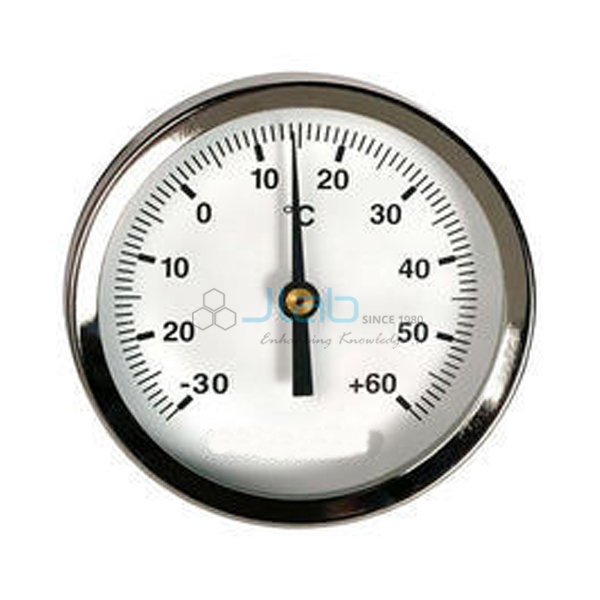
For a cooling curve, the clock runs while a Laboratory Thermometer is read every half minute in water cooling in the Apparatus for Newton’s Cooling Law. Students can also time a roller down the Inclined Plane at several angles and compare the times.
Frequently Asked Questions
Should a school buy bench stop clocks or handheld stopwatches?
Bench clocks suit timed practicals at a fixed station, where a group reads one display together and nobody has to hold the timer. Handheld stopwatches are easier for fieldwork and sports. This model is a bench clock that runs from the mains, so there are no cells to replace.
What should be checked when a batch of stop clocks arrives?
Connect each clock to a 230 V supply and run it for a few minutes beside a known timer, watching the count rise in steady 0.1 s steps. Check that every display segment lights and that reset clears the count only after the clock is stopped.
Why time many swings if the clock reads to 0.1 s?
Your reaction time at the start and the stop is about as large as the display step, or larger. On a single swing that error is a big share of the time. Over ten or more swings it is spread across the whole count, so the period works out much better.
How many decimal places should I record from the display?
Write the time exactly as the display shows it, to 0.1 s, and do not round the raw reading. A period found by dividing that time by the number of swings can carry one more decimal place, because the division also divides the uncertainty.
Other Lab Timers
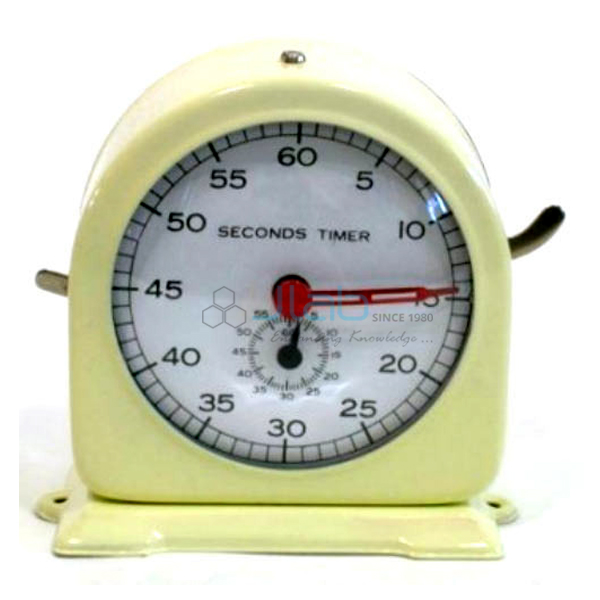
- Stop Clock (mechanical, with fly-back action)
- Stop Watch (reads to 1/10 second)
- Digital Stopwatch
For a quote, use Add To Cart or send us a message through the contact page.
Last updated: 16 November 2026