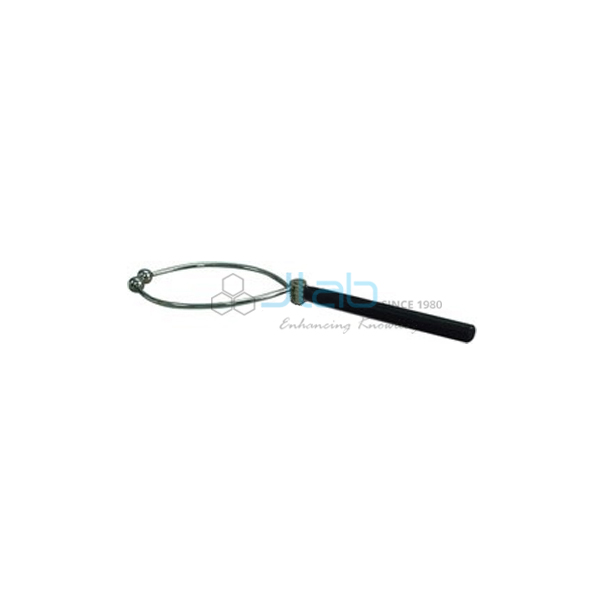
Tension Coefficients Apparatus Manufacturer,Supplier and Exporter in India

Product Code : EL-ELA-5519
Jlab Export is a leading Tension Coefficients Apparatus Manufacturer,and suppliers in India
Tension Coefficients Apparatus (code EL-ELA-5519) is a wall-mounted teaching apparatus used to measure the forces in a three-dimensional jib-and-tie frame and compare them with values calculated by the method of tension coefficients, in engineering mechanics labs. The jib and both chain ties carry spring balances for direct readings. It is made by Jain Laboratory Instruments Pvt Ltd (JLab) at its works in Ambala, India.
Specifications
| Parameter | Detail |
|---|---|
| Mounting | Wall mounted — the bottom of the jib is pivoted to a wall-mounted plate; self-contained and compact |
| Structure | A jib restrained by two chain ties, forming a triangulated three-dimensional structure |
| Force measurement | Spring balances fitted to the jib and to both ties, giving direct readings of the jib and tie loads |
| Tie attachment | Attachment locations can be varied independently at the wall ends of the ties |
| Loading | Load hung from the end of the jib |
| Geometry adjustment | Knurled collar to return the frame to its unloaded geometry before the spring balance readings are taken |
| Listed experiments | Forces in individual frame members by experiment; theoretical forces by the method of tension coefficients; comparison of the two; repeat for other frame configurations |
| Documentation | Complete instruction manual describing the apparatus, its application, experimental procedure and typical test results |
| Quality check | Each apparatus is visually inspected before dispatch |
| Pack quantity | Each (sold individually) |
| Minimum order quantity | 10 units |
| Dispatch time | Usually 7–10 working days |
| Product code | EL-ELA-5519 |
| Manufacturer | Jain Laboratory Instruments Pvt Ltd (JLab) — OEM |
| Country of origin | India (made in Ambala, Haryana) |
What Is the Tension Coefficients Apparatus Used For?
Structures such as cranes and towers carry loads through members that do not all lie in one plane, and the method of tension coefficients is a standard way to analyse them. The tension coefficient of a member is its force divided by its length, so the equilibrium equations at a joint can be written directly from the members’ coordinate projections. This apparatus turns that calculation into a practical: students find the forces in the jib and the two chain ties experimentally, calculate the theoretical forces by tension coefficients, compare the two sets of results, and repeat the exercise for other frame configurations by moving the tie attachment points.
Because the jib and tie loads are read directly from spring balances and setting-up time is minimal, student effort goes into the engineering principle rather than the instrumentation. The apparatus belongs in the applied mechanics and structural analysis practicals of engineering colleges, polytechnics and technical institutes, where it extends earlier work on coplanar forces, such as the triangle and polygon of forces, into three dimensions.
What to Specify When Ordering
- Quantity and wall space — the minimum order is 10 units, and each unit needs its own wall position because the jib plate and tie ends fix to the wall.
- Related statics apparatus — items such as the Shear Legs or the Funicular Polygon and Forces Apparatus are separate products and can be quoted on the same enquiry.
- Delivery details — destination country and port or city, and delivery terms such as FOB or CIF.
- Tender reference — quote it if the purchase is for a tender, so the quotation can follow its wording.
Frequently Asked Questions
What does the tension coefficients apparatus demonstrate?
It demonstrates how tension coefficients are applied to evaluate forces in three dimensions. A jib restrained by two chain ties forms a triangulated three-dimensional structure, and the measured member forces are compared with the calculated ones.
How are the member forces measured?
With spring balances fitted to the jib and to both ties, which give direct readings of the jib and tie loads. A load is hung from the jib end, and a knurled collar is used to return the geometry to its unloaded state before the readings are taken.
Why is the frame returned to its unloaded geometry before reading?
Spring balances extend under load, which slightly changes the lengths and angles of the members. Restoring the unloaded geometry keeps the readings matched to the frame dimensions used in the tension-coefficient calculation, which reduces the difference between measured and calculated forces.
Can the frame geometry be changed?
Yes. The tie attachment locations can be varied independently at their wall ends, and the listed experiments include repeating the test for other frame configurations.
How does it differ from the shear legs apparatus?
Both deal with forces in three dimensions measured on spring balances. This apparatus is wall mounted, with a jib and two chain ties; the Shear Legs apparatus is bench mounted and measures strut and backstay forces.
Is an instruction manual provided?
Yes. A complete instruction manual describes the apparatus, its application, the experimental procedure and typical test results.
What information is needed for an export quotation?
The quantity, the destination country and port or city, your delivery terms (for example FOB or CIF), any packing or labelling requirements, and a tender reference where one applies.
Who manufactures this apparatus?
JLab (Jain Laboratory Instruments Pvt Ltd) makes it at its works in Ambala, Haryana, India, and supplies it factory-direct.
OEM Manufacturer
JLab, the trading name of Jain Laboratory Instruments Pvt Ltd, is an Indian manufacturer of laboratory and engineering teaching apparatus, incorporated in 2017 and based on Hargolal Road in Ambala, Haryana. The tension coefficients apparatus comes from JLab’s own works and is not sourced from a trader; colleges, polytechnics, dealers and importers therefore buy it direct from the factory, each unit is visually checked before dispatch, and follow-up orders and spares stay with the maker. JLab exports worldwide and ships to buyers in every region — Indonesia in Southeast Asia, Nepal in South Asia, Lesotho in Southern Africa, Poland in Eastern Europe and Paraguay in South America are a few examples. Tender buyers can find more on the JLab lab tenders page.
Related Statics Apparatus
- Shear Legs — bench-mounted apparatus that measures strut and backstay forces in three dimensions with spring balances.
- Funicular Polygon and Forces Apparatus — verifies the triangle of forces, the polygon of forces and the link polygon for coplanar forces.
- Deflection of Truss Apparatus — a Pratt steel truss that shows the nature of the forces set up in truss members.
- Shearing Force Apparatus — split beam with a spring balance for measuring the shearing force at a section.
- Rubber in Shear Apparatus — another wall-mounted unit, used to find the modulus of rigidity of a rubber block.
More teaching apparatus is listed under Educational Laboratory Apparatus and Laboratory Apparatus.
Request a Quote
Send your enquiry with the Add To Cart button on this page or through the contact page, giving the number of units, the delivery city or port, and any other statics apparatus you would like quoted together.
Last updated: 15 October 2026