Vibration Lab Manufacturer,Supplier and Exporter in India

Product Code : EL-DOMLE-9126
Jlab Export is a leading Vibration Lab Manufacturer,and suppliers in India
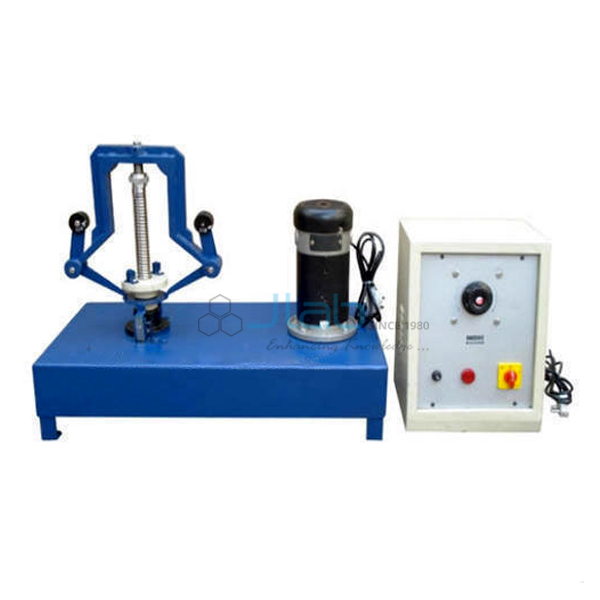
The vibration lab is a machine for experiments on longitudinal and torsional vibration, with control panels and speed indicators. It is offered in two versions. The basic machine covers undamped free vibration and forced vibration of an equivalent spring-mass system. Vibration Lab No II extends this to eleven experiments, from pendulums to damped and two rotor torsional systems.
Specifications
| Vibration types | Longitudinal and torsional |
| Controls | Control panels with speed indicators |
| Basic version | Equivalent spring-mass system: undamped free vibration and forced vibration |
| Vibration Lab No II | 11 experiments, including pendulums, damping and torsional rotors |
| Minimum order quantity | 1 unit |
| Dispatch time | Usually 14–18 working days |
| Manufacturer | JLab (Jain Laboratory Instruments Pvt Ltd), Ambala, India |
Experiments in Vibration Lab No II
The No II machine is set up for these eleven experiments:
- Simple pendulum
- Compound pendulum
- Bifilar suspension
- Spring-mass system
- Equivalent spring-mass system, undamped free vibration
- Equivalent spring-mass system, forced vibration
- Verification of Dunkerley’s rule
- Forced vibration with different amounts of damping
- Torsional vibration of a single rotor system
- Torsional vibration of a two rotor system
- Single rotor with viscous damping
Lab Exercises for Students and Teachers
For the spring-mass experiments, students find the spring stiffness k from the static deflection under known weights. They set the mass vibrating, time a counted number of oscillations with a Stop Clock and compare the frequency with f = (1/2π)√(k/m). Forced runs at rising speed show resonance as the forcing frequency passes the natural frequency.
The pendulum and bifilar suspension experiments give the radius of gyration and moment of inertia of a body from its period. In the torsional experiments, students compare single and two rotor systems and locate the node of the two rotor shaft. The Dunkerley’s rule results carry over to critical speeds on the Whirling of Shaft Apparatus.
Frequently Asked Questions
What is the difference between the basic Vibration Lab and Vibration Lab No II?
Both are machines for longitudinal and torsional vibration with control panels and speed indicators. The basic version covers undamped free and forced vibration of an equivalent spring-mass system. No II adds pendulums, bifilar suspension, Dunkerley’s rule, damping and torsional rotor experiments, eleven in all.
How is the natural frequency of a spring-mass system found?
For a mass m on a spring of stiffness k, the natural frequency is f = (1/2π)√(k/m). Students find k from a static deflection test, calculate f, and check it against the frequency timed on the machine.
What does Dunkerley’s rule tell students?
It estimates the lowest natural frequency of a system carrying several loads. The reciprocal of the square of the combined frequency is taken as the sum of the reciprocals of the squares of each load’s own frequency. The estimate comes out slightly low.
What is studied in the two rotor torsional experiment?
Two rotors on one shaft twist in opposite directions about a node, a section of the shaft that does not turn. Students measure the natural frequency, find the node and compare both with values worked out from the rotor inertias and shaft stiffness.
How is damping measured?
In the damped experiments, students record how the amplitude falls from one cycle to the next. The logarithmic decrement of successive amplitudes gives the damping ratio, and forced runs show how more damping lowers the peak at resonance.
Other Vibration, Torsion and Rotor Apparatus
- Universal Vibration Apparatus
- Torsion of Rods Apparatus
- Static and Dynamic Balancing Apparatus
- Motorized Gyroscope
For a quote, use Add To Cart or send us a message through the contact page.
Last updated: 5 November 2026