Scotch Yoke Mechanism Manufacturer,Supplier and Exporter in India

Product Code : EL-DOMLE-9147
Jlab Export is a leading Scotch Yoke Mechanism Manufacturer,and suppliers in India
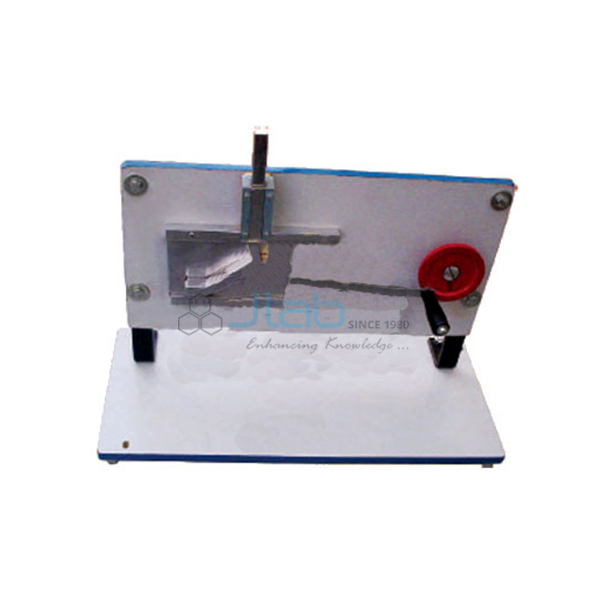
A Scotch yoke turns steady rotation of a crank into pure harmonic reciprocating motion. On this table unit the crank is an anodised aluminium disc running in ball bearings on a white plate. The crank pin can be set at different radii. A pointer reads the input angle on a built-in scale, and a ruler on the straight guide shows the output stroke.
Specifications
| Crank | Anodised aluminium disc on ball bearings |
| Crank radius | Crank pin can be set at different radii |
| Input reading | Pointer on an integrated angle scale |
| Output reading | Ruler on the straight guide |
| Motion produced | Pure harmonic reciprocating motion |
| Mounting | White plate with plastic feet, for table use |
| Carrying | Two handles |
| Minimum order quantity | 1 unit |
| Dispatch time | Usually 14–18 working days |
| Manufacturer | JLab (Jain Laboratory Instruments Pvt Ltd), Ambala, India |
Why the Motion Is Simple Harmonic
Take the crank radius as r and the crank angle as θ, measured from the line of stroke. The slider position is then x = r cos θ. Its velocity and acceleration also follow sine and cosine curves, and the acceleration is always proportional to the displacement and directed toward the centre. The full stroke is twice the crank radius.
Experiments with the Scotch Yoke
Students set a crank radius, turn the disc in equal steps on the angle scale and read the slider position on the ruler. Plotted against angle on Graph Paper, the readings give a cosine curve to compare with r cos θ drawn from the set radius. A run at a second radius shows the stroke growing in proportion.
Before each run, students can measure the crank radius from disc centre to pin with a Steel Rule. The measured stroke should be twice that figure. Teachers can then set the yoke beside the Whitworth Quick Return Mechanism to contrast equal stroke times with slow feed and quick return.
Frequently Asked Questions
Why does a Scotch yoke give simple harmonic motion?
The yoke slot lies at right angles to the line of stroke, so the slider follows only the part of the crank pin movement along that line. That part is r cos θ, which is the equation of simple harmonic motion.
How is the stroke length related to the crank radius?
The stroke is twice the crank radius, because the slider travels from r on one side of the centre to r on the other. Setting the crank pin farther out on the disc gives a longer stroke in the same proportion.
How does a Scotch yoke differ from a slider crank?
A slider crank uses a connecting rod, and its finite length adds extra terms, so the motion is only close to harmonic. The Scotch yoke has no connecting rod, so its slider follows r cos θ exactly.
Where is the Scotch yoke used?
It is used in some reciprocating pumps and compressors and in actuators that turn quarter-turn valves. Its sliding pin wears faster than a plain pin joint, so it is less common in fast machines.
Other Mechanism Teaching Models
For a quote, use Add To Cart or send us a message through the contact page.
Last updated: 5 November 2026