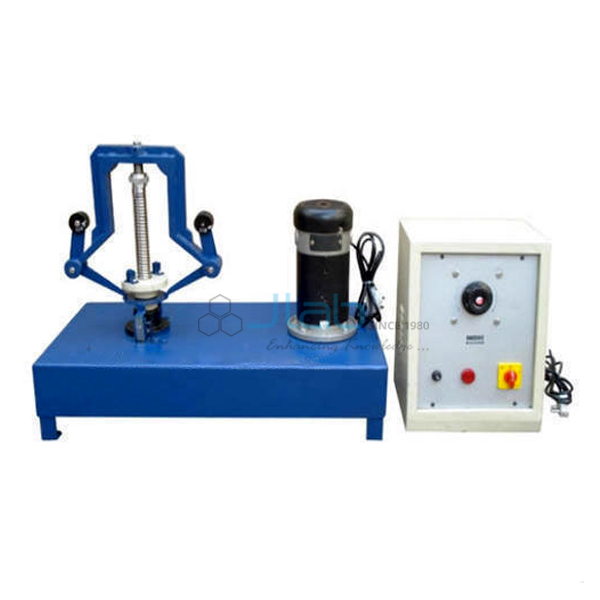
Cam and Follower Model Manufacturer,Supplier and Exporter in India
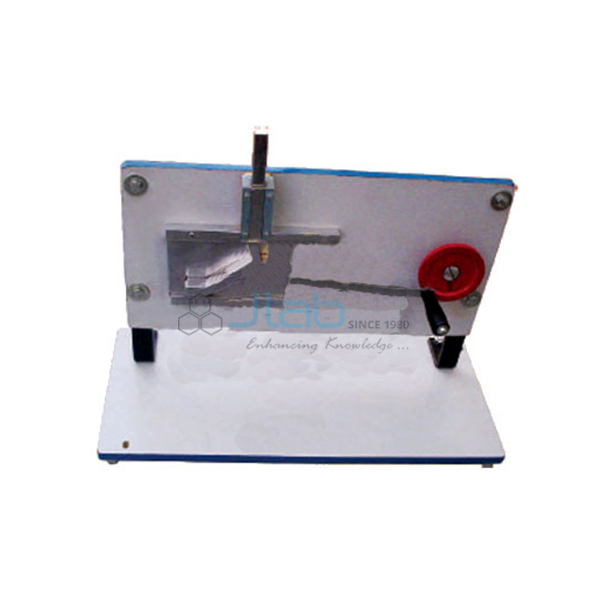
Product Code : EL-DOMLE-9150
Jlab Export is a leading Cam and Follower Model Manufacturer,and suppliers in India
This cam and follower model shows how the shape of a cam sets the lift of its follower. A scaled disc gives the angle of rotation, and a mechanical position gauge measures the stroke. The follower can be run as a roller tappet, a cup tappet or a trailing lever, and instructional material takes students through the experiments step by step.
Specifications
| Angle reading | Scaled disc |
| Stroke measurement | Mechanical position gauge |
| Follower types | Roller tappet, cup tappet or trailing lever |
| Demonstrates | Action principle of cams and the effect of different cam shapes |
| Instructional material | Fundamentals and step-by-step experiment guide |
| Minimum order quantity | 1 unit |
| Dispatch time | Usually 14–18 working days |
| Manufacturer | JLab (Jain Laboratory Instruments Pvt Ltd), Ambala, India |
Experiments on Cam and Follower Motion
Students turn the cam in equal steps on the scaled disc and record the follower lift from the position gauge at each step. Plotted on Graph Paper, the readings give the displacement diagram, lift against cam angle, for one full turn. Repeating the run with the roller tappet, cup tappet and trailing lever shows how the follower type changes the curve for the same cam.
Teachers can relate the results to engines with the Valve Timing Diagram, since cams open and close the valves of a combustion engine. Classes moving on to speed effects can use the motorised Cam Analysis Apparatus, on which follower jump at higher speeds can be observed.
Frequently Asked Questions
What is a cam displacement diagram?
It is a graph of follower lift against cam rotation angle over one revolution. On this model the angle comes from the scaled disc and the lift from the mechanical position gauge, so students can draw the diagram point by point.
Which follower types can be used on the model?
The follower can work as a roller tappet, a cup tappet or a trailing lever. Comparing them on one cam shows how the contact point and the follower layout change the lift curve.
Why do engines use cams?
A cam on a rotating camshaft opens and closes each valve at set points in the engine cycle. The cam shape fixes how far and how long the valve opens. Cams also time movements in many automatic machines.
What are rise, dwell and return on the lift curve?
Rise is the part of the turn in which the cam lifts the follower, and return is the part in which the follower comes back down. In a dwell the follower stays at one height while the cam keeps turning. Students mark whichever of the three appear on the curve they have plotted.
Other Cam and Mechanism Apparatus
- Cam and Follower Apparatus (five cams, roller and knife-edge followers)
- Scotch Yoke Mechanism
- Whitworth Quick Return Mechanism
For a quote, use Add To Cart or send us a message through the contact page.
Last updated: 5 November 2026