Herringbone Gear Manufacturer,Supplier and Exporter in India

Product Code : EL-DOMLE-9154
Jlab Export is a leading Herringbone Gear Manufacturer,and suppliers in India
A herringbone gear is a double helical gear. Two sets of helical teeth of opposite hand sit side by side and meet in a V across the face. Each half pushes along the shaft in the opposite direction, so the end thrusts cancel. The gear lets students see the tooth form used for smooth, heavy drives on parallel shafts.
Specifications
| Gear type | Double helical (herringbone) |
| Tooth form | Two helical sets of opposite hand, meeting in a V |
| Shafts | Parallel axes |
| Minimum order quantity | 10 units |
| Dispatch time | Usually 4–6 working days |
| Manufacturer | JLab (Jain Laboratory Instruments Pvt Ltd), Ambala, India |
Helical and Herringbone Teeth Compared
On a helical gear the teeth are cut at an angle to the axis, so each tooth enters mesh gradually and runs more quietly than a spur tooth. The teeth slide along their angled faces, and this extra friction costs a little efficiency compared with spur gears. The angle also pushes the gear along its shaft. A herringbone gear joins a left-hand and a right-hand helix, and their two thrusts cancel inside the gear.
Classroom Demonstrations with the Gear
Teachers can set the herringbone gear beside the plastic gears of a Spur Gear Set. Students compare the tooth lines: straight across the face on the spur gears, angled in a V here. Students then sketch the helix hand of each half and draw an arrow for the end thrust each half would produce on its own.
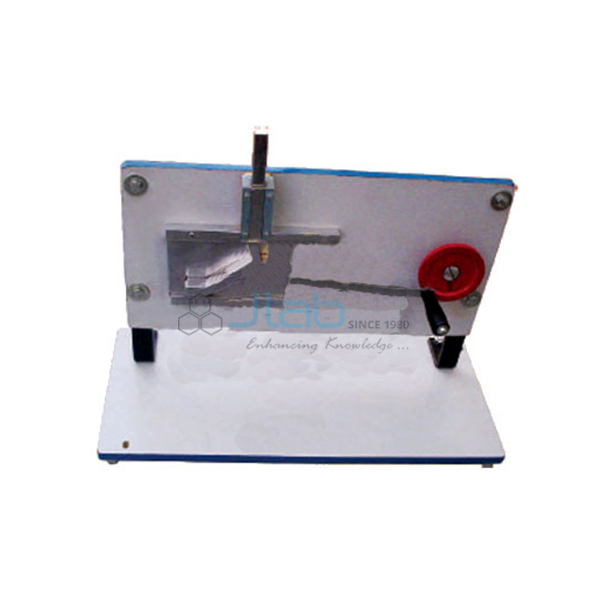
A second lesson links tooth form to manufacture. Students first trace an involute profile with the rack cutter on the Generation of Involute Gear Tooth Profile board. They can then discuss why a true herringbone V is hard to cut, and why many double helical gears have a groove between the halves.
Frequently Asked Questions
Why does a herringbone gear not push along its shaft?
Each half is a helical gear, and helical teeth produce a thrust along the shaft. The two halves of a herringbone gear have opposite helix hands, so their thrusts are equal and opposite and cancel within the gear.
How is a herringbone gear different from a helical gear?
A helical gear has one set of angled teeth and creates end thrust. A herringbone gear has two sets of opposite hand side by side, so it keeps the gradual, quiet mesh of helical teeth without that thrust.
Where are herringbone gears used?
They are used in heavy parallel-shaft drives that carry large torque, such as rolling mills, marine gearboxes and large industrial gear units. Because the thrust cancels, the shafts do not need large thrust bearings.
Are helical gears less efficient than spur gears?
Slightly. The teeth slide along their angled faces as they mesh, and this friction costs some efficiency compared with spur gears. When helical gears are crossed at an angle instead of running on parallel shafts, the loss is much larger.
Other Gear Models and Trainers
For a quote, use Add To Cart or send us a message through the contact page.
Last updated: 5 November 2026