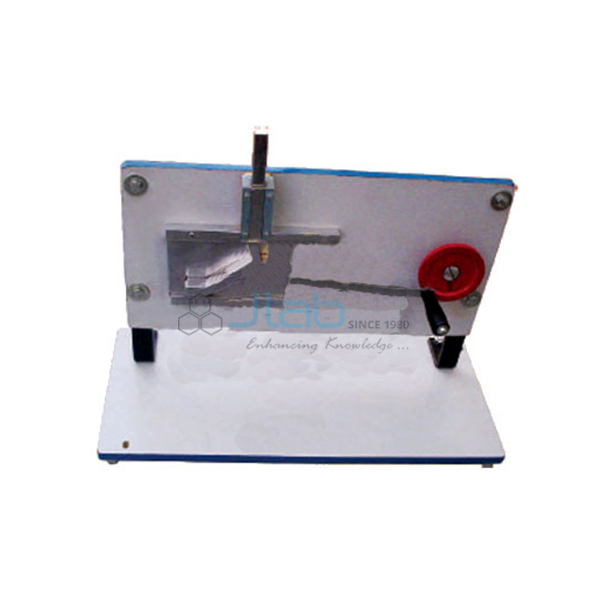
Oldham Coupling Manufacturer,Supplier and Exporter in India

Product Code : EL-DOMLE-9156
Jlab Export is a leading Oldham Coupling Manufacturer,and suppliers in India
An Oldham coupling joins two parallel shafts whose axes are slightly offset sideways. It has a slotted flange on each shaft and a centre disc with a tongue on each face. The two tongues lie at right angles to each other and slide in the slots, so the driven shaft turns at the same speed as the driver.
Specifications
| Coupling type | Oldham coupling |
| Shafts joined | Parallel, with a small lateral offset |
| Minimum order quantity | 10 units |
| Dispatch time | Usually 4–6 working days |
| Manufacturer | JLab (Jain Laboratory Instruments Pvt Ltd), Ambala, India |
How the Oldham Coupling Works
As the shafts turn, the centre disc slides to and fro in both slots at once. Its centre travels round a small circle whose diameter equals the offset between the shafts, and it goes round twice for each turn of the shafts. Because the tongues stay at a right angle, the velocity ratio is exactly one through the whole turn.
Classroom Demonstrations of the Coupling
Teachers can turn one flange slowly so students watch the disc slide in both slots while the two flanges stay in step. Students can measure the offset between the shaft axes with a Dial Caliper and compare it with the size of the circle traced by the disc centre.
The coupling is an inversion of the double slider crank chain, like the Scotch Yoke Mechanism. Showing the two together makes a short lesson on kinematic inversion: the same chain gives a shaft coupling in one case and harmonic motion in the other.
Frequently Asked Questions
What kind of shaft misalignment does an Oldham coupling handle?
It is made for parallel shafts with a small lateral offset. It is not meant for shafts that meet at an angle, where a universal joint or another flexible coupling is the usual choice.
Do both shafts turn at the same speed?
Yes. The tongues on the centre disc stay at right angles to each other. One turn of the driving shaft therefore gives exactly one turn of the driven shaft, with no change in speed during the turn.
What path does the centre disc follow?
Its centre moves round a circle whose diameter equals the offset between the shaft axes, going round twice for every turn of the shafts. This sliding is the source of friction and wear in the coupling.
Where are Oldham couplings used?
They join motors to pumps, feed screws, encoders and other light drives where the shafts are nearly parallel but not exactly in line. In many designs the centre disc is a replaceable part.
More Kinematics Teaching Models
For a quote, use Add To Cart or send us a message through the contact page.
Last updated: 5 November 2026