Electrical Defibrillator Manufacturer,Supplier and Exporter in India
Product Code : EL-ED-3933
Jlab Export is a leading Electrical Defibrillator Manufacturer,and suppliers in India
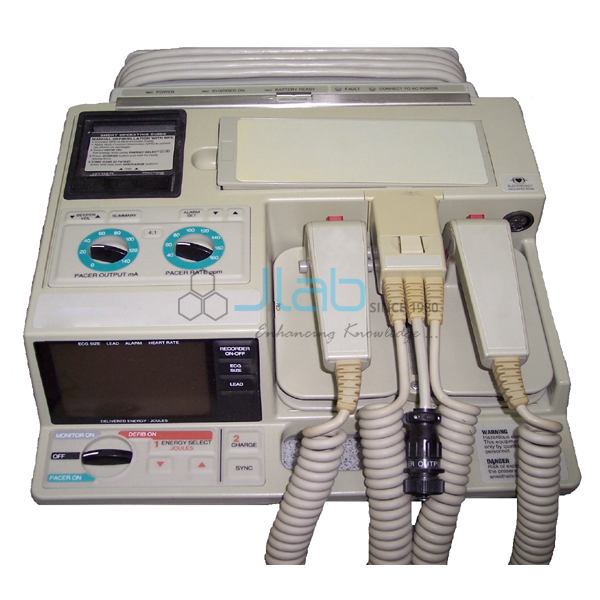
This defibrillator combines a shock unit with an external pacemaker in one case. Its energy control steps through set levels from 2 to 360 joules, it charges in less than 10 seconds and its CRT monitor shows the energy delivered. The pacer works in demand mode, or at a fixed rate when no ECG leads are connected. JLab supplies this unit from Ambala, India.
Specifications
| Pacemaker type | VVI demand; asynchronous (fixed rate) when used without ECG leads |
| Pacing pulse | Rectilinear, constant current, 40 ms |
| Pulse amplitude | Variable up to 140 mA |
| Pacing rate | Variable, 30–180 PPM |
| Pacer output | Defibrillator-protected and isolated |
| Pacer on indication | Message on the monitor |
| Selectable energy steps | 2, 3, 5, 7, 10, 20, 30, 50, 100, 150, 200, 300 and 360 J |
| Charge time | Less than 10 seconds |
| Energy display | Delivered energy shown on the CRT monitor |
| Minimum order quantity | 1 unit |
| Dispatch time | Usually 7–10 working days |
| Supplied by | JLab (Jain Laboratory Instruments Pvt Ltd), Ambala, India |
Biomedical Lab Exercises with the Pacer
Biomedical engineering students connect the pacer output to a resistive test load and view the pulses on a Dual Trace Oscilloscope. They measure the pulse width against the 40 ms figure, check that the pulse is flat-topped, and see how the pulse rate follows the rate control. The load resistor is first measured with a Digital Multimeter so the current can be worked out from the voltage seen on the screen.
For the defibrillator side, the tutor shows the charge cycle into a test load. Students time how long the unit takes to charge and read the delivered energy on the monitor. Each check goes into the equipment log.
Frequently Asked Questions
What is the difference between demand and fixed-rate pacing?
In demand mode the pacer watches the ECG and paces only when the heart rate drops below the set rate. Used without ECG leads, it cannot sense, so it paces at a fixed rate. Mode and settings are chosen by trained staff under the hospital protocol.
What do the rate and current controls set?
The rate control sets how many pulses per minute the pacer gives, from 30 to 180. The current control sets the strength of each pulse, up to 140 mA. These controls only set the output, and the values used are a clinical decision.
How do I know the pacer is switched on?
A message appears on the monitor while the pacer is on. In a training check on a test load, the pulses also show on an oscilloscope, which confirms that the output is reaching the leads.
What does the energy display show?
After a discharge the CRT monitor shows the energy that was delivered. In a function check, students compare that figure with the reading from a defibrillator analyser on the test load.
Why might the unit take too long to charge?
It is built to charge in less than 10 seconds. A slower charge points to a fault in the power supply or high-voltage section. Take the unit out of use and have a trained technician test it.
Other Defibrillators
For a quote, use Add To Cart or send us a message through the contact page.
Last updated: 20 November 2026