Casting Tray 7 x 14cm Manufacturer,Supplier and Exporter in India
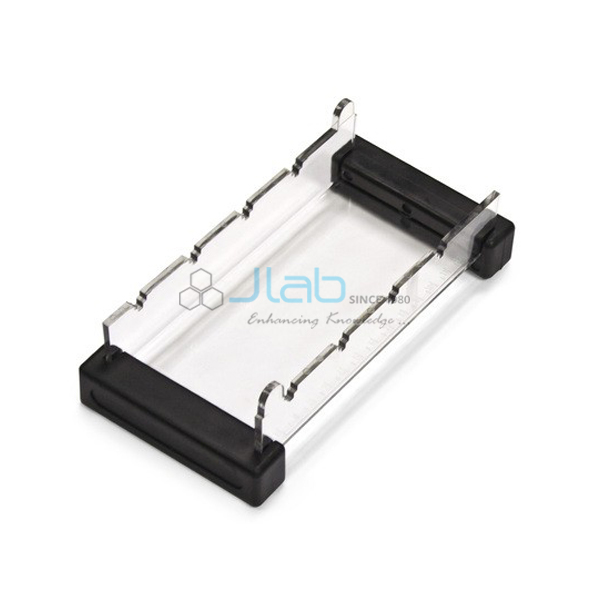
Product Code : EL-LE-8235
Jlab Export is a leading Casting Tray 7 x 14cm Manufacturer,and suppliers in India
Casting Tray 7 x 14cm (code EL-LE-8235) is a gel casting tray for electrophoresis, measuring 7 x 14 cm, in which the gel is poured and set before a run. An embossed gel ruler is moulded into the tray, and each tray comes with two rubber end caps for sealing it during casting. It serves school biotechnology practicals and college teaching labs, and is manufactured by Jain Laboratory Instruments Pvt Ltd (JLab) in Ambala, India.
Specifications
| Parameter | Detail |
|---|---|
| Product type | Gel casting tray for electrophoresis |
| Size | 7 x 14 cm |
| Gel ruler | Embossed on the tray |
| End caps | Two rubber end caps with each tray |
| Quality check | Each tray is visually inspected before dispatch |
| Pack quantity | Each (one tray with its two rubber end caps) |
| Minimum order quantity | 10 units |
| Dispatch time | Usually 7–10 working days |
| Product code | EL-LE-8235 |
| Manufacturer | Jain Laboratory Instruments Pvt Ltd (JLab) — OEM |
| Country of origin | India (made in Ambala, Haryana) |
What Is a Gel Casting Tray Used For?
The casting tray is the mould that gives an electrophoresis gel its shape. With the rubber end caps closing its open ends, the tray holds the molten gel while it sets around a comb; the caps are then taken off so that buffer and current can pass through the gel during the run. After staining, the embossed ruler gives a scale for reading how far each DNA band has travelled, which students use to compare fragment sizes with a marker lane. Trays of this kind are used wherever horizontal gel electrophoresis is taught — class 12 biotechnology topics in schools and molecular biology courses in colleges and universities.
Frequently Asked Questions
What size is this casting tray?
It is 7 x 14 cm, with a gel ruler embossed on the tray.
What are the rubber end caps for?
They close the two open ends of the tray so the gel can be poured and left to set without leaking. Two end caps come with each tray.
What details should an export enquiry include?
The number of trays, the destination country and port or city, preferred delivery terms such as FOB or CIF, packing or labelling instructions, and the tender reference where there is one.
Who manufactures this casting tray?
Jain Laboratory Instruments Pvt Ltd (JLab) makes it at Ambala in Haryana, India, and handles enquiries for it directly.
OEM Manufacturer
JLab is the trading name of Jain Laboratory Instruments Pvt Ltd, an Ambala-based maker of school and laboratory science equipment, incorporated in 2017, with premises on Hargolal Road, Ambala, Haryana. The casting tray is produced in JLab’s own works instead of being sourced from a trader, so institutions, dealers and importers buy factory-direct and each tray is visually inspected before it is dispatched. JLab exports worldwide and ships to buyers in every region — for example DR Congo in Central Africa, Hong Kong in East Asia, Portugal in Southern Europe, Eswatini in Southern Africa and Maldives in South Asia. Tender information is on the JLab lab tenders page.
Other Items for Gel Electrophoresis
- 6 Tooth Gel Comb — a replacement comb that forms six sample wells.
- Double Comb 8/10 — a replacement double gel comb with two tooth counts.
- Electrophoresis Dual Station — a horizontal electrophoresis station for classroom groups, with a cover safety stop.
- Horizontal Gel Electrophoresis System — a submerged-gel unit moulded in transparent polycarbonate, for nucleic acid work in colleges and research institutes.
- Power Supply (for one or two electrophoresis cells) — a power source that can run one or two cells.
These are separate items that can be quoted on the same enquiry. The full Laboratory Equipment section and the wider Laboratory Supplies range list more.
Request a Quote
Use the Add To Cart enquiry button on this page to request a quotation, or write through the contact page with the number of trays, any combs or other spares, and where they should be delivered.
Last updated: 15 October 2026