Double Comb 8/10 Manufacturer,Supplier and Exporter in India

Product Code : EL-LE-8234
Jlab Export is a leading Double Comb 8/10 Manufacturer,and suppliers in India
Double Comb 8/10 (code EL-LE-8234) is a replacement double gel comb for electrophoresis units, used to mould the sample wells in a gel during DNA electrophoresis practicals. A double comb carries a row of teeth on each edge — on this one, 8 and 10 — so a single comb lets the teacher cast gels with either eight or ten wells. JLab (Jain Laboratory Instruments Pvt Ltd) makes it at Ambala, India.
Specifications
| Parameter | Detail |
|---|---|
| Product type | Replacement double gel comb for electrophoresis units |
| Tooth arrangement | 8/10 (double comb: 8 teeth on one edge, 10 on the other) |
| Quality check | Each comb is visually inspected before dispatch |
| Pack quantity | Each (sold individually) |
| Minimum order quantity | 10 units |
| Dispatch time | Usually 7–10 working days |
| Product code | EL-LE-8234 |
| Manufacturer | Jain Laboratory Instruments Pvt Ltd (JLab) — OEM |
| Country of origin | India (made in Ambala, Haryana) |
What Is a Double Gel Comb Used For?
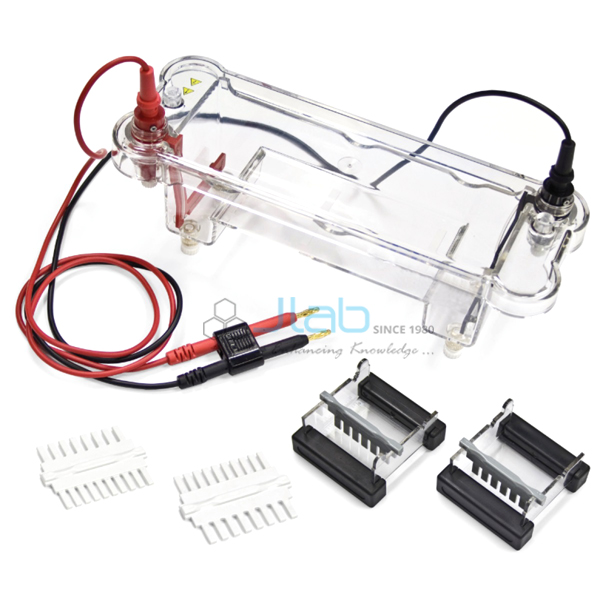
The comb sits across the casting tray while the gel sets; when it is pulled out, each tooth leaves a well for loading a sample. In the run, negatively charged DNA migrates through the gel towards the positive electrode, and smaller fragments travel further than larger ones. The 10-tooth edge suits classes with more samples per gel. Gel electrophoresis of this kind supports the biotechnology topics of class 12 biology and the molecular biology practicals of colleges, universities and research institutes.
Frequently Asked Questions
What does 8/10 mean on this gel comb?
It gives the two tooth counts of the double comb: one edge has 8 teeth and the other has 10, so the comb casts a gel with either eight or ten wells depending on which edge is used.
How does it compare with the 6 Tooth Gel Comb?
The 6 Tooth Gel Comb is a single comb that forms six wells. This double comb offers two well counts in one part, with more lanes per gel on either edge.
What should an export enquiry for spare combs include?
The number of combs, the destination country and port or city, the delivery terms you want (for example FOB or CIF), packing or labelling requirements, and any tender reference.
Who makes the Double Comb 8/10?
JLab — Jain Laboratory Instruments Pvt Ltd — manufactures it in Ambala, Haryana, India, and supplies it direct.
OEM Manufacturer
Behind the JLab name is Jain Laboratory Instruments Pvt Ltd, a manufacturer of laboratory and educational science equipment in India, incorporated in 2017 and working from Hargolal Road, Ambala, Haryana. Spares like this double comb are produced in its own works, not resold from a trading house, so schools, colleges, dealers and importers buy direct from the maker and can reorder further spares from the same source. JLab exports worldwide, with shipments possible to every region — for example Iraq in the Middle East, Taiwan in East Asia, Maldives in South Asia, Switzerland in Western Europe and Sudan in North Africa. Buyers working through a tender can refer to the lab tenders page.
Related Electrophoresis Items
- 6 Tooth Gel Comb — a single replacement comb that forms six sample wells.
- Casting Tray 7 x 14cm — a gel casting tray with an embossed gel ruler and rubber end caps.
- Electrophoresis Classroom Kit — a classroom set built around a leak-proof, UV-transparent acrylic chamber with a safety stop.
- Electrophoresis Apparatus — a horizontal unit that runs two gel trays at once on adjustable levelling feet.
- Power Supply (for one or two electrophoresis cells) — a power source for running gels in one cell or two cells together.
Each linked item is a separate catalogue entry that can be quoted on the same enquiry. See the full Laboratory Equipment listing or the broader Laboratory Supplies range.
Request a Quote
Ask for a quotation with the Add To Cart enquiry button on this page, or send the number of combs, any other spares and the delivery location through the contact page.
Last updated: 15 October 2026