
Cathode Ray Oscilloscope Manufacturer,Supplier and Exporter in India
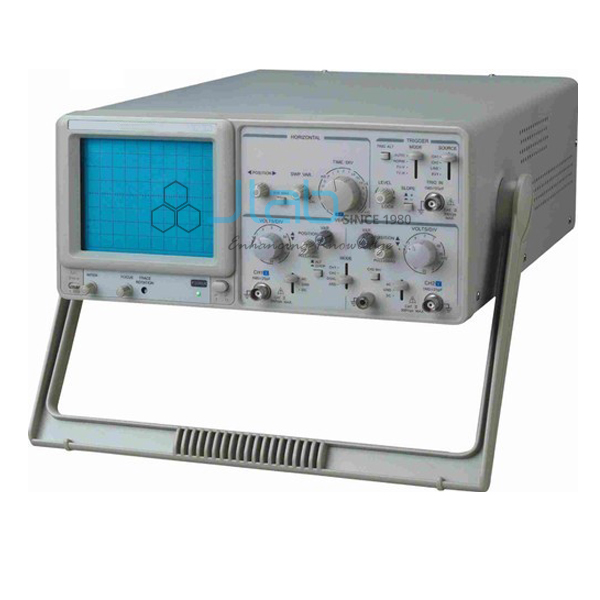
Product Code : EL-SLE-4778
Jlab Export is a leading Cathode Ray Oscilloscope Manufacturer,and suppliers in India
Cathode Ray Oscilloscope (code EL-SLE-4778) is a CRO used in general physics and electronics labs to display and analyse voltage signals over a wide range of frequencies, helping students understand the fundamentals of electric circuits and electricity. It is offered in versions that measure signals up to 10 MHz, 20 MHz or 30 MHz, so schools, colleges and training institutes can match the bandwidth to their work. It is made by Jain Laboratory Instruments Pvt Ltd (JLab) at its works in Ambala, India.
Specifications
| Parameter | Detail |
|---|---|
| Type | Cathode ray oscilloscope (CRO) |
| Signal measurement | Up to 10 MHz, 20 MHz or 30 MHz, depending on the version ordered |
| Function | Displays and analyses voltage signals over a wide range of frequencies |
| Use | General laboratory work and teaching the fundamentals of electric circuits |
| Quality check | Each oscilloscope is visually inspected before dispatch |
| Pack quantity | Each (sold individually) |
| Minimum order quantity | 10 units |
| Dispatch time | Usually 7–10 working days |
| Product code | EL-SLE-4778 |
| Manufacturer | Jain Laboratory Instruments Pvt Ltd (JLab) — OEM |
| Country of origin | India (made in Ambala, Haryana) |
How Does It Compare with Other JLab Oscilloscopes?
| Model | Bandwidth | Other listed details |
|---|---|---|
| This CRO (EL-SLE-4778) | 10, 20 or 30 MHz versions | General lab use; analysis of voltage signals over a wide frequency range |
| Dual Trace Oscilloscope | 20 MHz | Dual channel; 80 x 100 mm cathode ray tube; external trigger and Z-axis modulation input |
| Demonstration Cathode Ray Oscilloscope CRO | — | Basic model on a printed phenolic board for studying how each section works; faults can be set with banana plugs or switches |
| Digital Storage Oscilloscope Dual Channel | 60 MHz | Digital storage; dual channel; colour TFT/LCD display |
Choose this CRO for everyday waveform measurement in teaching labs, picking the bandwidth to suit your signals. The dual-trace model is listed with two channels and a stated tube size, the demonstration CRO is for learning how an oscilloscope works inside, and the digital storage model captures and holds waveforms for higher-frequency work.
What Is the Cathode Ray Oscilloscope Used For?
An oscilloscope draws a graph of voltage against time, so students can see a signal instead of reading a single number from a meter. From the trace they measure peak voltage, read the period and work out the frequency, compare the phase of two signals, and form Lissajous figures to compare frequencies. In class 12 physics it is used to show the output of half-wave and full-wave rectifiers and the effect of a smoothing capacitor; in colleges, polytechnics and ITI electronics trades it is the standard instrument for checking amplifiers, oscillators and signal generators.
Choose a bandwidth comfortably above the highest frequency you want to view: a 10 MHz version covers audio-frequency and most school experiments, while the 20 MHz and 30 MHz versions leave room for faster electronics work. Never connect the input directly to the mains; observe mains-derived signals through a step-down transformer. Let the instrument warm up before measuring, keep its ventilation slots clear, and turn the trace intensity down when the display is idle.
What to Specify When Ordering
- Bandwidth — 10 MHz, 20 MHz or 30 MHz.
- Channels and probes — state how many channels you need and whether probes should be included, as the listing does not specify them.
- Power supply — give your local mains voltage and frequency for export orders.
- Quantity — the minimum order is 10 units; add a signal generator if each bench needs a signal source.
Frequently Asked Questions
What bandwidths are available?
The CRO is offered in versions that measure signals up to 10 MHz, 20 MHz or 30 MHz. Say which one you need in your enquiry.
Which bandwidth suits a school physics lab?
For audio-frequency work, rectifier experiments and most school practicals, the 10 MHz version is usually enough. Colleges and electronics courses working with faster signals often choose 20 MHz or 30 MHz.
How many channels does it have, and are probes supplied?
Neither is stated in this listing. Tell JLab how many channels you need and whether probes should be included, and confirm both in the quotation.
How does it differ from the demonstration CRO?
This instrument is for measuring and analysing signals. The demonstration CRO is a basic model on a printed board for studying how each section of an oscilloscope works, with faults that can be created using plugs or switches.
Who manufactures this oscilloscope?
JLab — Jain Laboratory Instruments Pvt Ltd — makes it at its works in Ambala, Haryana, India, and quotes for it directly as the manufacturer.
OEM Manufacturer
JLab is the trading name of Jain Laboratory Instruments Pvt Ltd, a manufacturer of physics and electronics laboratory instruments in India, incorporated in 2017 and based on Hargolal Road, Ambala, Haryana. This CRO is produced at JLab’s own works and not sourced from a trader, so schools, colleges, dealers and importers buy it factory-direct, each instrument is visually inspected before dispatch, and repeat orders are handled by the manufacturer. JLab exports worldwide and ships to buyers in every region — for example Tonga in Oceania, North Macedonia in Southern Europe, France in Western Europe, Mexico in North America and Mongolia in East Asia. For tenders, see the JLab lab tenders page.
Related Oscilloscopes and Signal Sources
- Frequency Signal Generator — a bench source of sine, square and triangular waves to view on the CRO.
- Audio Signal Generator — an AF oscillator for audio-frequency experiments.
- Dual Trace Oscilloscope — a dual-channel analog oscilloscope.
- Demonstration Cathode Ray Oscilloscope CRO — for teaching how an oscilloscope works section by section.
- Digital Storage Oscilloscope Dual Channel — a digital storage model with colour display.
See more items in the School Lab Equipment range.
Request a Quote
Quotes come direct from the manufacturer. Use the Add To Cart enquiry button on this page, or send the bandwidth, number of channels, quantity (minimum 10 units) and your delivery location through the contact page.
Last updated: 4 October 2026