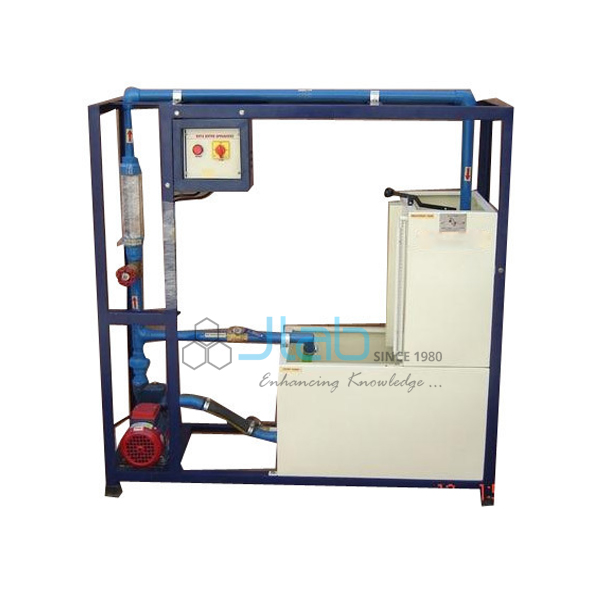
Deionizer Manufacturer,Supplier and Exporter in India

Product Code : EL-ELA-5493
Jlab Export is a leading Deionizer Manufacturer,and suppliers in India
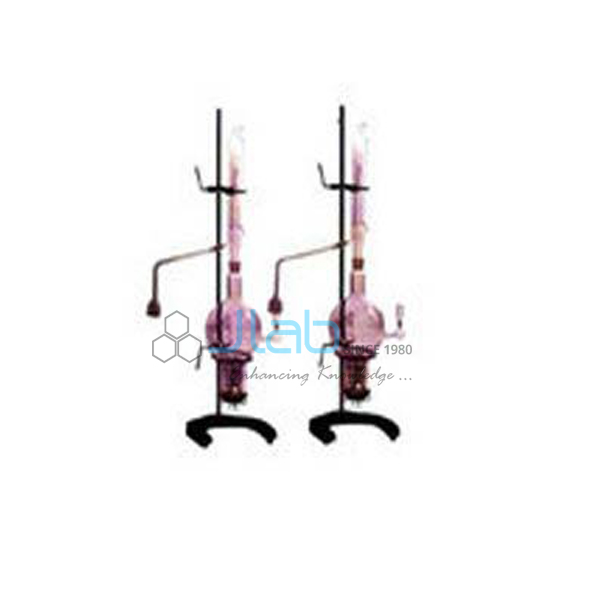
Deionizer (code EL-ELA-5493) is a two-column ion-exchange plant that produces demineralised water for laboratories, with one cation exchanger column and one anion exchanger column on a mild steel stand. A direct-reading conductivity meter with cell monitors the purified water, and the plant is listed in 30–50 and 75–100 litres-per-hour versions. It is made by Jain Laboratory Instruments Pvt Ltd (JLab) at its works in Ambala, India.
Specifications
| Parameter | Detail |
|---|---|
| Type | Deionizer (ion exchanger), two-column |
| Cation column | One column containing cation exchange resin |
| Anion column | One column containing anion exchange resin |
| Mounting | Mild steel (M.S.) stand with an assembly of valves and tubing |
| Water quality monitoring | Direct-reading conductivity meter with cell, to monitor the ionised solids in the purified water and control demineralisation |
| Capacity (flow rate) | 30 to 50 litres per hour, or 75 to 100 litres per hour |
| Quality check | Each plant is visually inspected before dispatch |
| Pack quantity | Each (sold individually) |
| Minimum order quantity | 10 units |
| Dispatch time | Usually 7–10 working days |
| Product code | EL-ELA-5493 |
| Manufacturer | Jain Laboratory Instruments Pvt Ltd (JLab) — OEM |
| Country of origin | India (made in Ambala, Haryana) |
How Does It Compare with Other JLab Water Purification Units?
| Model | Method | Output and monitoring (as listed) |
|---|---|---|
| This deionizer (EL-ELA-5493) | Separate cation and anion exchanger columns on an M.S. stand | 30–50 or 75–100 litres per hour; conductivity meter with cell |
| Deionised Water Apparatus | Monobed deionizer with disposable cartridge | Maximum flow 227 litres per hour; colour-coded resistivity indicator |
| Double Stage Glass Distillation | All-glass two-stage still | Double-distilled water; automatic water-level arrangement |
Choose this deionizer when you want a two-column plant with its own conductivity meter and a choice of two flow-rate versions. The cartridge-type apparatus suits labs that prefer replacing a cartridge, and the glass still is the option when the method calls for double-distilled rather than deionised water.
What Is the Deionizer Used For?
As water passes through the cation resin, dissolved cations such as calcium, magnesium and sodium are exchanged for hydrogen ions; the anion resin then exchanges anions such as chloride, sulphate and bicarbonate for hydroxide ions, and the hydrogen and hydroxide ions combine to form water. The result is demineralised water, and because dissolved ions carry current, the conductivity meter shows how well the resins are still removing them.
Demineralised water is used to prepare reagents, standard solutions, buffers and media, for the final rinse of washed glassware, and as feed water for equipment such as water baths, autoclaves and stills. The plant suits chemistry and biology teaching labs in schools, colleges and universities, as well as pharmacy, food-testing and research laboratories.
What to Specify When Ordering
- Flow-rate version — 30 to 50 or 75 to 100 litres per hour, based on your daily demand.
- Quantity — the minimum order is 10 units.
- Feed water — tell us whether the plant will run on municipal tap water or borewell water.
- Other items — a separate conductivity meter or a glass distillation unit can be quoted on the same enquiry.
Frequently Asked Questions
How does the deionizer purify water?
By ion exchange in two columns: cation exchange resin in the first removes dissolved cations and anion exchange resin in the second removes dissolved anions, giving demineralised water.
What flow rates are available?
Two versions are listed, one with a capacity of 30 to 50 litres per hour and one with 75 to 100 litres per hour.
How is the purified water checked?
A direct-reading conductivity meter with cell is part of the plant. It monitors the ionised solids remaining in the purified water so the demineralisation can be controlled.
Is deionised water the same as distilled water?
Not exactly. Deionisation removes dissolved ions but not uncharged impurities such as many organic compounds or microorganisms, while distillation boils and condenses the water and leaves most non-volatile impurities behind. Many labs use deionised water for routine work and distilled or double-distilled water where a method specifies it.
How is it different from the Deionised Water Apparatus?
That unit is listed as a monobed deionizer with a disposable cartridge and a colour-coded resistivity indicator. This deionizer has separate cation and anion columns on a mild steel stand with valves, tubing and a conductivity meter.
What should an export enquiry include?
The version and quantity, the destination country and port or city, delivery terms such as FOB or CIF, any packing or labelling requirements and a tender reference if relevant.
Who manufactures this deionizer?
Jain Laboratory Instruments Pvt Ltd (JLab) makes it at its works in Ambala, Haryana, India.
OEM Manufacturer
JLab is the trading name of Jain Laboratory Instruments Pvt Ltd, a laboratory apparatus manufacturer in India, incorporated in 2017 and based on Hargolal Road, Ambala, Haryana. The deionizer is assembled at JLab’s own works, not bought in from a trader, so schools, colleges, dealers and importers buy it factory-direct, each plant is visually inspected before dispatch, and spares and repeat orders are handled by the manufacturer. JLab exports worldwide and ships to buyers in every region — for example Turkmenistan in Central Asia, Ireland in Western Europe, Sri Lanka in South Asia, Vietnam in Southeast Asia and Benin in West Africa. Tender information is on the JLab lab tenders page.
Water Purification and Testing Equipment
- Deionised Water Apparatus — a monobed cartridge deionizer with a colour-coded resistivity indicator.
- Double Stage Glass Distillation — an all-glass two-stage still for double-distilled water.
- Water Purification System — a compact system fed by tap water, with a 30-litre reservoir, for laboratory-grade water.
- Digital Conductivity Meter (3½-digit LED, five ranges) — a bench meter for measuring the conductivity of solutions.
Browse more items in Educational Laboratory Apparatus or the wider Laboratory Apparatus range.
Request a Quote
For a quotation, use the Add To Cart enquiry button on this page or the contact page, and give the flow-rate version, the number of plants and the delivery destination.
Last updated: 15 October 2026