Dicot Woody Stem Model Manufacturer,Supplier and Exporter in India
Product Code : EL-PE-7554
Jlab Export is a leading Dicot Woody Stem Model Manufacturer,and suppliers in India
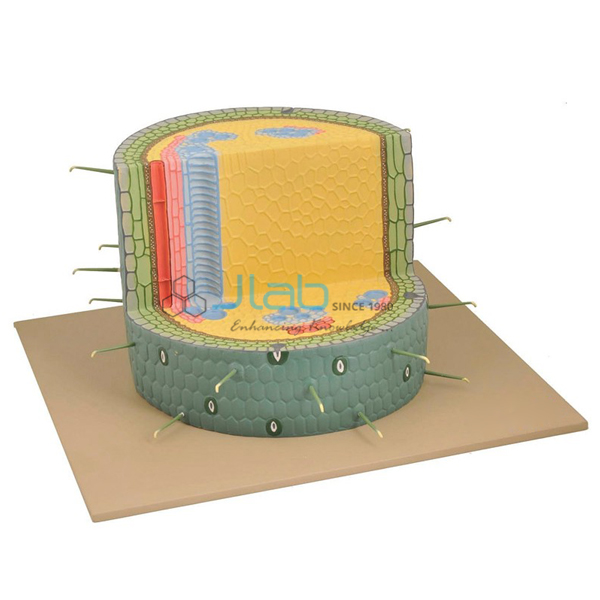
Dicot Woody Stem Model (code EL-PE-7554) is a botany model of the stem of a dicot plant that has become woody, listed with bean (Phaseolus vulgaris) as the plant represented and an approximate size of 340 x 340 x 260 mm. It supports lessons on secondary growth in school and college botany. Jain Laboratory Instruments Pvt Ltd (JLab) manufactures it at its works in Ambala, India.
Specifications
| Parameter | Detail |
|---|---|
| Subject | Woody stem of a dicot plant |
| Plant represented | Bean (Phaseolus vulgaris), as listed |
| Size | Approx. 340 x 340 x 260 mm |
| Quality check | Each model is visually inspected before dispatch |
| Pack quantity | Each (sold individually) |
| Minimum order quantity | 10 units |
| Dispatch time | Usually 7–10 working days |
| Product code | EL-PE-7554 |
| Manufacturer | Jain Laboratory Instruments Pvt Ltd (JLab) — OEM |
| Country of origin | India (made in Ambala, Haryana) |
What Is the Dicot Woody Stem Model Used For?
A young dicot stem has only primary tissues, but as the plant grows the vascular cambium starts to divide, adding secondary xylem (wood) towards the inside and secondary phloem towards the outside, while a cork cambium in the outer layers forms the protective periderm, or bark, with lenticels for gas exchange. Secondary growth is a core topic in college plant anatomy and appears in senior school syllabuses that cover stem structure in depth. A model at roughly 340 mm across helps teachers explain the change from the primary to the woody stem before students look at real sections, and it pairs well with a primary dicot stem model for comparison.
What to Specify When Ordering
- Quantity — minimum 10 units.
- Confirmation of the plant represented and of the labelled tissues, if your syllabus or tender names a particular specimen.
- Any companion stem models or charts for the same consignment.
Frequently Asked Questions
What size is the Dicot Woody Stem Model?
Approximately 340 x 340 x 260 mm. Weight is not stated in the listing.
Which plant does the model represent?
The listing names bean (Phaseolus vulgaris). Common bean is usually grown as a herbaceous annual, so confirm with JLab that the specimen suits your course before ordering.
What is the difference between a woody and a primary dicot stem?
A primary stem has a ring of vascular bundles with a thin strip of cambium in each. In a woody stem that cambium has produced layers of secondary xylem and phloem, and a cork cambium has formed bark on the outside.
Who manufactures it?
JLab (Jain Laboratory Instruments Pvt Ltd), at its own works in Ambala, Haryana, India.
OEM Manufacturer
JLab is the trading name of Jain Laboratory Instruments Pvt Ltd, an Indian manufacturer of plant anatomy models and school science lab equipment, incorporated in 2017 and based on Hargolal Road, Ambala, Haryana. Models like this one are made in JLab’s own works rather than traded, which lets schools, colleges, dealers and importers buy factory-direct and come back to the maker for repeat orders. JLab exports worldwide and ships to buyers in every region — for example the USA in North America, Morocco in North Africa, Sri Lanka in South Asia, Uzbekistan in Central Asia and DR Congo in Central Africa. Tender buyers can refer to the JLab lab tenders page.
Related Stem Models and Aids
- Dicot Stem T.S. Model — the primary dicot stem in transverse section, with its tissues and vascular bundles.
- Dicotyledon Stem Model — a one-year sunflower stem showing cork layer, phloem, cambium, xylem and pith.
- The Stem of a Flowering Plant — includes basswood stems of different ages, an annual ring and a lenticel.
- T.S. Dicot Stem Chart — a laminated wall chart of a dicot stem section.
Browse Plant Equipment or all Biology Lab Equipment.
Request a Quote
Quotations come straight from the manufacturer. Use the Add To Cart enquiry button on this page, or send the quantity (minimum 10 units), any specimen requirement and your destination through the contact page.
Last updated: 4 October 2026