Digital Multi Meter Manufacturer,Supplier and Exporter in India

Product Code : EL-SLE-5795
Jlab Export is a leading Digital Multi Meter Manufacturer,and suppliers in India
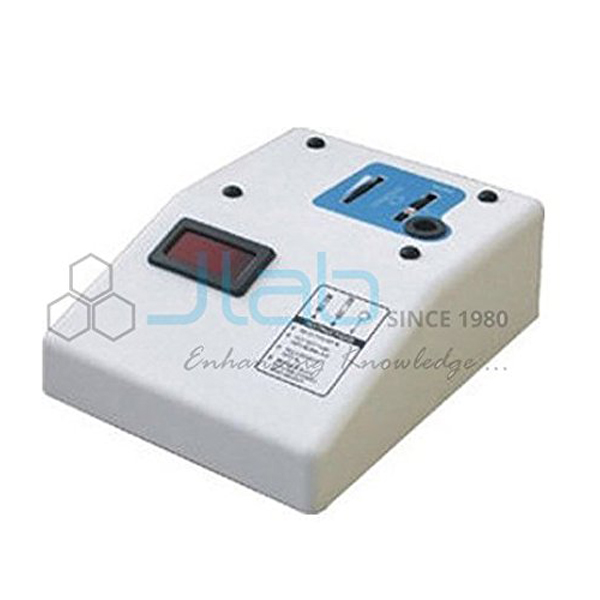
Digital Multi Meter (code EL-SLE-5795) is a hand-held test meter that can be quickly set to work as a voltmeter, an ammeter or an ohmmeter, for electricity practicals in school, college and ITI labs. A rotating multi-position switch selects the function, readings appear on an LCD digital display, and the test leads plug into three sockets on the front. It is made by Jain Laboratory Instruments Pvt Ltd (JLab) at its works in Ambala, India.
Specifications
| Parameter | Detail |
|---|---|
| Functions | Voltmeter, ammeter and ohmmeter |
| Selector | Rotating multi-position switch |
| Display | LCD (liquid crystal display), digital |
| Lead sockets | Three, on the front |
| Quality check | Each meter is visually inspected before dispatch |
| Pack quantity | Each (sold individually) |
| Minimum order quantity | 10 units |
| Dispatch time | Usually 7–10 working days |
| Product code | EL-SLE-5795 |
| Manufacturer | Jain Laboratory Instruments Pvt Ltd (JLab) — OEM |
| Country of origin | India (made in Ambala, Haryana) |
How Does It Compare with Other JLab Multimeters?
| Meter | Display | Listed functions and features |
|---|---|---|
| This meter (EL-SLE-5795) | LCD digital | Voltmeter, ammeter, ohmmeter; rotary multi-position switch; three front sockets |
| Digital Multimeter | Digital | 9 V battery; 7 functions, 19 ranges: AC and DC voltage, DC current, resistance, diode, transistor (hFE), battery and continuity tests |
| Digital Multimeter (physics lab range) | 3½-digit LCD | Voltage, current and resistance with diode and continuity tests; single rotary dial |
| Multimeter, Analog | Analog pointer | Voltage, current and resistance (volt-ohm-milliammeter) |
Choose this meter for basic voltage, current and resistance measurements in student practicals; the other digital models list their ranges and extra tests such as diode, transistor and continuity, and the analog meter shows changes as a moving pointer.
What Is the Digital Multi Meter Used For?
One meter replaces a separate voltmeter, ammeter and ohmmeter at each bench. Students use it to measure the potential difference across a resistor, the current in a circuit and the resistance of a component in Ohm’s law and resistance experiments in class 10 and class 12, in college current electricity practicals and in ITI electrical trade training. The digital readout removes the scale-reading and parallax errors of a pointer meter.
Turn the switch to the function and, where there is a choice, the highest range before connecting, then step down for a more precise reading. Connect it in parallel to read voltage and in series to read current, moving the red lead to the correct socket — on most multimeters one socket is common, one serves voltage, resistance and small currents, and one is for higher currents; check the markings on your meter. Measure resistance only with the circuit switched off. Return the switch to OFF after use to save the internal battery, and replace the battery when the display weakens.
What to Specify When Ordering
- Quantity — the minimum order is 10 meters.
- Ranges — tell us the voltage, current and resistance ranges your practicals need so JLab can confirm the model.
- Test leads and battery — confirm whether leads and a battery are to be supplied with each meter.
- Circuit items — power supplies, rheostats and resistors for the same practical are separate catalogue items.
Frequently Asked Questions
What can the digital multi meter measure?
Voltage, current and resistance: the rotating switch sets it to work as a voltmeter, an ammeter or an ohmmeter, and the result is shown on the LCD display.
What ranges does it have?
The ranges are not stated in this listing. Send the ranges your experiments need and JLab will confirm them in the quotation; the other JLab digital multimeters list their ranges on their own pages.
Why are there three sockets?
Multimeters use separate sockets so the leads can be connected for different functions. Typically one is the common socket and the others serve voltage, resistance and small currents, or higher currents; follow the markings on the meter.
Are test leads included?
The listing describes the sockets for the leads but does not say whether leads are supplied. Confirm this in your enquiry.
How is it connected to measure current?
In series: break the circuit, put the meter into the gap, and use the current function and socket. Connecting a meter set to current directly across a supply can damage it.
Who manufactures this digital multi meter?
Jain Laboratory Instruments Pvt Ltd, trading as JLab, makes it at its works in Ambala, Haryana, India, and quotes for it directly as the manufacturer.
OEM Manufacturer
JLab is the trading name of Jain Laboratory Instruments Pvt Ltd, a manufacturer of electrical measuring instruments and school laboratory equipment in India, incorporated in 2017 and based on Hargolal Road, Ambala, Haryana. The meter comes from JLab’s own works rather than a trader, so schools, colleges, dealers and importers buy factory-direct, each unit is visually inspected before dispatch, and repeat orders are handled by the manufacturer. JLab exports worldwide and ships to buyers in every region — for example Lesotho in Southern Africa, Zambia in East Africa, Latvia in Northern Europe, Vietnam in Southeast Asia and the USA in North America. Tender details are on the JLab lab tenders page.
Electrical Measurement Apparatus
- Digital Multimeter — a 9 V battery meter with diode, transistor and continuity tests.
- Voltmeters Dual Range — dedicated voltmeters on a stand for class practicals.
- Digital Ammeter — a two-range ammeter with digital display.
- Power Supply — 0–12 V AC and DC in 2 V steps for circuit work.
- Rheostats (Nichrome Type) — variable resistors for Ohm’s law experiments.
See the full School Lab Equipment range.
Request a Quote
Quotes come direct from the manufacturer. Use the Add To Cart enquiry button on this page, or send the number of meters (minimum 10 units), the ranges you need, whether leads should be included, and your delivery location through the contact page.
Last updated: 4 October 2026