

Du Bois-Reymond Key Manufacturer,Supplier and Exporter in India
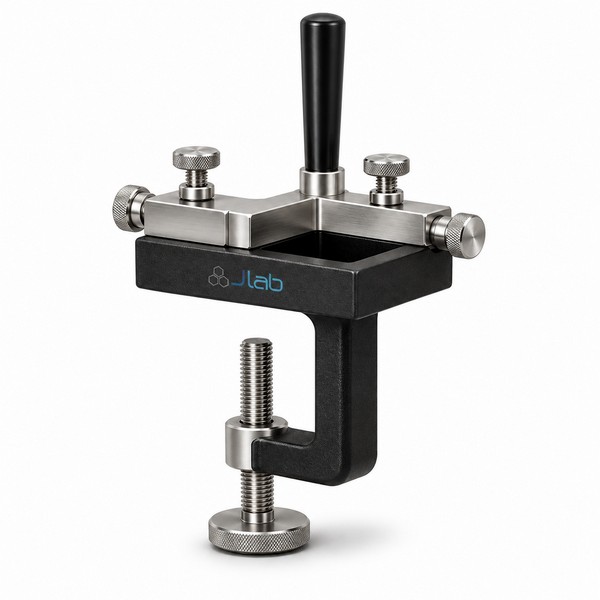
Product Code : EL-DRK-2400
Jlab Export is a leading Du Bois-Reymond Key Manufacturer,and suppliers in India
A Du Bois-Reymond key is a short-circuiting key used in the stimulating circuit of nerve and muscle experiments. While the key is closed, induced shocks from the coil pass across it instead of through the tissue. Opening it lets the next shock reach the electrodes. This key is mounted on a vulcanite base and has a table clamp to hold it at the bench edge.
Specifications
| Base | Vulcanite |
| Mounting | Table clamp |
| Minimum order quantity | 10 units |
| Dispatch time | Usually 4–6 working days |
| Manufacturer | JLab (Jain Laboratory Instruments Pvt Ltd), Ambala, India |
Nerve-Muscle Practicals Using the Key
In the classic twitch practical, the key is wired across the two leads from the secondary coil of the Induction Coil, between the coil and a Simple Electrode. Students close the key, make the primary circuit, then open the key and break the circuit. Only the break shock reaches the muscle, and the twitch is written on a kymograph drum.
The same wiring serves for threshold and graded stimulus experiments, where the secondary coil is moved closer step by step. A Du Bois-Reymond key also comes in the Muscle Twitch Assembly and the Student Nerve-Muscle Assembly. Both group it with a coil, an electrode and recording parts.
Frequently Asked Questions
Where does the key go in the circuit?
Across the two leads of the secondary coil, between the induction coil and the electrodes. The key that makes and breaks the cell current, such as the Simple Key, goes in the primary circuit.
Why is it called a short-circuiting key?
Closing it joins the two secondary leads through a path of very low resistance. The induced current takes that path and almost none passes through the tissue, so the muscle stays at rest until the key is opened.
Should the key stay closed between recordings?
Yes. Keeping it closed while you move the coil or reset the lever stops stray shocks from reaching the tissue. The preparation then does not tire before the next recording.
Why does it have a table clamp?
The clamp grips the edge of the bench, so working the key does not drag the leads or shift the key during a recording. It also keeps the key in one place within reach beside the drum.
What should be checked if no shock reaches the tissue?
First check that the key is really open. Then look for loose terminal screws, dirty contacts and a broken lead. Cleaning the contact faces and tightening every terminal clears most faults in student circuits.
Other Stimulation Apparatus
- Student Induction Coil
- Variable Interrupter
- Plug Key (make-and-break key)
- Student Stimulator
For a quote, use Add To Cart or send us a message through the contact page.
Last updated: 6 November 2026