Gems Collection (Set of 20) Manufacturer,Supplier and Exporter in India
Product Code : EL-ERAM-4383
Jlab Export is a leading Gems Collection (Set of 20) Manufacturer,and suppliers in India
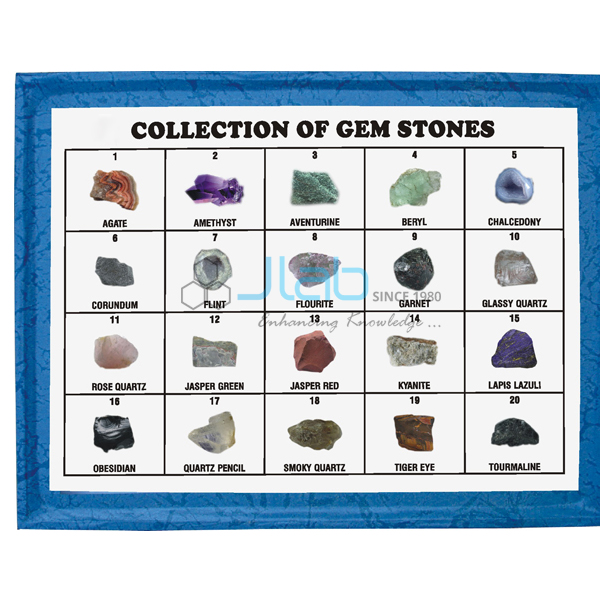
Gems Collection (Set of 20) (code EL-ERAM-4383) is a set of 20 types of gem mineral specimens — from amethyst, rose quartz and tiger eye to beryl, corundum, garnet and tourmaline — used in school and college geology and earth science lessons, gemmology introductions and museum-style displays to show the minerals behind familiar gemstones. Jain Laboratory Instruments Pvt Ltd (JLab) prepares the collection at its works in Ambala, India.
Specifications
| Parameter | Detail |
|---|---|
| Contents | 20 types of gem mineral specimens |
| Specimens listed | Agate, amethyst, aventurine, beryl, chalcedony, corundum, flint, fluorite, garnet, glassy quartz, green jasper, red jasper, kyanite, lapis lazuli, obsidian, quartz pencil, rose quartz, smoky quartz, tiger eye and tourmaline (the listing says “some of the following”) |
| Quality check | Each collection is visually inspected before dispatch |
| Pack quantity | One collection of 20 specimens |
| Minimum order quantity | 10 units |
| Dispatch time | Usually 7–10 working days |
| Product code | EL-ERAM-4383 |
| Manufacturer | Jain Laboratory Instruments Pvt Ltd (JLab) — OEM |
| Country of origin | India (made in Ambala, Haryana) |
How the Specimens Group Together
| Group | Specimens in the list | Teaching point |
|---|---|---|
| Quartz and other forms of silica | Agate, amethyst, aventurine, chalcedony, flint, glassy quartz, green and red jasper, quartz pencil, rose quartz, smoky quartz, tiger eye | One mineral family can look completely different in colour, transparency and texture |
| Other gem minerals | Beryl, corundum, fluorite, garnet, kyanite, tourmaline | Beryl includes emerald and aquamarine; corundum includes ruby and sapphire |
| A rock and a natural glass | Lapis lazuli, obsidian | Lapis lazuli is a rock made mainly of lazurite; obsidian is volcanic glass, not a mineral |
What Is the Gems Collection Used For?
Most students know gemstones by their trade names, not as minerals. This collection makes the link: more than half of the listed specimens are varieties of quartz or other forms of silica, which shows how traces of other elements, inclusions and grain size can change one mineral’s colour and appearance, while beryl and corundum show that emerald, aquamarine, ruby and sapphire are coloured varieties of common minerals. Kyanite is a classroom curiosity because its hardness differs with direction, tourmaline crystals often show more than one colour, and obsidian breaks with the smooth, curved conchoidal fracture typical of glass.
The set supports rocks-and-minerals topics in secondary-school geography and science, college geology and earth science practicals, introductory gemmology courses and teacher training, and it makes an attractive display for a school science room. Handle obsidian and flint with care, as their broken edges can be very sharp.
What to Specify When Ordering
- Quantity — the minimum order is 10 collections.
- Specimen list — the listing names the specimens as “some of the following”, so confirm the final list with your quotation.
- Specimen form — ask whether rough or tumbled specimens suit your lessons or display.
Frequently Asked Questions
Which gems are in the collection?
The listing names agate, amethyst, aventurine, beryl, chalcedony, corundum, flint, fluorite, garnet, glassy quartz, green and red jasper, kyanite, lapis lazuli, obsidian, quartz pencil, rose quartz, smoky quartz, tiger eye and tourmaline. Confirm the final list with your quotation.
Are these cut gemstones?
The listing describes them as gem mineral specimens and does not say whether they are rough, tumbled or cut. Ask JLab about the specimen form when you enquire.
Why are so many of the specimens forms of quartz?
Quartz and related silica minerals occur in many colours and textures, from purple amethyst and pink rose quartz to banded agate and opaque jasper, which makes them ideal for showing how a single mineral can look very different.
Who manufactures this collection?
JLab, the trading name of Jain Laboratory Instruments Pvt Ltd, prepares it at its works in Ambala, Haryana, India, and supplies it direct.
OEM Manufacturer
JLab is the trading name of Jain Laboratory Instruments Pvt Ltd, an educational lab equipment manufacturer in India, incorporated in 2017 and based on Hargolal Road, Ambala, Haryana. The gems collection is put together at JLab’s own works rather than bought from a trader, so schools, colleges, dealers and importers buy from the maker itself; each collection is inspected by eye before dispatch, and repeat orders are handled by the same team. JLab exports worldwide and ships to buyers in every region — for example Austria in Western Europe, DR Congo in Central Africa, Belize in Central America and the Caribbean, Brazil in South America and Lesotho in Southern Africa. Tender buyers can see the JLab lab tenders page.
Related Mineral Collections
- Minerals Colour Collection (Set of 10) — minerals in ten different colours, and why colour alone can mislead.
- Minerals Crystal Collection (Set of 15) — minerals representing the six crystal systems.
- Collection of 9 Mohs Hardness Set — the Mohs scale, including quartz, topaz and corundum.
- Minerals Fracture Collection (Set of 10) — minerals with conchoidal and other fractures.
See the Educational Rock and Minerals range or the Rocks and Minerals section.
Request a Quote
Quotes come direct from the manufacturer. Use the Add To Cart enquiry button, or send the number of collections (minimum 10 units), your preferred specimen form and your delivery location through the contact page.
Last updated: 9 October 2026