Minerals Crystal Collection (Set of 15) Manufacturer,Supplier and Exporter in India
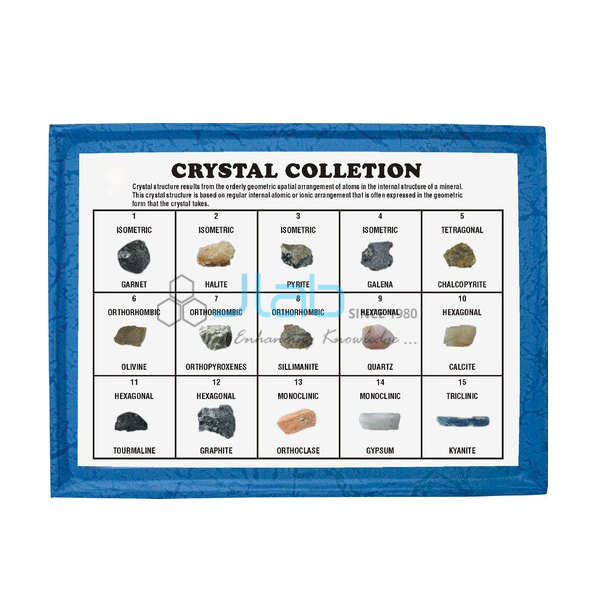
Product Code : EL-ERAM-4382
Jlab Export is a leading Minerals Crystal Collection (Set of 15) Manufacturer,and suppliers in India
Minerals Crystal Collection (Set of 15) (code EL-ERAM-4382) is a set of 15 mineral specimens that represent the six crystal systems — isometric, tetragonal, orthorhombic, hexagonal, monoclinic and triclinic — used in school and college geology, chemistry and earth science lessons to show how the orderly arrangement of atoms inside a mineral is expressed in the shape of its crystals. Jain Laboratory Instruments Pvt Ltd (JLab) prepares the collection at its works in Ambala, India.
Specifications
| Parameter | Detail |
|---|---|
| Contents | 15 mineral specimens |
| Property shown | Crystal structure and crystal form |
| Crystal systems covered | Isometric, tetragonal, orthorhombic, hexagonal, monoclinic and triclinic |
| Quality check | Each collection is visually inspected before dispatch |
| Pack quantity | One set of 15 specimens |
| Minimum order quantity | 10 units |
| Dispatch time | Usually 7–10 working days |
| Product code | EL-ERAM-4382 |
| Manufacturer | Jain Laboratory Instruments Pvt Ltd (JLab) — OEM |
| Country of origin | India (made in Ambala, Haryana) |
The Six Crystal Systems in the Set
| System | Crystal axes | Classic example (not necessarily in this set) |
|---|---|---|
| Isometric (cubic) | Three equal axes, all at right angles | Halite, galena, pyrite, garnet |
| Tetragonal | Three axes at right angles; two equal, one longer or shorter | Zircon, chalcopyrite |
| Orthorhombic | Three unequal axes, all at right angles | Olivine, topaz, barite |
| Hexagonal | Three equal axes in one plane, with a fourth axis of different length at right angles to them | Beryl, apatite |
| Monoclinic | Three unequal axes, one of them inclined | Gypsum, orthoclase |
| Triclinic | Three unequal axes, none at right angles | Plagioclase feldspar, kyanite |
In this six-system scheme, trigonal minerals such as quartz and calcite are grouped with the hexagonal system.
What Is the Minerals Crystal Collection Used For?
A crystal’s outward shape is the visible result of a regular internal arrangement of atoms or ions. Handling real specimens from each system helps students connect the diagrams in their textbooks — cubes, prisms and pyramids drawn on crystal axes — with minerals they can turn in their hands, and see why the same mineral tends to grow in the same form. The set supports crystallography and mineralogy practicals in college geology departments, rocks-and-minerals topics in secondary-school geography and chemistry, and teacher training. Pairing it with a ball-and-stick crystal model set lets students link a mineral’s external symmetry with the atomic structure inside, and with the cleavage directions that follow from it.
What to Specify When Ordering
- Quantity — the minimum order is 10 sets.
- Specimen list — ask for it with your quotation, including how many specimens represent each system.
- Models — add crystal structure model sets if you also teach atomic packing.
Frequently Asked Questions
Which crystal systems does the collection represent?
All six used in this scheme: isometric, tetragonal, orthorhombic, hexagonal, monoclinic and triclinic, spread across the 15 specimens.
What decides a mineral’s crystal system?
The orderly arrangement of atoms or ions inside the mineral. That internal structure sets the symmetry of the crystal, which is described by the lengths of its crystal axes and the angles between them.
Where is the trigonal system?
In the six-system scheme used for this set, trigonal minerals such as quartz and calcite are counted under the hexagonal system. Some textbooks list trigonal separately, giving seven systems.
Are the specimens named?
The listing does not name the minerals. Request the specimen list with your quotation if your syllabus calls for particular examples.
Who manufactures this collection?
Jain Laboratory Instruments Pvt Ltd, trading as JLab, prepares it at its works in Ambala, Haryana, India, and quotes for it directly.
OEM Manufacturer
JLab is the trading name of Jain Laboratory Instruments Pvt Ltd, a geology, chemistry and school lab equipment manufacturer in India, incorporated in 2017 and based on Hargolal Road, Ambala, Haryana. The crystal collection is made up at JLab’s own works rather than sourced from a trader, so schools, colleges, dealers and importers deal with the manufacturer directly; each set is visually inspected before dispatch and repeat orders are handled by the same works. JLab exports worldwide and ships to buyers in every region — for example Ireland in Western Europe, Honduras in Central America and the Caribbean, Nigeria in West Africa, Laos in Southeast Asia and the USA in North America. Tender buyers can refer to the JLab lab tenders page.
Related Crystal and Mineral Items
- Crystal Model Set — coloured jacks and connectors for building diamond, graphite and sodium chloride structures.
- Minerals Cleavage Collection (Set of 10) — minerals that split along planes set by their crystal structure.
- Gems Collection (Set of 20) — gem minerals including beryl, corundum, garnet and tourmaline.
- Collection of 9 Mohs Hardness Set — the Mohs scale minerals from talc to corundum.
- Hand Lens — for examining crystal faces and edges.
Browse the Educational Rock and Minerals range or the Rocks and Minerals section.
Request a Quote
Quotes come direct from the manufacturer. Use the Add To Cart enquiry button, or send the number of sets (minimum 10 units), any model sets and your delivery location through the contact page.
Last updated: 9 October 2026