Minerals Cleavage Collection (Set of 10) Manufacturer,Supplier and Exporter in India
Product Code : EL-ERAM-4373
Jlab Export is a leading Minerals Cleavage Collection (Set of 10) Manufacturer,and suppliers in India
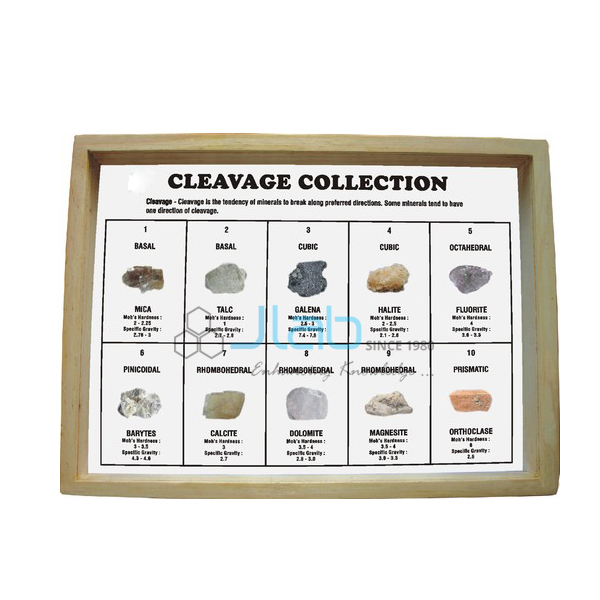
Minerals Cleavage Collection (Set of 10) (code EL-ERAM-4373) is a set of 10 mineral specimens that show cleavage — the tendency of a mineral to break along preferred directions — in basal, cubic, octahedral, pinacoidal, rhombohedral and prismatic forms. It is used for mineral identification work in school geography and science lessons and in college geology and earth science labs. JLab (Jain Laboratory Instruments Pvt Ltd) prepares the collection at its works in Ambala, India.
Specifications
| Parameter | Detail |
|---|---|
| Contents | 10 mineral specimens |
| Property shown | Cleavage — the tendency of a mineral to break along preferred directions |
| Cleavage types covered | Basal, cubic, octahedral, pinacoidal, rhombohedral and prismatic |
| Quality check | Each collection is visually inspected before dispatch |
| Pack quantity | One set of 10 specimens |
| Minimum order quantity | 10 units |
| Dispatch time | Usually 7–10 working days |
| Product code | EL-ERAM-4373 |
| Manufacturer | Jain Laboratory Instruments Pvt Ltd (JLab) — OEM |
| Country of origin | India (made in Ambala, Haryana) |
Cleavage Types Covered by the Set
| Cleavage | How the mineral splits | Classic example (not necessarily in this set) |
|---|---|---|
| Basal | In one direction, into thin sheets parallel to the base of the crystal | Micas such as muscovite |
| Cubic | In three directions at right angles, giving cube-shaped pieces | Halite, galena |
| Octahedral | In four directions, giving octahedron-shaped pieces | Fluorite |
| Pinacoidal | Parallel to a pinacoid — a pair of parallel crystal faces | Depends on the mineral |
| Rhombohedral | In three directions not at right angles, giving rhomb-shaped pieces | Calcite |
| Prismatic | In two directions parallel to the length of a prism-shaped crystal | Pyroxenes and amphiboles such as hornblende |
What Is the Minerals Cleavage Collection Used For?
Cleavage reflects planes of weak bonding in a mineral’s crystal structure, so a given mineral always cleaves in the same directions and at the same angles — one reason it is among the most dependable identification clues. Some minerals, such as the micas, have a single direction of cleavage; others have two, three or four. With this collection students learn to spot the flat, light-catching surfaces that repeat as parallel steps, count the cleavage directions and judge the angles between them, and then contrast these with fracture, which follows no plane at all.
The set fits rocks-and-minerals lessons in secondary-school geography and science, college geology and earth science practicals, and teacher training, and sits well with other earth science kit items such as hardness and streak sets. Turning a specimen under a lamp shows the cleavage faces flashing together; a hand lens reveals the steps. Avoid splitting the specimens further in class, as cleaved pieces can have sharp edges.
What to Specify When Ordering
- Quantity — at least 10 sets.
- Specimen list — ask for it with the quotation if a syllabus or tender names particular minerals.
- Companion sets — the fracture collection for contrast and the crystal collection to link cleavage with crystal systems.
Frequently Asked Questions
What is cleavage in a mineral?
It is the tendency of a mineral to break along preferred directions, producing flat surfaces. The directions follow weak planes in the crystal structure, so they are the same in every specimen of that mineral.
Which cleavage types does the collection show?
Basal, cubic, octahedral, pinacoidal, rhombohedral and prismatic cleavage, spread across the 10 specimens.
How can students tell cleavage from fracture?
Cleavage surfaces are flat and reflect light together when the specimen is turned, often as a series of parallel steps. Fractured surfaces are curved, rough, splintery or jagged and do not repeat.
Are the specimens named?
The listing does not name the minerals. Request the specimen list with your quotation if you need particular minerals.
Who manufactures the collection?
JLab — Jain Laboratory Instruments Pvt Ltd — prepares it at its works in Ambala, Haryana, India, and quotes as the manufacturer.
OEM Manufacturer
JLab is the trading name of Jain Laboratory Instruments Pvt Ltd, a manufacturer of geology specimens and science lab equipment in India, incorporated in 2017 and based on Hargolal Road in Ambala, Haryana. This cleavage collection is made up at JLab’s own works, not bought in from a trader, so schools, colleges, dealers and importers buy directly from the source; each set is inspected by eye before dispatch and repeat orders are handled by the same team. JLab exports worldwide and ships to buyers in every region — the Philippines in Southeast Asia, Papua New Guinea in Oceania, Benin in West Africa, Guyana in South America and Eswatini in Southern Africa are some examples. See the JLab lab tenders page for tender buying.
Sets That Go with the Cleavage Collection
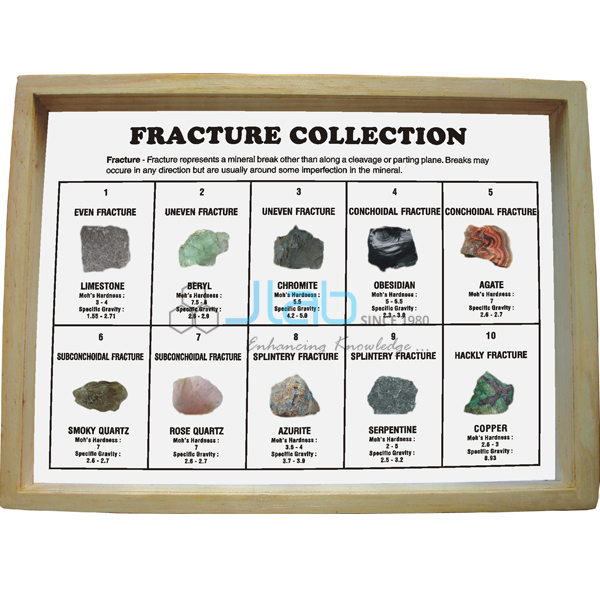
- Minerals Fracture Collection (Set of 10) — minerals that break with conchoidal, uneven, splintery and hackly fracture, for contrast.
- Minerals Crystal Collection (Set of 15) — minerals representing the isometric, tetragonal, hexagonal and other crystal systems.
- Collection of 9 Mohs Hardness Set — the Mohs scale minerals from talc to corundum.
- Minerals Tenacity Collection (Set of 10) — minerals showing brittle, sectile, malleable and elastic behaviour.
- Hand Lens — for seeing cleavage steps up close.
See the complete Educational Rock and Minerals range or the Rocks and Minerals section.
Request a Quote
Quotes come direct from the manufacturer. Click Add To Cart, or send the number of sets (minimum 10 units), any companion collections and your delivery location through the contact page.
Last updated: 9 October 2026