Collection of 6 Plastic Material with Properties and Uses Manufacturer,Supplier and Exporter in India
Product Code : EL-ERAM-4386
Jlab Export is a leading Collection of 6 Plastic Material with Properties and Uses Manufacturer,and suppliers in India
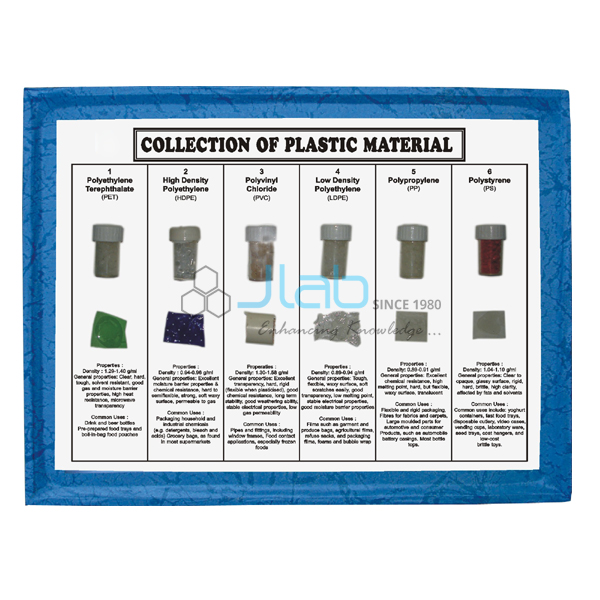
Six everyday plastics are shown in this collection as labelled coupons, each with an example photo and a use card for its properties and uses. They are low-density polyethylene (LDPE), high-density polyethylene (HDPE), polypropylene (PP), rigid polyvinyl chloride (PVC), polystyrene (PS) and polymethyl methacrylate (PMMA, acrylic). The coupons sit in a framed display with numbered compartments.
Specifications
| Plastics | 6 types, as labelled coupons about 50 × 25 × 3 mm each |
| Specimens (6) | Low Density Polyethylene (LDPE, code 4), High Density Polyethylene (HDPE, code 2), Polypropylene (PP, code 5), Rigid Polyvinyl Chloride (PVC, code 3), Polystyrene (PS, code 6), Polymethyl Methacrylate (PMMA, no resin code of its own) |
| Shown with each plastic | An example photo and a use card: LDPE film or bag, HDPE bottle, PP cap, PVC pipe, PS rigid packaging, PMMA clear glazing |
| Supplied in | One framed compartment display, each specimen in its own numbered, labelled compartment, with a matching printed contents key |
| Minimum order quantity | 10 units |
| Dispatch time | Usually 4–6 working days |
| Manufacturer | JLab (Jain Laboratory Instruments Pvt Ltd), Ambala, India |
Classroom Experiments on Plastics
The float test is the usual starting point. Students cut small pieces from household items with known codes, drop them into water in a Beaker and stir with a Stirring Rod Glass to free any bubbles. Pieces of PP, LDPE and HDPE float, while PVC sinks. The results are then checked against the reference plastics in the set.
A second exercise sorts empty containers by the code number moulded into their base and matches each to the plastic with the same code. Students compare stiffness, clarity and how easily each one bends or tears, then link those properties to the uses shown in the collection.
Frequently Asked Questions
What else should a school order to run plastics tests with this set?
The set gives reference samples of the six plastics with their properties and uses. Each group also needs beakers, water and small labelled pieces cut from household packaging. A salt solution and a weak alcohol and water mix, made up beforehand, separate plastics that water alone cannot tell apart.
Which resin codes do the six plastics carry?
HDPE is code 2, PVC code 3, LDPE code 4, PP code 5 and PS code 6. PET, code 1, is not in this set. PMMA, or acrylic, has no code of its own and falls under code 7, the catch-all for other plastics such as polycarbonate and nylon.
Why do some plastics float in water and others sink?
A piece floats when the plastic is less dense than the liquid. PP, LDPE and HDPE are lighter than water, so they float. PVC and PMMA are denser and sink. Solid PS is only a little denser than water and sinks slowly, while foamed PS is full of air and floats.
Why can a float test give the wrong answer?
Air bubbles clinging to a piece can lift a sinker, so push each piece under and stir. Fillers and pigments can also shift a plastic’s density. A bottle and its cap are often different plastics, such as a PET bottle with a PP or HDPE cap, so test them separately.
Other Plastics and Materials Teaching Items
- Plastics (wall chart on plastics as polymers)
- Plastics Sample Pack (novel and unusual plastics)
- Collection of Fibres
- Collection of 9 Glass
For a quote, use Add To Cart or send us a message through the contact page.
Last updated: 20 November 2026