Collection of Fibres Manufacturer,Supplier and Exporter in India
Product Code : EL-ERAM-4388
Jlab Export is a leading Collection of Fibres Manufacturer,and suppliers in India
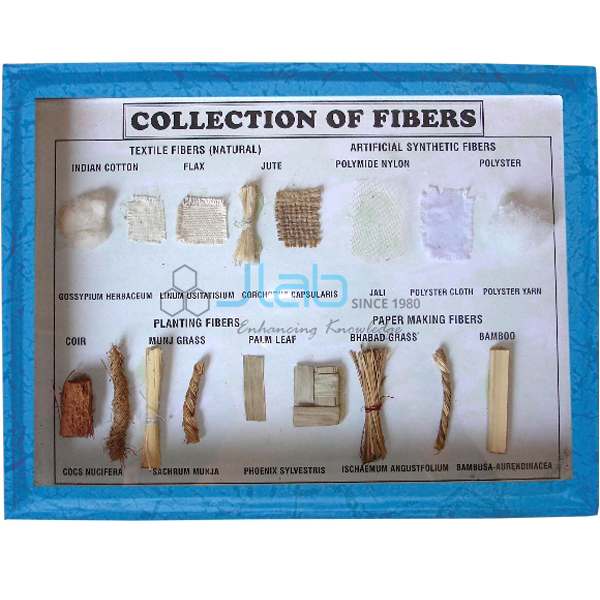
Collection of Fibres (code EL-ERAM-4388) is a set of 10 types of fibres for school science lessons on fibres, fabrics and materials. The listing groups the fibres as natural textile fibres, artificial and synthetic fibres, plant fibres and paper-making fibres, so a single set covers both natural and man-made fibres. Jain Laboratory Instruments Pvt Ltd (JLab) assembles it at its works in Ambala, India.
Specifications
| Parameter | Detail |
|---|---|
| Contents | 10 types of fibres |
| Fibre groups listed | Natural textile fibres; artificial and synthetic fibres; plant fibres (listed as “planting fibers”); paper-making fibres |
| Individual fibres | Not named in the listing — ask for the list of 10 with your quotation |
| Quality check | Each collection is visually inspected before dispatch |
| Pack quantity | One collection (set of 10 fibres) |
| Minimum order quantity | 10 units |
| Dispatch time | Usually 7–10 working days |
| Product code | EL-ERAM-4388 |
| Manufacturer | Jain Laboratory Instruments Pvt Ltd (JLab) — OEM |
| Country of origin | India (made in Ambala, Haryana) |
What Is the Fibre Collection Used For?
Fibres are the thin strands that are spun into yarn and woven or knitted into fabric, or matted together to make paper. The four groups in this set match the way school science sorts them: natural fibres come from plants, such as cotton and jute, or from animals, such as wool and silk; artificial fibres such as rayon are regenerated from wood cellulose; synthetic fibres such as nylon, polyester and acrylic are made from petrochemicals; and paper-making fibres are mostly cellulose from wood pulp, bamboo, straw or cotton rags. These are examples of each group, not a contents list.
Teachers use the collection in middle-school lessons on fibre to fabric and synthetic fibres, and in textile and home-science courses. Students compare how the groups look and feel, and under supervision a burning test on spare fibre shows the difference clearly: cotton burns like paper, wool and silk smell of burnt hair, and most synthetics melt and shrink into hard beads.
What to Specify When Ordering
- Quantity — the minimum order is 10 collections.
- Fibre list — ask JLab for the 10 fibres that will be supplied.
- Companion items — fibre slides or a synthetic fibres chart, linked below.
Frequently Asked Questions
Which fibres are in the collection?
Ten fibres from four groups: natural textile, artificial and synthetic, plant and paper-making fibres. The listing does not name the individual fibres, so ask for the full list with your quotation.
What is the difference between artificial and synthetic fibres?
Artificial, or regenerated, fibres such as rayon are made by chemically processing natural cellulose, while synthetic fibres such as nylon and polyester are built entirely from petrochemical raw materials.
Who manufactures the fibre collection?
JLab (Jain Laboratory Instruments Pvt Ltd) assembles it at its works in Ambala, Haryana, India, and quotes for it directly.
OEM Manufacturer
JLab is the trading name of Jain Laboratory Instruments Pvt Ltd, a manufacturer of educational science equipment in India, incorporated in 2017 and based on Hargolal Road, Ambala, Haryana. The fibre collection is put together at JLab’s own works rather than bought from a trader, so schools, colleges, dealers and importers buy from the maker and reorders match earlier supplies. The company is registered for GST under GSTIN 06AADCJ9848D1ZE and holds Legal Entity Identifier 549300DTGS77DGYD6N03. JLab exports worldwide and ships to buyers in every region — for example Gabon in Central Africa, Slovenia in Southern Europe, Afghanistan in South Asia, Iceland in Northern Europe and South Korea in East Asia. Tender details are on the JLab lab tenders page.
Related Fibre and Materials Items
- Textile Fibre Prepared Slide Set — 12 labelled glass slides of natural and man-made fibres, such as cotton, wool, silk and nylon, for microscope study.
- Synthetic Fibers — a chemistry wall chart on man-made fibres such as rayon, nylon, polyester and acrylic.
- Collection of 6 Plastic Material with Properties and Uses — PET, HDPE, PVC, LDPE, polypropylene and polystyrene.
- Collection of 9 Glass — nine glass types, including glass fibre.
Browse the Educational Rock and Minerals range or the Rocks and Minerals section.
Request a Quote
Quotes come direct from the manufacturer. Use Add To Cart, or send the number of collections (minimum 10 units) and your delivery location through the contact page.
Last updated: 9 October 2026