Synthetic Fibers Manufacturer,Supplier and Exporter in India
Product Code : EL-CC-2868
Jlab Export is a leading Synthetic Fibers Manufacturer,and suppliers in India
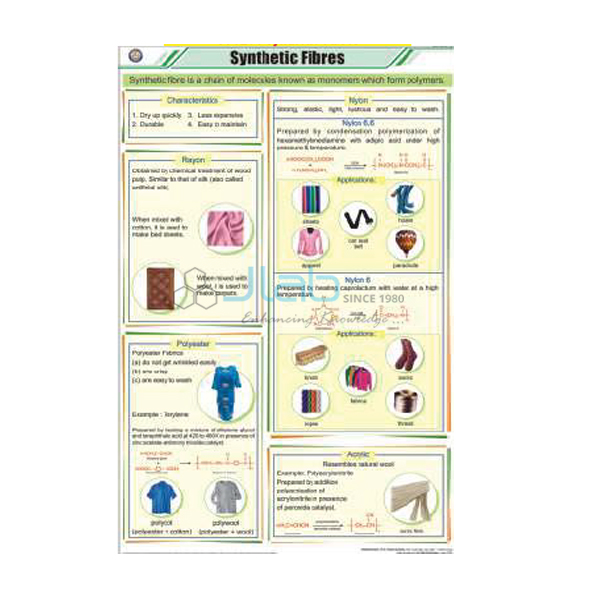
Synthetic Fibers (code EL-CC-2868) is a 58 x 90 cm chemistry wall chart on man-made fibres such as rayon, nylon, polyester and acrylic, for school science and college textile-chemistry lessons. The chart is laminated on both sides, fitted with plastic rollers and printed in English only. JLab (Jain Laboratory Instruments Pvt Ltd, Ambala, India) supplies it to schools, colleges and dealers.
Specifications
| Parameter | Detail |
|---|---|
| Chart topic | Synthetic fibres (Chemistry Charts series) |
| Size (overall) | 58 x 90 cm (about 22.8 x 35.4 in) |
| Paper | Coated art paper, 130 gsm |
| Printing | Full colour, offset printed using CTP technology |
| Lamination | Both sides, 30 micron heat-sealable polyester film |
| Hanging | Wall hanging, fitted with plastic rollers |
| Surface | Markable and washable |
| Weight | 228 g |
| Size when rolled | 58 x 4 x 2 cm |
| Language | English only |
| Quality check | Each chart is visually inspected before dispatch |
| Pack quantity | Each (sold individually) |
| Minimum order quantity | 10 units |
| Dispatch time | Usually 7–10 working days |
| Product code | EL-CC-2868 |
| Supplied by | Jain Laboratory Instruments Pvt Ltd (JLab), Ambala, India |
What Is the Synthetic Fibers Chart Used For?
Synthetic fibres are long polymer chains drawn out into threads. Rayon is made by chemically treating wood pulp, so it is a regenerated form of natural cellulose rather than a fully synthetic fibre; it looks like silk, costs less, and is blended with cotton for bed sheets and with wool for carpets. Nylon was the first fully synthetic fibre, made from chemicals obtained from coal, water and air; nylon 6,6 is formed by condensation polymerisation of hexamethylenediamine with adipic acid. It is strong, elastic and light, which suits ropes, parachutes, socks and toothbrush bristles. Polyester — PET, the material of many drinks bottles, is one — keeps its shape and resists creasing, so it is widely worn and is blended with cotton as polycot and with wool as polywool. Acrylic resembles wool and goes into sweaters, shawls and blankets at lower cost.
Synthetic fibres absorb little water, dry quickly and are not eaten by moths, but they melt when heated and can stick to the skin, which is why cotton clothing is advised in the kitchen and the laboratory. In India the topic appears in middle-school science, around class 8, alongside plastics, and the polymer chemistry behind it is taken further in college and textile-technology courses. A wall chart lets the class compare the fibres side by side while handling fabric samples, and the markable, washable lamination takes notes during the lesson. The listing does not itemise the diagrams on the chart, so request a preview image if the exact content matters.
What to Specify When Ordering
- Quantity — 10 units is the minimum order; charts are supplied singly.
- The Plastics chart — the matching title in the same series, for the other half of the synthetic fibres and plastics lesson.
- Tender or indent reference — include it if the purchase is for a school or college tender.
- Destination — country, port or city and delivery terms, so the export quotation includes the right freight basis.
Frequently Asked Questions
What does the Synthetic Fibers chart show?
Its subject is man-made fibres and the polymers they are made from. The product listing does not itemise the diagrams, so ask for a preview image to confirm the content.
Why is rayon not counted as a fully synthetic fibre?
Because it starts from natural cellulose in wood pulp, which is dissolved and regenerated as fibre. Nylon, polyester and acrylic are built from small molecules made in chemical plants.
Which classes is it suitable for?
Class 8 science in Indian syllabuses, where synthetic fibres and plastics are taught together, and college or polytechnic courses in polymer and textile chemistry.
What are the chart’s dimensions and materials?
58 x 90 cm overall (about 22.8 x 35.4 in), 130 gsm coated art paper, full-colour offset printing, 30 micron polyester lamination on both sides and plastic rollers; it weighs 228 g.
Can the chart be wiped clean?
Yes. The listing describes the surface as washable as well as markable.
What should I send for an export quotation?
The quantity, destination country and port or city, delivery terms such as FOB or CIF, any packing or labelling needs and the tender reference if there is one.
Who supplies this chart?
JLab, the trading name of Jain Laboratory Instruments Pvt Ltd, Ambala, Haryana, supplies it and quotes directly.
Supplier
Jain Laboratory Instruments Pvt Ltd, trading as JLab, was incorporated in 2017 and is based on Hargolal Road, Ambala, Haryana. Alongside its own school laboratory apparatus it supplies printed teaching charts such as this one, so a science department can source wall charts and equipment from one supplier, and every chart is visually inspected before it leaves. The company is registered under CIN U29309HR2017PTC069123 and holds GSTIN 06AADCJ9848D1ZE. JLab exports worldwide and can ship to every region — Ivory Coast in West Africa, Turkey in the Middle East, Tunisia in North Africa, New Zealand in Oceania and Turkmenistan in Central Asia are examples. For tender purchases see the JLab lab tenders page.
Related Polymer and Organic Chemistry Charts
- Plastics — thermoplastics and thermosetting plastics, the companion title for the same lesson.
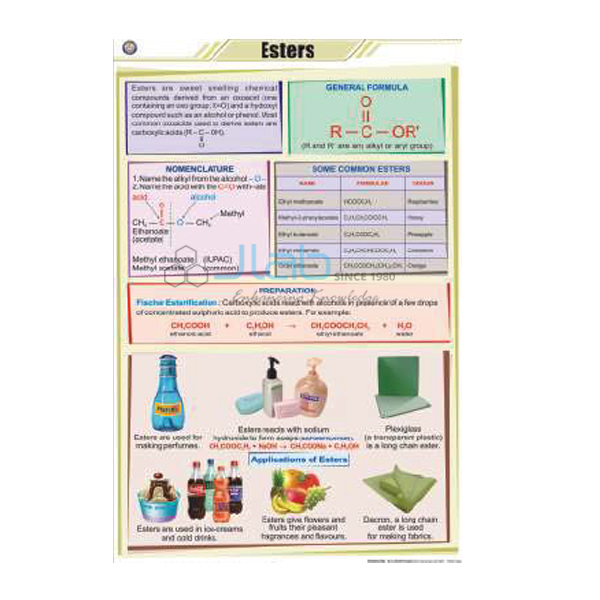
- Esters — compounds of a carboxylic acid and an alcohol; polyesters are built from the same kind of link.
- Organic Acids — carboxylic acids, the family that includes adipic acid used for nylon.
More titles are in Chemistry Charts and the full Charts range.
Request a Quote
JLab quotes directly for this chart. Click the Add To Cart enquiry button on this page, or use the contact page to send the quantity (minimum 10 units), any companion titles and the delivery destination.
Last updated: 4 October 2026