Plastics Manufacturer,Supplier and Exporter in India

Product Code : EL-CC-2867
Jlab Export is a leading Plastics Manufacturer,and suppliers in India
Plastics (code EL-CC-2867) is a 58 x 90 cm chemistry wall chart on plastics as polymers — long chains of repeating units — and on the difference between thermoplastics, which soften on heating, and thermosetting plastics, which do not. Laminated on both sides, it hangs from plastic rollers and is in English only. JLab (Jain Laboratory Instruments Pvt Ltd, Ambala, India) supplies it to schools, colleges and dealers.
Specifications
| Parameter | Detail |
|---|---|
| Chart topic | Plastics (Chemistry Charts series) |
| Size (overall) | 58 x 90 cm (about 22.8 x 35.4 in) |
| Paper | Coated art paper, 130 gsm |
| Printing | Full colour, offset printed using CTP technology |
| Lamination | Both sides, 30 micron heat-sealable polyester film |
| Hanging | Wall hanging, fitted with plastic rollers |
| Surface | Markable and washable |
| Weight | 228 g |
| Size when rolled | 58 x 4 x 2 cm |
| Language | English only |
| Quality check | Each chart is visually inspected before dispatch |
| Pack quantity | Each (sold individually) |
| Minimum order quantity | 10 units |
| Dispatch time | Usually 7–10 working days |
| Product code | EL-CC-2867 |
| Supplied by | Jain Laboratory Instruments Pvt Ltd (JLab), Ambala, India |
What Is the Plastics Chart Used For?
A plastic is a synthetic polymer: a very large number of small molecules, called monomers, joined into long chains. Polythene is formed by joining ethene molecules, and PVC (polyvinyl chloride) by joining vinyl chloride molecules. In a thermoplastic the chains are linear or only slightly branched, so the material softens when heated and can be moulded again; polythene, PVC and polystyrene behave this way. Low-density polythene goes into carry bags and films, high-density polythene into bottles and containers, and PVC into pipes, cable insulation and raincoats. In a thermosetting plastic the chains become heavily cross-linked as the article sets, so once moulded it cannot be softened by heat. Bakelite, a poor conductor of heat and electricity, is used for electrical switches and the handles of cooking utensils, and melamine for kitchenware and fire-resistant laminates.
The topic is introduced in middle-school science, around class 8 in Indian syllabuses, together with the problem that most plastics are not biodegradable: they persist in the environment for many years, burning them releases harmful gases, and the answer is to reduce, reuse and recycle. College polymer chemistry builds on the same ideas with addition and condensation polymerisation. The chart helps students sort everyday objects into thermoplastic and thermosetting groups, and its markable, washable surface can carry the class’s own examples during a lesson. The listing does not itemise the diagrams printed on it; request a preview image if you need to see them.
What to Specify When Ordering
- Number of charts — the minimum order is 10 units, each chart supplied individually.
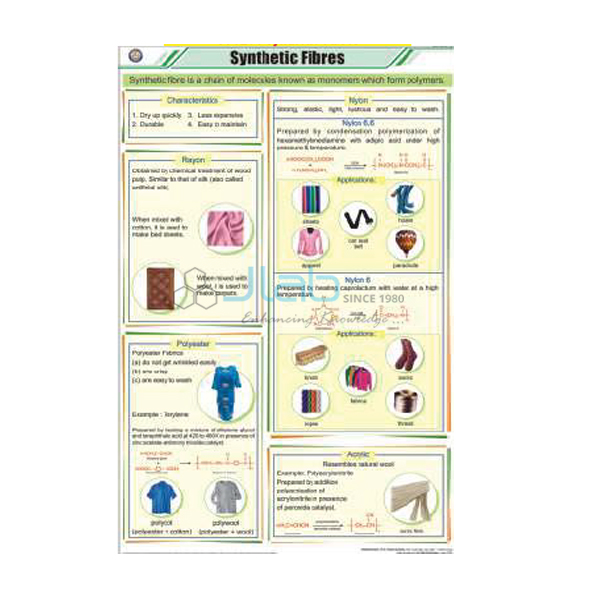
- Companion title — the Synthetic Fibers chart in the same series deals with fibre-forming polymers and pairs naturally with this one.
- Tender details — quote the tender or indent reference if the charts are for a school or college tender.
- Destination — country, port or city and preferred delivery terms for an export quotation.
Frequently Asked Questions
What does the Plastics chart cover?
Its subject is plastics as polymers and the two main groups, thermoplastics and thermosetting plastics. The listing does not itemise the diagrams, so ask for a preview image to see the exact content.
What is the difference between a thermoplastic and a thermosetting plastic?
A thermoplastic such as polythene or PVC softens on heating and can be reshaped. A thermosetting plastic such as Bakelite or melamine is cross-linked when it sets and does not soften again when heated.
Which students is it meant for?
Middle-school science classes, around class 8 in Indian syllabuses, plus senior-secondary and college courses that introduce polymer chemistry and environmental studies.
What size is the chart, and how compact is it when rolled?
The chart is 58 x 90 cm (about 22.8 x 35.4 in) and rolls to 58 x 4 x 2 cm. It weighs 228 g and is printed on 130 gsm coated art paper with 30 micron polyester lamination on both sides.
Is the laminated surface washable?
Yes. The listing gives the surface as markable and washable.
How many must I order, and when will they ship?
At least 10 units. Charts are visually inspected and usually dispatched within 7–10 working days; export transit time is extra and depends on the route.
What details does JLab need for an export quote?
Quantity, destination country and port or city, delivery terms such as FOB or CIF, packing or labelling needs and any tender reference.
Who supplies the Plastics chart?
JLab, the trading name of Jain Laboratory Instruments Pvt Ltd in Ambala, Haryana, supplies it and sends quotations directly.
Supplier
JLab, the trading name of Jain Laboratory Instruments Pvt Ltd, was incorporated in 2017 and operates from Hargolal Road, Ambala, Haryana. It supplies teaching charts like this one together with its own range of school laboratory apparatus, which lets a science department place one order for wall charts and equipment, and each chart is visually inspected before dispatch. JLab exports worldwide and can deliver to buyers in every region, for example Greece in Southern Europe, Bahrain in the Middle East, Japan in East Asia, Brunei in Southeast Asia and Botswana in Southern Africa. Tender buyers can refer to the JLab lab tenders page.
More Charts on Materials and Carbon Compounds
- Synthetic Fibers — fibre-forming polymers, the textile side of the same topic.
- Soaps and Detergents — another everyday-chemistry chart, on cleaning agents and hard water.
- Alkanes — the saturated hydrocarbons that begin the study of carbon compounds.
- Cement and Concrete — a materials chart on how cement is made and sets into concrete.
See every title in Chemistry Charts or browse all Charts.
Request a Quote
Quotations come straight from JLab. Use the Add To Cart enquiry button on this page, or send the quantity (minimum 10 units), the chart titles you need and your delivery location through the contact page.
Last updated: 4 October 2026