Soaps and Detergents Manufacturer,Supplier and Exporter in India
Product Code : EL-CC-2866
Jlab Export is a leading Soaps and Detergents Manufacturer,and suppliers in India
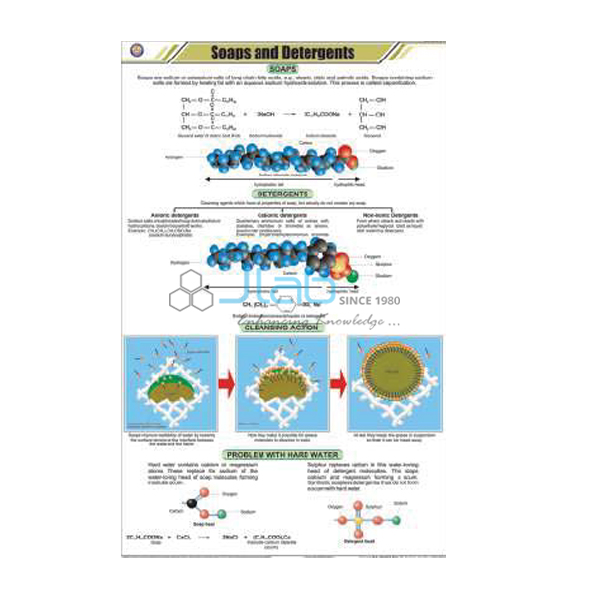
Soaps and Detergents (code EL-CC-2866) is a 58 x 90 cm chemistry wall chart on two kinds of cleaning agent — soaps made from fats and oils, and synthetic detergents — and on how they lift greasy dirt. It is printed in full colour on laminated art paper with plastic rollers, in English only. JLab (Jain Laboratory Instruments Pvt Ltd, Ambala, India) supplies it to schools, colleges and dealers.
Specifications
| Parameter | Detail |
|---|---|
| Chart topic | Soaps and detergents (Chemistry Charts series) |
| Size (overall) | 58 x 90 cm (about 22.8 x 35.4 in) |
| Paper | Coated art paper, 130 gsm |
| Printing | Full colour, offset printed using CTP technology |
| Lamination | Both sides, 30 micron heat-sealable polyester film |
| Hanging | Wall hanging, fitted with plastic rollers |
| Surface | Markable and washable |
| Weight | 228 g |
| Size when rolled | 58 x 4 x 2 cm |
| Language | English only |
| Quality check | Each chart is visually inspected before dispatch |
| Pack quantity | Each (sold individually) |
| Minimum order quantity | 10 units |
| Dispatch time | Usually 7–10 working days |
| Product code | EL-CC-2866 |
| Supplied by | Jain Laboratory Instruments Pvt Ltd (JLab), Ambala, India |
What Is the Soaps and Detergents Chart Used For?
A soap is the sodium or potassium salt of a long-chain fatty acid. It is made by saponification: an oil or fat, which is an ester of glycerol, is boiled with sodium hydroxide solution to give soap and glycerol, and adding common salt makes the soap separate out. Potassium hydroxide gives the softer soaps used in liquid and shaving soaps. Each soap molecule has an ionic end that dissolves in water and a long hydrocarbon tail that dissolves in oil. In water the tails gather around oily dirt to form micelles, which stay suspended and rinse away with the dirt trapped inside.
Hard water contains calcium and magnesium salts, which react with soap to form an insoluble scum, so much of the soap is wasted before any lather appears. Synthetic detergents — generally sodium salts of sulphonic acids, or ammonium salts with chloride or bromide ions — have charged ends that do not form insoluble compounds with calcium and magnesium ions, so they keep working in hard water and are used in shampoos and washing powders. Detergents with branched hydrocarbon chains break down slowly in rivers and cause foaming, which is why biodegradable straight-chain detergents are preferred. These ideas are taught in class 10 science under carbon and its compounds, including the classroom test of shaking soap with hard and soft water, and again in college courses on applied chemistry. The markable, washable lamination lets a teacher annotate the chart during the lesson and wipe it clean afterwards. The listing does not itemise the diagrams printed on it, so ask for a preview image if you need to check them.
What to Specify When Ordering
- Quantity — the minimum order is 10 units, supplied as individual charts.
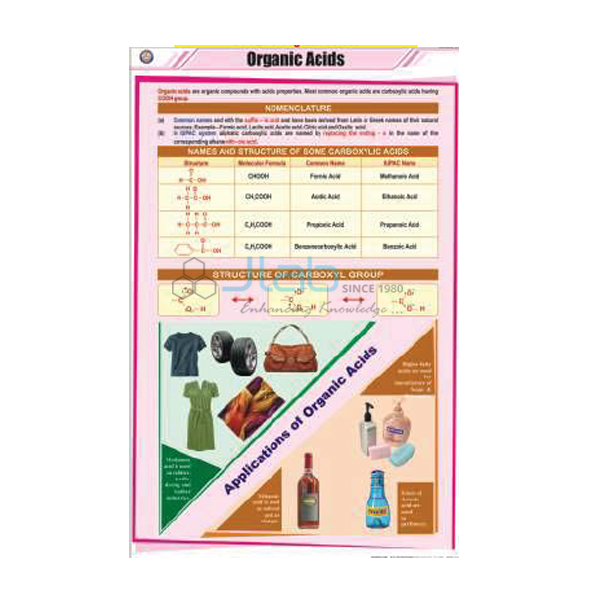
- Companion titles — the Esters and Organic Acids charts in the same 58 x 90 cm format cover the ester and carboxylic-acid chemistry behind soap.
- Classroom sets — if you are equipping several chemistry rooms, list each title and its quantity in one enquiry.
- Delivery — destination country, port or city and delivery terms for an export quotation.
Frequently Asked Questions
What does the Soaps and Detergents chart cover?
Its subject is soaps, synthetic detergents and the way they clean. The product listing does not itemise the diagrams, so request a preview image to see exactly what is printed.
Which classes is it suited to?
Class 10 science, where soaps, detergents, micelles and hard water are taught under carbon compounds, and college or vocational courses that cover applied chemistry.
Why does soap form scum in hard water while a detergent does not?
Calcium and magnesium ions in hard water combine with soap to give an insoluble precipitate. Detergent molecules have charged ends that do not precipitate with these ions, so they still lather.
How big is the chart and how is it finished?
It measures 58 x 90 cm overall (about 22.8 x 35.4 in), is offset printed in full colour on 130 gsm coated art paper, laminated on both sides with 30 micron polyester film and fitted with plastic rollers. It weighs 228 g.
Can students write on it?
The listing describes the surface as markable and washable, so notes can be added for a lesson and wiped off afterwards.
What should an export enquiry include?
The quantity, destination country and port or city, delivery terms (for example FOB or CIF), any packing or labelling instructions and a tender reference if there is one.
Who supplies this chart?
JLab — Jain Laboratory Instruments Pvt Ltd of Ambala, Haryana — supplies it and quotes for it directly.
Supplier
JLab is the trading name of Jain Laboratory Instruments Pvt Ltd, a company incorporated in 2017 and based on Hargolal Road, Ambala, Haryana. Besides its own range of chemistry lab equipment for schools, JLab supplies printed teaching charts such as this one, so a school can order its wall charts and its apparatus together; every chart is checked by eye before it is packed. JLab exports worldwide and can ship to buyers in every region — for example Malta in Southern Europe, Cameroon in Central Africa, Taiwan in East Asia, Iraq in the Middle East and Papua New Guinea in Oceania. Schools buying through a tender will find details on the JLab lab tenders page.
Related Chemistry Charts
- Esters — esters form when a carboxylic acid reacts with an alcohol, and fats and oils are esters of glycerol.
- Organic Acids — carboxylic acids, the family that includes the fatty acids in soap.
- Alcohols — compounds with a hydroxyl group; glycerol, the by-product of soap making, is one of them.
- Plastics — another everyday-chemistry title in the same 58 x 90 cm series.
Browse all Chemistry Charts or the wider Charts range.
Request a Quote
JLab replies with a direct quotation. Press the Add To Cart enquiry button on this page, or write through the contact page with the number of charts (minimum 10 units), any other titles you want quoted alongside it and the delivery address or port.
Last updated: 4 October 2026