Alcohols Manufacturer,Supplier and Exporter in India
Product Code : EL-CC-2863
Jlab Export is a leading Alcohols Manufacturer,and suppliers in India
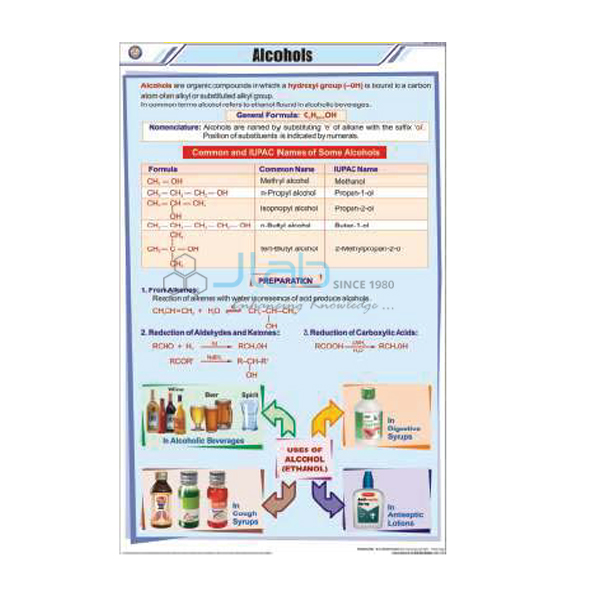
Alcohols (code EL-CC-2863) is a 58 x 90 cm organic chemistry wall chart on alcohols — compounds with a hydroxyl (–OH) group — covering ideas met from class 10 science to class 12 chemistry. It is printed in full colour on coated art paper, laminated on both sides with polyester film, fitted with plastic rollers and labelled in English only. JLab (Jain Laboratory Instruments Pvt Ltd, Ambala, India) supplies it to schools, colleges and dealers.
Specifications
| Parameter | Detail |
|---|---|
| Chart topic | Alcohols (Chemistry Charts series) |
| Size (overall) | 58 x 90 cm (about 22.8 x 35.4 in) |
| Paper | Coated art paper, 130 gsm |
| Printing | Full colour, offset printed using CTP technology |
| Lamination | Both sides, 30 micron heat-sealable polyester film |
| Hanging | Wall hanging, fitted with plastic rollers |
| Surface | Markable and washable |
| Weight | 228 g |
| Size when rolled | 58 x 4 x 2 cm |
| Language | English only |
| Quality check | Each chart is visually inspected before dispatch |
| Pack quantity | Each (sold individually) |
| Minimum order quantity | 10 units |
| Dispatch time | Usually 7–10 working days |
| Product code | EL-CC-2863 |
| Supplied by | Jain Laboratory Instruments Pvt Ltd (JLab), Ambala, India |
What Is the Alcohols Chart Used For?
An alcohol has a hydroxyl group joined to a saturated carbon atom, and its name ends in -ol: methanol, ethanol, propanol and so on. Alcohols are classed as primary, secondary or tertiary according to how many other carbon atoms are attached to the carbon carrying the –OH group, and this decides how they react. Ethanol is made industrially by fermenting sugars with yeast and by adding water to ethene; in the laboratory alcohols can also be made by reducing aldehydes and ketones. Their typical reactions are a favourite part of the syllabus: sodium releases hydrogen from them, acidified potassium dichromate oxidises primary alcohols (turning from orange to green), they combine with carboxylic acids to form sweet-smelling esters, and hot concentrated sulphuric acid dehydrates them to alkenes.
Ethanol is widely used as a solvent, in medicines and sanitisers, and as a fuel blended with petrol, while methanol is poisonous even in small amounts — a safety point every class should hear. In India ethanol and its properties are taught in the class 10 science chapter on carbon and its compounds, and the full chemistry of alcohols in the class 12 chapter on alcohols, phenols and ethers. Teachers can write reaction schemes on the markable, washable lamination and wipe them off after the lesson. The listing does not itemise the diagrams printed on this chart, so ask JLab for a preview image if you want to check them against your textbook.
What to Specify When Ordering
- Quantity — minimum 10 units, each chart supplied individually.
- Functional-group series — Alkanes, Organic Acids and Esters are listed in the same 58 x 90 cm format.
- Models — an organic molecular model set lets students build ethanol and its isomers alongside the chart.
- Delivery — destination country, port or city and delivery terms for export quotations.
Frequently Asked Questions
Which topics does the Alcohols chart support?
Naming and classifying alcohols, their preparation, their main reactions and their uses, as taught in class 10 science and class 12 chemistry. The listing does not itemise the diagrams, so request a preview image if exact content matters.
What size is it and how is it finished?
It measures 58 x 90 cm (about 22.8 x 35.4 in), is printed on 130 gsm coated art paper, laminated on both sides with 30 micron heat-sealable polyester and hung on plastic rollers.
How much does it weigh and how does it pack?
The chart weighs 228 g and rolls to 58 x 4 x 2 cm, so it travels easily in a carton with other charts.
Can teachers draw on it?
Yes, the surface is described as markable and washable.
What should be included in an export quotation request?
The quantity, destination country and port or city, delivery terms (for example FOB or CIF), packing or labelling instructions and any tender reference.
Who supplies the Alcohols chart?
Jain Laboratory Instruments Pvt Ltd, trading as JLab, Ambala, Haryana, supplies it and quotes directly.
Supplier
JLab is the trading name of Jain Laboratory Instruments Pvt Ltd, incorporated in 2017 and based on Hargolal Road, Ambala, Haryana. The company supplies chemistry charts like this one together with its own range of laboratory apparatus and model sets, which lets schools and colleges equip their organic chemistry teaching from one supplier; each chart is visually inspected before it is dispatched. JLab exports worldwide and serves every region — for example Lesotho in Southern Africa, Mauritius in East Africa, Ghana in West Africa, Tonga in Oceania and Nepal in South Asia. Tender buyers can find details on the JLab lab tenders page.
Organic Chemistry Charts and Models
- Alkanes — the parent hydrocarbons whose names alcohols are built on, on a 58 x 90 cm chart.
- Organic Acids — the carboxylic acids formed when primary alcohols are fully oxidised.
- Esters — the products of alcohols reacting with organic acids, in the same series.
- Organic Atom Molecular Model Set — models built firmly enough to be passed around during the lesson.
Browse the Chemistry Charts range or all Charts.
Request a Quote
Quotes come directly from JLab. Use the Add To Cart enquiry button on this page, or send the number of charts (minimum 10 units), any other titles or model sets and your delivery location through the contact page.
Last updated: 4 October 2026