
Manufacture of Bleaching Powder Manufacturer,Supplier and Exporter in India
Product Code : EL-CC-2878
Jlab Export is a leading Manufacture of Bleaching Powder Manufacturer,and suppliers in India
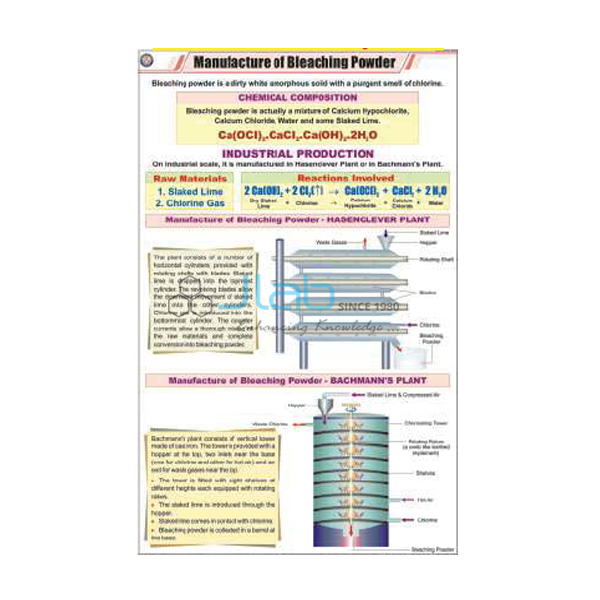
Manufacture of Bleaching Powder (code EL-CC-2878) is a 58 x 90 cm industrial-chemistry wall chart on how bleaching powder is produced on a large scale by passing chlorine over dry slaked lime. The chart is laminated on both sides, fitted with plastic rollers and printed in English only. JLab (Jain Laboratory Instruments Pvt Ltd, Ambala, India) supplies it to schools, colleges and dealers.
Get a quote: use the Add To Cart enquiry button below, or send your quantity and destination through the contact page.
Specifications
| Parameter | Detail |
|---|---|
| Chart topic | Industrial production of bleaching powder (Chemistry Charts series) |
| Size (overall) | 58 x 90 cm (about 22.8 x 35.4 in) |
| Paper | Coated art paper, 130 gsm |
| Printing | Full colour, offset printed using CTP technology |
| Lamination | Both sides, 30 micron heat-sealable polyester film |
| Hanging | Wall hanging, fitted with plastic rollers |
| Surface | Markable and washable |
| Weight | 228 g |
| Size when rolled | 58 x 4 x 2 cm |
| Language | English only |
| Quality check | Each chart is visually inspected before dispatch |
| Pack quantity | Each (sold individually) |
| Minimum order quantity | 10 units |
| Dispatch time | Usually 7–10 working days |
| Product code | EL-CC-2878 |
| Supplied by | Jain Laboratory Instruments Pvt Ltd (JLab), Ambala, India |
What Is the Manufacture of Bleaching Powder Chart Used For?
Bleaching powder is made by the action of chlorine on dry slaked lime (calcium hydroxide): Ca(OH)2 + Cl2 → CaOCl2 + H2O. Its formula is usually written as CaOCl2, calcium oxychloride, although the product is better described as a mixture whose active ingredient is calcium hypochlorite. Two classic plant designs appear in textbooks. In the Hasenclever plant, slaked lime is moved through a set of horizontal iron cylinders by rotating blades while chlorine flows the opposite way, so fresh chlorine meets nearly finished powder. In Bachmann’s plant the lime is fed in at the top of a vertical tower fitted with shelves and rotating rakes, chlorine mixed with hot air enters from below, and the finished powder is collected at the base.
Bleaching powder gives off chlorine when treated with dilute acids, and it slowly loses chlorine in moist air containing carbon dioxide, which is why it is kept in airtight containers. It is used for bleaching cotton and linen in the textile industry and wood pulp for paper, for bleaching washed clothes in laundries, as an oxidising agent in the chemical industry, and for disinfecting drinking water. NCERT class 10 science covers its preparation and uses under acids, bases and salts, alongside the chlor-alkali process that supplies the chlorine, and the plant-scale process is studied in college industrial-chemistry courses. The markable, washable lamination lets a teacher add the equation during the lesson. The listing does not itemise the diagrams printed on the chart, so request a preview image if you need to check them.
What to Specify When Ordering
- Quantity — the minimum order is 10 units, supplied as individual charts.
- Chlorine charts — Prep. of Chlorine and Hydrochloric acid and Prep. of Sodium Hydroxide and Sodium Carbonate show where the chlorine comes from.
- Tender reference — include it if the order is for a school, college or government tender.
- Destination — country, port or city and delivery terms for an export quotation.
Frequently Asked Questions
What does this chart cover?
Its subject is the large-scale production of bleaching powder from chlorine and dry slaked lime. The listing does not itemise the diagrams, so ask for a preview image to see exactly what is printed.
What is the chemical formula of bleaching powder?
It is usually written as CaOCl2, calcium oxychloride. Its bleaching action comes from calcium hypochlorite, which releases chlorine.
Why is bleaching powder stored in airtight containers?
Moisture and carbon dioxide in the air slowly react with it and release chlorine, so an open container gradually loses its strength.
What is bleaching powder used for?
Bleaching cotton, linen and wood pulp, bleaching laundry, acting as an oxidising agent in chemical industries and disinfecting drinking water.
Which classes is it suitable for?
Class 10 science (acids, bases and salts) and college or polytechnic courses in industrial chemistry.
What size is the chart and how is it finished?
58 x 90 cm (about 22.8 x 35.4 in), offset printed in full colour on 130 gsm coated art paper, laminated on both sides with 30 micron polyester film and fitted with plastic rollers; it weighs 228 g.
What are the minimum order and dispatch time?
The minimum order is 10 units. Each chart is visually inspected, and dispatch usually takes 7–10 working days; export transit time depends on the destination.
What information is needed for an export quotation?
The quantity, destination country and port or city, delivery terms such as FOB or CIF, packing or labelling requirements and any tender reference.
Who supplies this chart?
JLab, the trading name of Jain Laboratory Instruments Pvt Ltd, Ambala, Haryana, supplies it and quotes directly.
Supplier
JLab is the trading name of Jain Laboratory Instruments Pvt Ltd, a company incorporated in 2017 and based on Hargolal Road, Ambala, Haryana. JLab supplies industrial-chemistry charts such as this one together with its own range of laboratory apparatus, which allows a chemistry department to source charts and equipment in one order; each chart is visually inspected before dispatch. JLab exports worldwide and can ship to buyers in every region — for example El Salvador in Central America and the Caribbean, Sweden in Northern Europe, Bangladesh in South Asia, Fiji in Oceania and Mauritius in East Africa. Tender information is on the JLab lab tenders page.
Related Chlorine and Alkali Charts
- Prep. of Chlorine and Hydrochloric acid — how chlorine gas is prepared and handled.
- Prep. of Sodium Hydroxide and Sodium Carbonate — brine electrolysis, the large-scale source of chlorine.
- Soaps and Detergents — another everyday cleaning-chemistry chart in the same series.
See all Chemistry Charts or every title in Charts.
Request a Quote
For a direct quotation from JLab, use the Add To Cart enquiry button on this page or send the quantity (minimum 10 units), any related titles and your delivery location through the contact page.
Last updated: 4 October 2026