Different Kinds of Cells Manufacturer,Supplier and Exporter in India

Product Code : EL-CC-2858
Jlab Export is a leading Different Kinds of Cells Manufacturer,and suppliers in India
Different Kinds of Cells (code EL-CC-2858) is a 58 x 90 cm chemistry wall chart on electrochemical cells — the cells and batteries that turn chemical energy into electricity — for electrochemistry lessons in senior-school and college chemistry. It is printed in full colour on 130 gsm coated art paper, laminated on both sides with polyester film and fitted with plastic rollers, with English text only. JLab (Jain Laboratory Instruments Pvt Ltd, Ambala, India) supplies it to schools, colleges and dealers.
Specifications
| Parameter | Detail |
|---|---|
| Chart topic | Different kinds of electrochemical cells (Chemistry Charts series) |
| Size (overall) | 58 x 90 cm (about 22.8 x 35.4 in) |
| Paper | Coated art paper, 130 gsm |
| Printing | Full colour, offset printed using CTP technology |
| Lamination | Both sides, 30 micron heat-sealable polyester film |
| Hanging | Wall hanging, fitted with plastic rollers |
| Surface | Markable and washable |
| Weight | 228 g |
| Size when rolled | 58 x 4 x 2 cm |
| Language | English only |
| Quality check | Each chart is visually inspected before dispatch |
| Pack quantity | Each (sold individually) |
| Minimum order quantity | 10 units |
| Dispatch time | Usually 7–10 working days |
| Product code | EL-CC-2858 |
| Supplied by | Jain Laboratory Instruments Pvt Ltd (JLab), Ambala, India |
What Is the Different Kinds of Cells Chart Used For?
An electrochemical (galvanic or voltaic) cell produces electricity from a spontaneous redox reaction: oxidation takes place at the anode, reduction at the cathode, and electrons flow through the external circuit between them. The Daniell cell, with zinc and copper electrodes joined by a salt bridge, is the usual starting point. Practical cells are then grouped by whether they can be recharged. Primary cells, such as the dry (Leclanché) cell with its zinc case, carbon rod, manganese dioxide and ammonium chloride paste, or the small button cells used in watches, are discarded when their reactants are used up. Secondary cells — the lead–acid accumulator in a car, nickel–cadmium cells and lithium-ion batteries — can be recharged by driving the reaction backwards. Fuel cells, such as the hydrogen–oxygen cell, keep working as long as fuel is supplied and give water as the product, whereas a solar cell makes electricity directly from light rather than from a chemical reaction.
In India these cells are part of the class 12 chemistry chapter on electrochemistry, alongside electrode potentials and corrosion, and they are revisited in college physical chemistry and in applied-science courses at ITIs and polytechnics. Comparing several kinds of cell on one wall chart helps students see why a torch, a car and a phone use different batteries. The markable, washable lamination lets the teacher write half-equations on the chart and wipe them off. The listing does not itemise the diagrams printed on this chart, so ask for a preview image if you need to check which cells are shown.
What to Specify When Ordering
- Quantity — the minimum order is 10 units, each chart sold individually.
- Demonstration cells — a simple voltaic cell or a Leclanché cell can be quoted with the chart so students see a working cell.
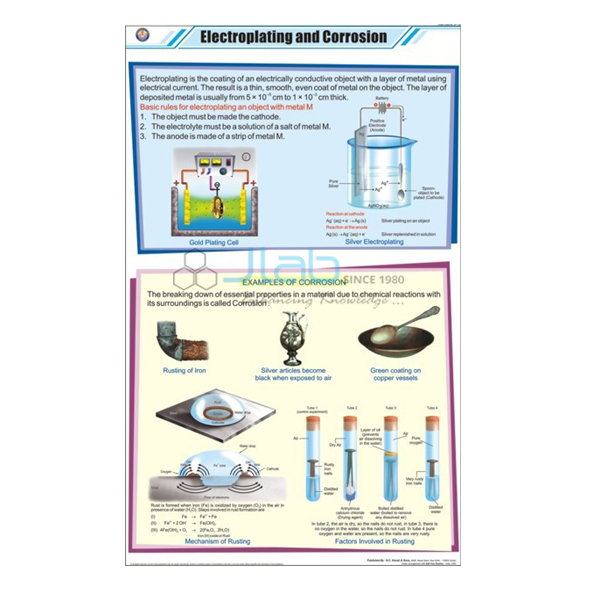
- Companion chart — Electroplating and Corrosion covers the electrolysis side of electrochemistry in the same format.
- Delivery — destination country, port or city and delivery terms for export orders.
Frequently Asked Questions
What kinds of cells does this chart deal with?
It is a chemistry chart, so it deals with electrochemical cells and batteries rather than biological cells. The listing does not itemise its diagrams, so request a preview image to see exactly which cells are drawn.
What are the chart’s size and weight?
It is 58 x 90 cm (about 22.8 x 35.4 in) overall and weighs 228 g; rolled on its plastic rollers it measures 58 x 4 x 2 cm.
How durable is the chart?
It is printed on 130 gsm coated art paper and laminated on both sides with 30 micron heat-sealable polyester film, and the surface is described as markable and washable.
Which syllabus does it support?
Mainly class 12 chemistry (electrochemistry), plus college physical chemistry and vocational courses that deal with batteries.
What should I send for an export quotation?
The quantity, destination country and port or city, delivery terms (for example FOB or CIF), any packing or labelling requirements and a tender reference if applicable.
Who supplies the Different Kinds of Cells chart?
Jain Laboratory Instruments Pvt Ltd (JLab), based in Ambala, Haryana, supplies it and quotes directly.
Supplier
JLab is the trading name of Jain Laboratory Instruments Pvt Ltd, incorporated in 2017 and based on Hargolal Road, Ambala, Haryana. It supplies printed chemistry charts like this one together with its own range of school laboratory apparatus, including cells and electrolysis equipment, so teachers can source a whole electrochemistry topic from one place; each chart is visually inspected before it leaves. JLab exports worldwide and serves buyers in every region — for example Bangladesh in South Asia, Mexico in North America, Zambia in East Africa, Thailand in Southeast Asia and Turkmenistan in Central Asia. Tender details are on the JLab lab tenders page.
Electrochemistry Apparatus and Charts
- Simple and Voltaic Cell — zinc and copper plates in an inert plastic jar for showing how a cell generates electricity.
- Leclanché Cell — the forerunner of today’s dry cell, with a charged porous pot and zinc rod in an inert plastic jar.
- Copper Voltameter Electrolysis Apparatus — three thick copper plates in an inert jar for electrolysis experiments, the reverse of a galvanic cell.
- Electroplating and Corrosion — a companion 58 x 90 cm chart on electrolysis and rusting.
Browse the Chemistry Charts range or the full Charts section.
Request a Quote
Quotations come directly from JLab. Use the Add To Cart enquiry button on this page, or send the number of charts (minimum 10 units), any cells or apparatus you need and your delivery location through the contact page.
Last updated: 4 October 2026