Manufacture of Glass Manufacturer,Supplier and Exporter in India
Product Code : EL-CC-2861
Jlab Export is a leading Manufacture of Glass Manufacturer,and suppliers in India
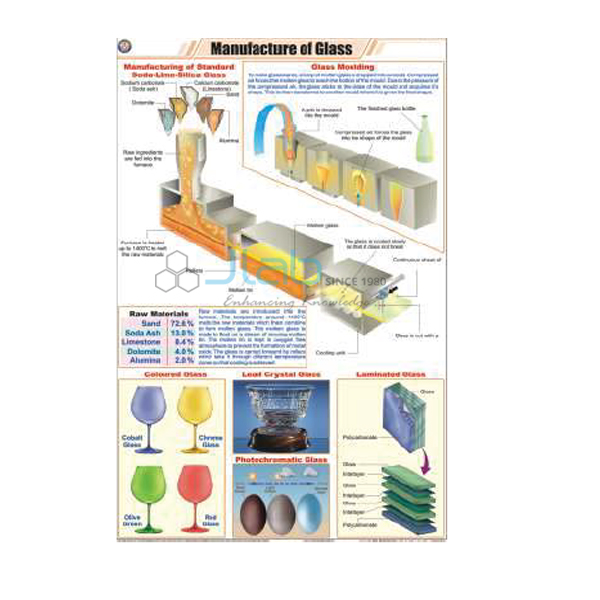
Manufacture of Glass (code EL-CC-2861) is a 58 x 90 cm industrial-chemistry wall chart on how glass is produced, for senior-school chemistry and for materials classes at polytechnics and ITIs. Printed in full colour on coated art paper, it is laminated on both sides, fitted with plastic rollers and labelled in English only. JLab (Jain Laboratory Instruments Pvt Ltd, Ambala, India) supplies it to schools, colleges and dealers.
Specifications
| Parameter | Detail |
|---|---|
| Chart topic | Manufacture of Glass (Chemistry Charts series) |
| Size (overall) | 58 x 90 cm (about 22.8 x 35.4 in) |
| Paper | Coated art paper, 130 gsm |
| Printing | Full colour, offset printed using CTP technology |
| Lamination | Both sides, 30 micron heat-sealable polyester film |
| Hanging | Wall hanging, fitted with plastic rollers |
| Surface | Markable and washable |
| Weight | 228 g |
| Size when rolled | 58 x 4 x 2 cm |
| Language | English only |
| Diagrams | Not itemised in the listing; ask JLab for a preview image |
| Quality check | Each chart is visually inspected before dispatch |
| Pack quantity | Each (sold individually) |
| Minimum order quantity | 10 units |
| Dispatch time | Usually 7–10 working days |
| Product code | EL-CC-2861 |
| Supplied by | Jain Laboratory Instruments Pvt Ltd (JLab), Ambala, India |
What Is the Manufacture of Glass Chart Used For?
Ordinary window and bottle glass is soda-lime glass, made by melting silica sand with soda ash (sodium carbonate) and limestone (calcium carbonate) in a furnace. Broken glass, called cullet, is usually added because it melts more easily and saves fuel. In the melt, the carbonates react with silica to form silicates and release carbon dioxide — Na2CO3 + SiO2 → Na2SiO3 + CO2 and CaCO3 + SiO2 → CaSiO3 + CO2 — so glass is described as a fused mixture of sodium and calcium silicates. The molten glass is then shaped by blowing, pressing, drawing or rolling; flat glass is commonly produced by floating it on a bath of molten tin. Finally it is annealed, cooled slowly and evenly, so that internal stresses do not make it crack.
The chart suits applied and industrial chemistry lessons in senior school, and the materials units of diploma, ITI and polytechnic courses. Teachers often extend the topic to special glasses: metal oxides colour glass (cobalt oxide gives blue, chromium oxide green), boron oxide gives heat-resistant borosilicate glass for laboratory glassware, and lead oxide gives the high-sparkle glass used for optical and decorative items. Glass is also a good example of an amorphous, non-crystalline solid. The laminated surface is markable and washable, so equations can be written on it and wiped off. The diagrams are not itemised in the listing; ask JLab for a preview image if you need to check them.
What to Specify When Ordering
- Quantity — minimum 10 units, each chart sold individually.
- Industrial chemistry set — Cement and Concrete, Blast Furnace and Plastics are listed in the same 58 x 90 cm format.
- Language — this chart is in English only.
- Delivery — destination country, port or city and delivery terms for export orders.
Frequently Asked Questions
What is the Manufacture of Glass chart used for?
Teaching how glass is produced from its raw materials, in senior-school industrial chemistry and in materials courses at polytechnics and ITIs. The listing does not itemise the diagrams, so request a preview image if exact content matters.
What are the size and weight?
The chart is 58 x 90 cm (about 22.8 x 35.4 in) and weighs 228 g; rolled up it measures 58 x 4 x 2 cm.
How durable is it in a classroom?
It is printed on 130 gsm coated art paper, laminated on both sides with 30 micron heat-sealable polyester film and fitted with plastic rollers. The surface is markable and washable.
Which raw materials are used to make ordinary glass?
Silica sand, soda ash and limestone, usually with some cullet (broken glass). Together they give soda-lime glass, the common glass of windows and bottles.
Why is glass annealed?
Glass that cools unevenly keeps internal stresses and can crack later. Annealing cools it slowly and evenly so that those stresses are relieved.
Is this chart available in Hindi?
No. It is listed in English only.
Who supplies this chart?
JLab, the trading name of Jain Laboratory Instruments Pvt Ltd of Ambala, Haryana, India, supplies the chart and quotes for it directly.
Supplier
JLab is the trading name of Jain Laboratory Instruments Pvt Ltd, incorporated in 2017 and based on Hargolal Road, Ambala, Haryana. JLab supplies printed chemistry charts such as this one alongside the laboratory glassware and teaching equipment of its own range, so a school, college or dealer can order wall charts and lab items together, and every chart is visually checked before it is dispatched. JLab exports worldwide and ships to buyers in every region — for example Myanmar in Southeast Asia, Japan in East Asia, Argentina in South America, Cameroon in Central Africa and Guatemala in Central America and the Caribbean. Tender buyers can find details on the JLab lab tenders page.
Related Industrial Chemistry Charts and Glassware
- Cement and Concrete — how cement is made and how it sets into concrete.
- Blast Furnace — how iron ore is reduced to molten iron with coke, limestone and a blast of hot air.
- Plastics — plastics as polymers, and thermoplastics compared with thermosetting plastics.
- Squat Form Beakers, Borosilicate Glass, Economy — laboratory beakers in borosilicate glass, the heat-resistant glass of labware.
See all titles in Chemistry Charts or the full Charts range.
Request a Quote
JLab quotes directly. Use the Add To Cart enquiry button or the contact page to send the quantity (minimum 10 units), the delivery destination and any other charts from the industrial chemistry set you want quoted.
Last updated: 4 October 2026