Prep. of Hydrogen and Carbon dioxide Manufacturer,Supplier and Exporter in India
Product Code : EL-CC-2877
Jlab Export is a leading Prep. of Hydrogen and Carbon dioxide Manufacturer,and suppliers in India
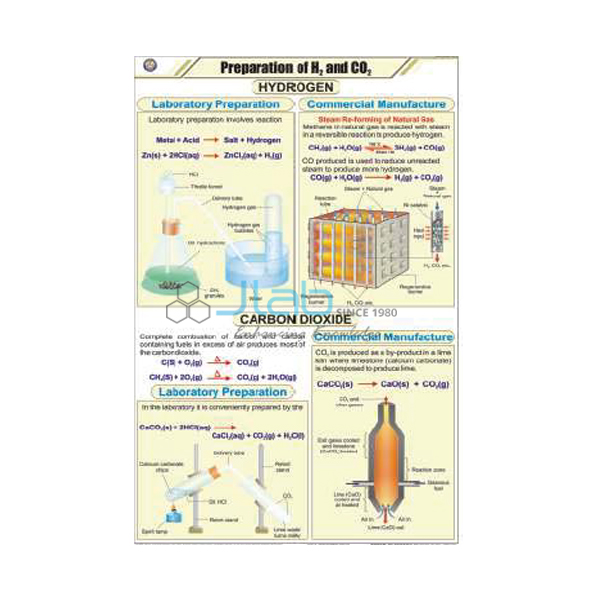
Prep. of Hydrogen and Carbon dioxide (code EL-CC-2877) is a 58 x 90 cm chemistry wall chart on preparing hydrogen and carbon dioxide in the laboratory and on a commercial scale. It is laminated on both sides, fitted with plastic rollers and printed in English only. JLab (Jain Laboratory Instruments Pvt Ltd, Ambala, India) supplies it to schools, colleges and dealers.
Specifications
| Parameter | Detail |
|---|---|
| Chart topic | Preparation of hydrogen and carbon dioxide (Chemistry Charts series) |
| Size (overall) | 58 x 90 cm (about 22.8 x 35.4 in) |
| Paper | Coated art paper, 130 gsm |
| Printing | Full colour, offset printed using CTP technology |
| Lamination | Both sides, 30 micron heat-sealable polyester film |
| Hanging | Wall hanging, fitted with plastic rollers |
| Surface | Markable and washable |
| Weight | 228 g |
| Size when rolled | 58 x 4 x 2 cm |
| Language | English only |
| Quality check | Each chart is visually inspected before dispatch |
| Pack quantity | Each (sold individually) |
| Minimum order quantity | 10 units |
| Dispatch time | Usually 7–10 working days |
| Product code | EL-CC-2877 |
| Supplied by | Jain Laboratory Instruments Pvt Ltd (JLab), Ambala, India |
What Is the Hydrogen and Carbon Dioxide Chart Used For?
Hydrogen is prepared in the laboratory by the action of dilute hydrochloric or sulphuric acid on granulated zinc: Zn + 2HCl → ZnCl2 + H2. It is almost insoluble in water, so it is collected over water, and it is identified by the squeaky pop it makes when a lighted splint is brought near. Because a mixture of hydrogen and air explodes when ignited, no flame is allowed near the apparatus until all the air has been driven out. Commercially, most hydrogen is made by reacting natural gas with steam over a catalyst, and some comes from the electrolysis of water and brine; it is used to make ammonia, to harden vegetable oils and as a fuel.
Carbon dioxide is prepared by adding dilute hydrochloric acid to marble chips (calcium carbonate): CaCO3 + 2HCl → CaCl2 + H2O + CO2, often in a Kipp’s apparatus that delivers gas on demand. Dilute sulphuric acid is avoided because insoluble calcium sulphate coats the marble and stops the reaction. The gas is denser than air, so it is collected by upward displacement of air, and it turns lime water milky; passing more gas makes the solution clear again. On a large scale carbon dioxide is obtained from lime kilns, fermentation and ammonia plants, and it is used in fire extinguishers, fizzy drinks and, as dry ice, for refrigeration. Indian students meet both gases in class 10 science, where acids react with metals to give hydrogen and with carbonates to give carbon dioxide, and ICSE students study hydrogen in detail in class 9. The washable lamination can carry notes during the practical. The listing does not itemise the diagrams printed on the chart, so request a preview image if you need to check them.
What to Specify When Ordering
- Quantity — the minimum order is 10 units, each chart sold individually.
- Gas generator — a Kipp’s gas generator can be added to the enquiry for the carbon dioxide practical.
- Companion titles — Prep. of Oxygen and Liquefaction of Air and the other gas-preparation charts use the same format.
- Destination — country, port or city and delivery terms for an export quotation.
Frequently Asked Questions
What does this chart cover?
Its subject is the laboratory and commercial preparation of hydrogen and carbon dioxide. The listing does not itemise the diagrams, so ask for a preview image to see exactly what is printed.
How is hydrogen prepared in a school laboratory?
Granulated zinc reacts with dilute hydrochloric or sulphuric acid, and the hydrogen is collected over water. A lighted splint gives a squeaky pop with the gas.
Why is dilute sulphuric acid not used with marble chips?
It forms calcium sulphate, which is insoluble and coats the marble, so the reaction soon stops. Dilute hydrochloric acid gives soluble calcium chloride instead.
How is carbon dioxide identified?
It turns lime water milky as calcium carbonate precipitates; with more carbon dioxide the milkiness clears as soluble calcium hydrogencarbonate forms.
Which classes is it suitable for?
Class 10 science (reactions of acids with metals and carbonates), ICSE class 9 chemistry (hydrogen) and introductory college chemistry.
What are the chart’s size and finish?
58 x 90 cm (about 22.8 x 35.4 in), offset printed in full colour on 130 gsm coated art paper, laminated on both sides with 30 micron polyester film and fitted with plastic rollers; it weighs 228 g and rolls to 58 x 4 x 2 cm.
What should an export quotation request include?
The quantity, destination country and port or city, delivery terms such as FOB or CIF, any packing or labelling instructions and the tender reference, if any.
Who supplies this chart?
JLab, the trading name of Jain Laboratory Instruments Pvt Ltd in Ambala, Haryana, supplies it and quotes directly.
Supplier
JLab is the trading name of Jain Laboratory Instruments Pvt Ltd, which was incorporated in 2017 and is based on Hargolal Road, Ambala, Haryana. It supplies printed chemistry charts like this one alongside its own range of laboratory apparatus, including gas-preparation equipment, so a teacher can order the chart and the practical kit together; every chart is visually inspected before dispatch. JLab exports worldwide and can ship to buyers in every region — Congo in Central Africa, Samoa in Oceania, Latvia in Northern Europe, South Africa in Southern Africa and Senegal in West Africa, for example. Tender details are on the JLab lab tenders page.
Related Apparatus and Charts
- Kipps Gas Generator — a three-chamber borosilicate glass generator for controlled amounts of gases such as carbon dioxide and hydrogen sulphide.
- Prep. of Oxygen and Liquefaction of Air — the companion gas-preparation chart for oxygen.
- Prep. of Ammonia and Haber Process — where hydrogen is combined with nitrogen to make ammonia.
- Composition of Water by Weight — the proportion of hydrogen to oxygen in water.
See all Chemistry Charts or browse the Charts range.
Request a Quote
JLab sends quotations directly. Use the Add To Cart enquiry button on this page, or write through the contact page with the quantity (minimum 10 units), any apparatus to quote alongside and the delivery location.
Last updated: 4 October 2026