Composition of Water by Weight Manufacturer,Supplier and Exporter in India
Product Code : EL-CC-2857
Jlab Export is a leading Composition of Water by Weight Manufacturer,and suppliers in India
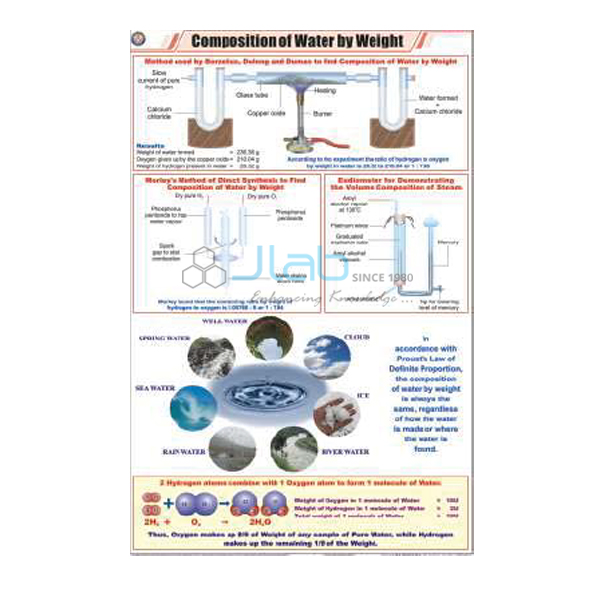
Composition of Water by Weight (code EL-CC-2857) is a 58 x 90 cm chemistry wall chart on how the proportion of hydrogen to oxygen in water is found by weight, for lessons on the law of constant proportions and quantitative chemistry in schools and colleges. It is offset-printed in full colour on 130 gsm coated art paper, laminated on both sides and hung on black rollers. JLab (Jain Laboratory Instruments Pvt Ltd, Ambala, India) supplies it to schools, colleges and dealers.
Specifications
| Parameter | Detail |
|---|---|
| Chart topic | Composition of water by weight (Chemistry Charts series) |
| Size (overall) | 58 x 90 cm (about 22.8 x 35.4 in) |
| Paper | Coated art paper, 130 gsm |
| Printing | Full colour, offset printed using CTP technology |
| Lamination | Both sides, 30 micron heat-sealable polyester film |
| Hanging | Wall hanging, fitted with black rollers |
| Surface | Markable and washable |
| Weight | 228 g |
| Size when rolled | 58 x 4 x 2 cm |
| Language | English |
| Quality check | Each chart is visually inspected before dispatch |
| Pack quantity | Each (sold individually) |
| Minimum order quantity | 10 units |
| Dispatch time | Usually 7–10 working days |
| Product code | EL-CC-2857 |
| Supplied by | Jain Laboratory Instruments Pvt Ltd (JLab), Ambala, India |
What Is the Composition of Water by Weight Chart Used For?
Pure water always contains hydrogen and oxygen in the same proportion by mass — about one part hydrogen to eight parts oxygen — whether it comes from rain, a river, the sea or a laboratory reaction. This is the classic example of the law of constant (definite) proportions. The ratio was first measured gravimetrically: dry hydrogen is passed over heated copper oxide, the loss in mass of the oxide gives the oxygen used, the water formed is trapped and weighed in calcium chloride drying tubes, and the mass of hydrogen follows by difference. Berzelius and Dulong used this method, and Dumas later refined it. By volume the ratio is different — two volumes of hydrogen to one of oxygen — which students see when water is synthesised by sparking the gases in a eudiometer or split by electrolysis.
In India the law of constant proportions, with water as its example, is taught in the class 9 science chapter on atoms and molecules, and electrolysis of water appears again in class 10; the topic returns in class 11 chemistry and in college courses on stoichiometry. Because the polyester lamination is markable and washable, a teacher can write the mass calculation on the chart and wipe it off afterwards. The listing does not itemise the diagrams printed on this chart, so ask JLab for a larger preview image if you want to check it against your textbook.
What to Specify When Ordering
- Quantity — the minimum order is 10 units, supplied as individual charts.
- Apparatus for the experiment — a Hofmann electrolysis apparatus can be quoted on the same enquiry to demonstrate the volume ratio.
- Other chemistry titles — the Chemistry Charts series includes further laboratory-preparation and industrial-process charts in the same 58 x 90 cm format.
- Delivery details — destination country, port or city and delivery terms for export orders.
Frequently Asked Questions
What is the composition of water by weight?
About one part hydrogen to eight parts oxygen by mass, the same for every sample of pure water. The chart is used to teach how this ratio is measured and why it supports the law of constant proportions.
What size is the chart and how is it hung?
It measures 58 x 90 cm (about 22.8 x 35.4 in) and hangs from black rollers. Rolled up it is 58 x 4 x 2 cm and weighs 228 g.
Can teachers write on it?
Yes. It is laminated on both sides with 30 micron heat-sealable polyester film, and the listing describes the surface as markable and washable.
Which syllabus does it suit?
Class 9 science (law of constant proportions), class 10 work on electrolysis of water, class 11 chemistry and introductory college chemistry. Ask for a preview image to compare the diagrams with your textbook.
What should an export quotation request include?
The quantity, destination country and port or city, preferred delivery terms (for example FOB or CIF), packing or labelling needs, and any tender reference.
Who supplies the Composition of Water by Weight chart?
JLab (Jain Laboratory Instruments Pvt Ltd), Ambala, Haryana, supplies it and quotes for it directly.
Supplier
JLab is the trading name of Jain Laboratory Instruments Pvt Ltd, incorporated in 2017 and based on Hargolal Road, Ambala, Haryana. It supplies printed science charts such as this chemistry chart alongside its own range of school laboratory apparatus, so a chemistry department can order wall charts and experiment equipment from one supplier, and each chart is visually inspected before dispatch. JLab exports worldwide and can ship to every region — for example Chile in South America, Finland in Northern Europe, Honduras in Central America and the Caribbean, Mali in West Africa and Greece in Southern Europe. Tender buyers can see the JLab lab tenders page.
Related Apparatus and Chemistry Charts
- Hoffman Electrolysis Apparatus Complete with Stand — supplied with platinum electrodes for the electrolysis of water and carbon electrodes for other electrolytes.
- Prep. of Oxygen and Liquefaction of Air — a companion chart on oxygen, one of the two elements in water, in the same 58 x 90 cm format.
- Electroplating and Corrosion — another 58 x 90 cm chart built around electrolysis.
See every title in the Chemistry Charts range or browse all Charts.
Request a Quote
JLab quotes directly. Use the Add To Cart enquiry button on this page, or send the number of charts (minimum 10 units), any apparatus you want with them and your delivery location through the contact page.
Last updated: 4 October 2026